How did coal come to be available in Minto, but not in Jemseg? How did the unique Grand Point Bar extending a kilometre into Grand Lake arise? The water is very deep (> 20 m) on both sides of the bar and the bar is almost entirely exposed in the summer during low water. Why is the Portobello Creek National Wildlife Area so prone to flooding during the spring freshet compared to other areas around it? How did 300 million year old fossils come to be in the rocks around Grand Lake? Join this webinar by Toon Pronk, a professional geologist, and hear the fascinating story of how the Jemseg Grand Lake watershed and the lower Wolastoq ecosystem arose. What might the future watershed look like? Questions are encouraged, both before the webinar via email (to [email protected]), and during the webinar itself.
Air pollution is a complex mixture, including particulate matter (PM) and volatile compounds. Many are products of incomplete combustion, such as polycyclic aromatic hydrocarbons (PAHs) and black carbon nanoparticles. Globally, these nanoparticles are associated with increased risk of adverse pregnancy outcomes, including pregnancy loss and low birth weight. However, it has been assumed that the principal impacts are on the mother and the placenta, rather than the fetus.
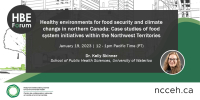
This research on healthy northern environments has an emphasis on community action, and to better understand the intersections between food security, climate change, and Indigenous communities in northern regions within Canada. This webinar will share past and ongoing case studies to evaluate community-led food system initiatives in the Northwest Territories and their links to environmental health, policy, and health and risk communication.
All are welcome to the January meeting of the Saint John Naturalists Club!
This month’s webinar will feature guest speaker Shauna Sands, the Conservation Coordinator at ACAP Saint John. It will take place via Zoom at 10AM on January 21, 2023.
On Tuesday, January 31 at 8:30am Atlantic time, Sarah Agustio will kick off the series with the talk, "How People on Borneo Survive Climate Change Under the Pressure of the Extractive Industries." Sarah will report back from the UN Climate Change Conference (COP 27) in Egypt, provide a critical take on climate financing and Indonesia's plans to build a new "green" capital city in her region. Sarah is based in Samarinda, Indonesia and is a scholar/activist against the harms of coal mining in her region and incorporates eco-feminist and feminist political ecology thought in her activism.

).png)