
News from Groups
- Details
- Posted by Alya Nouasri
- Hits: 917
FOR IMMEDIATE RELEASE June 16th, 2026
The members of New Brunswick Environmental Rights Caucus (ERC) are concerned that the proposed plant could adversely affect human health through impacts on air quality, water quality, soil quality, and food systems. The project may release air pollutants including nitrogen oxides (NOx), sulphur dioxide (SO₂), particulate matter (PM2.5), carbon monoxide (CO), volatile organic compounds (VOCs), formaldehyde, polycyclic aromatic hydrocarbons (PAHs), benzene, toluene, xylenes, and other air contaminants commonly associated with fossil fuel combustion. The World Health Organization (WHO), Health Canada, and the United States Environmental Protection Agency (EPA) have documented links between exposure to these pollutants and respiratory disease, cardiovascular disease, asthma exacerbation, adverse pregnancy outcomes, cancer, and premature mortality (WHO, 2021; Health Canada, Air Quality; EPA, Health and Environmental Effects of Particulate Matter).
“Air pollution harms everyone, but it is our children, elders, pregnant individuals, and people with pre-existing lung and heart conditions who may experience the most severe effects,” said spokesperson Marg Milburn. Vulnerable populations are recognized by the WHO and Health Canada as being at increased risk from air pollution exposure (WHO Air Quality and Health; Health Canada, Air Quality).
Milburn stressed that “We need to transition away from fossil fuels. We know that gas plants emit greenhouse gases that contribute to climate change. Climate change is already increasing the frequency and severity of extreme heat events, droughts, storms, flooding, and wildfires, creating growing risks for present and future generations” (IPCC Sixth Assessment Report, 2023).
As United Nations Secretary-General António Guterres warned in 2023: “Fossil fuels are incompatible with human survival, and governments must accelerate the transition to renewable energy” (United Nations Secretary-General Press Conference on Climate, June 15th, 2023).
Therefore, if this Project proceeds without adequate consideration of health and environmental impacts, the Environmental Rights Caucus believes serious concerns may arise regarding Charter-protected rights, particularly the right to life, liberty, and security of the person under Section 7 of the Canadian Charter of Rights and Freedoms (Government of Canada, Guide to the Canadian Charter of Rights and Freedoms).
RECOMMENDATION 1
In our view, this Project requires a Public Health Risk Assessment (PHRA) that considers all health concerns raised by citizens. Historically, such an assessment was completed for the Irving Oil Refinery Expansion Project following recommendations from the Minister of the Environment.
The proposed gas plant may contribute to the formation of ground-level ozone, a secondary pollutant created when nitrogen oxides (NOx) and volatile organic compounds (VOCs) react in the presence of sunlight. Ground-level ozone is associated with respiratory irritation, reduced lung function, asthma attacks, and damage to vegetation and ecosystems (WHO Global Air Quality Guidelines, 2021; EPA Ground-Level Ozone Pollution). The ERC urges the Minister to order such an assessment because the health of both people and ecosystems must be considered before this Project proceeds.
RECOMMENDATION 2
The members of ERC requests an independent environmental and health assessment conducted by a panel of experts to examine all significant public health and environmental concerns. We recommend that the Minister move the project to the next step in the Environmental Impact Assessment (EIA) process: a Comprehensive Review Assessment under the EIA Regulation.
As stated by the Government of New Brunswick, Comprehensive EIAs provide additional opportunities for public participation, Indigenous engagement, and expert review where significant impacts are possible or where further study is warranted (Government of New Brunswick, Environmental Impact Assessment Program).
We, the undersigned, therefore urge the Minister not to approve this Project until all requirements of the Environmental Impact Assessment Regulation have been fulfilled (Environmental Impact Assessment Regulation 87-83, Clean Environment Act).
Based on our collective knowledge, experience, and the available scientific literature on air pollution and public health, we remain gravely concerned about the potential health impacts of the proposed Tantramar Gas Plant and recommend that the Minister not approve the Project.
Submitted by:
The members of the Environmental Rights Caucus of the New Brunswick Environmental Network:
- Samuel Arnold – Sustainable Energy Group, Carleton County
- Bonnie Hamilton Bogart – Voices for Sustainable Environments and Communities
- Gordon Dalzell – Citizens Coalition for Clean Air
- Denise Melanson – Council of Canadians, Kent County Chapter
- Marg Milburn, Chair – The Climate Reality Project Canada
- Saadia Hara – UNBSJ Medical Student
Media Contacts
- Marg Milburn, Chair, Fredericton
- The Climate Reality Project Canada
- (506) 238-8295
- Denise Melanson, Kent County
- Council of Canadians, Kent County Chapter
- (506) 523-9467
- Sam Arnold, Carleton County
- Sustainable Energy Group, Carleton County
- (506) 328-9420
- Gordon Dalzell, Saint John
- Citizens Coalition for Clean Air
- (506) 696-3510
REFERENCES / BIBLIOGRAPHY
Canadian Charter of Rights and Freedoms. Government of Canada. "Guide to the Canadian Charter of Rights and Freedoms."
https://www.canada.ca/en/canadian-heritage/services/how-rights-protected/guide-canadian-charter-rights-freedoms.html
Government of New Brunswick. Environmental Impact Assessment in New Brunswick.
https://www.gnb.ca/en/topic/environment-resources/environmental-assessment/projects.html
Government of New Brunswick. Environmental Impact Assessment Regulation 87-83 under the Clean Environment Act.
https://laws.gnb.ca/en/document/cr/87-83
United Nations Secretary-General António Guterres. Press Conference on Climate, June 15th, 2023.
https://www.un.org/sg/en/content/sg/press-encounter/2023-06-15/secretary-generals-press-encounter-climate
World Health Organization (WHO). Air Pollution.
https://www.who.int/health-topics/air-pollution
World Health Organization (WHO). Air Quality and Health.
https://www.who.int/teams/environment-climate-change-and-health/air-quality-and-health
World Health Organization (WHO). WHO Global Air Quality Guidelines: Particulate Matter (PM2.5 and PM10), Ozone, Nitrogen Dioxide, Sulfur Dioxide and Carbon Monoxide. Geneva: WHO, 2021.
https://www.who.int/publications/i/item/9789240034228
Health Canada. Human Health Effects of Air Pollution.
https://www.canada.ca/en/health-canada/services/air-quality.html
Health Canada. National Air Pollution Surveillance Program (NAPS).
https://www.canada.ca/en/environment-climate-change/services/air-pollution/monitoring-networks-data/national-air-pollution-program.html
Environment and Climate Change Canada. Air Pollutant Emissions Inventory.
https://www.canada.ca/en/environment-climate-change/services/pollutants/air-emissions-inventory-overview.html
United States Environmental Protection Agency (EPA). Health and Environmental Effects of Particulate Matter (PM).
https://www.epa.gov/pm-pollution/health-and-environmental-effects-particulate-matter-pm
United States Environmental Protection Agency (EPA). Ground-Level Ozone Pollution.
https://www.epa.gov/ground-level-ozone-pollution
United States Environmental Protection Agency (EPA). Nitrogen Oxides (NOx) Pollution.
https://www.epa.gov/no2-pollution
United States Environmental Protection Agency (EPA). Integrated Risk Information System (IRIS): Benzene.
https://iris.epa.gov
International Agency for Research on Cancer (IARC). Outdoor Air Pollution. IARC Monographs Volume 109. Lyon, France: World Health Organization, 2016.
https://publications.iarc.fr/538
International Agency for Research on Cancer (IARC). Benzene. IARC Monographs on the Evaluation of Carcinogenic Risks to Humans.
https://monographs.iarc.who.int/list-of-classifications
Intergovernmental Panel on Climate Change (IPCC). Sixth Assessment Report (AR6) Synthesis Report: Climate Change 2023.
https://www.ipcc.ch/report/ar6/syr/
Canadian Association of Physicians for the Environment (CAPE). Fossil Fuels and Health.
https://cape.ca
- Details
- Posted by Amanda Fenech
- Hits: 2099
For immediate release
June 9th, 2026
Traditional Homeland of Wolastoqewiyik (Wolastoq Peoples) - Organizations and concerned community members from across New Brunswick have joined together to form the Stop Sisson Mine Coalition in opposition to the proposed Sisson tungsten and molybdenum mine.
In letters sent yesterday to Premier Susan Holt and all MLAs, the coalition called on the provincial government to halt the proposed mine project, which poses one of the largest environmental and public health risks ever proposed in New Brunswick. The letters cited risks related to public health, tailings management liabilities, questionable economic benefits, improper consultations as required under the United Nations Declaration on the Rights of Indigenous Peoples specifically “Free, Prior and Informed Consent”, and the potential burden future cleanup costs could place on taxpayers.
Northcliff Resources, the company behind the proposed mine, is headquartered outside New Brunswick and is majority owned by Todd Corporation, a private company controlled by the Todd family of New Zealand, one of the wealthiest business families in that country. Coalition members say profits are likely to leave the province, while New Brunswickers are left to carry the environmental and financial risks long after the executives and investors are gone.
Speaking about the mine, Wolastoqewi Grand Chief Ron Tremblay quoted his Osage Nation Relatives, "When the last tree has been cut down, the last fish caught, the last river poisoned, only then will we realize that one cannot eat money."
Stalled since 2018, the proposed mine was revived in 2025 when Northcliff Resources received funding from the US Department of War and the Government of Canada for an updated feasibility study, which is anticipated in mid-2026.
In November 2025, the Sisson project was referred to the Major Projects Office by Prime Minister Mark Carney, making it eligible for federal investment and off-take agreements, in which the government agrees to buy a set amount of the mineral for a set period at a fixed price, regardless of global prices. Premier Holt has been championing the mine for the past year, despite the meager promise of just $280 million in royalties over the 27-year lifespan of the mine.
The Coalition unites a wide variety of members, including physicians, environmentalists, faith communities, and engineers, all committed to a clean and sustainable future for New Brunswick.
- 30 -
About the Coalition:
The Stop Sisson Mine Coalition is focused on public education, community outreach, municipal engagement, and advocacy related to the proposed project. Planned activities include public information sessions, educational materials, outreach to elected officials, and opportunities for residents to become involved.
Current coalition members include (alphabetical): Atlantic Salmon Federation, Breaking the Silence - Maritimes Guatemala Solidarity Network, Canadian Association of Physicians for the Environment NB, Coalition for Responsible Energy Development - NB, Council of Canadians – Fredericton Chapter, Conservation Council of New Brunswick, Conseil de la paix NB Peace Council, Fredericton Community Climate Hub, National Farmers Union in New Brunswick, Nashwaak Watershed Association Inc., NB Religious Society of Friends (Quakers), Peace and Friendship Alliance NB, Saint John Community Coalition, United Spirit Nature Network, and Wolastoq Grand Council, as well as over 100 individuals.
More information about the coalition and upcoming activities will be shared in the coming weeks.
Additional resources at stopsissonmine.ca or conservationcouncil.ca/sisson-mine-risks/
Media Contact:
Amanda Wildeman
Stop Sisson Mine
506 259-6674
[email protected]
- Details
- Posted by Axel Hamdi
- Hits: 905
FOR IMMEDIATE RELEASE
May 28, 2026
Traditional territory of the Wabanaki Peoples/Fredericton – New Brunswickers are stuck holding a costly bill after the Energy and Utilities Board approved the expensive and high-polluting Tantramar diesel and gas plant.
“This decision will expose residents to higher power bills, more pollution, and decades of dependence on fossil fuels”, said Dr. Moe Qureshi, the Conservation Council of New Brunswick’s Director of Climate Research and Policy.
This plant is projected to be among the top polluters in New Brunswick, producing cancer-causing air toxins linked to respiratory illness and climate change, threatening the quality of life for New Brunswickers. New Brunswick ratepayers will bear the financial burden of a project expected to cost more than $1 billion, resulting in an estimated 5% increase in electricity bills. At the same time, the facility will be owned by the U.S.-based company PROENERGY, meaning ownership and profits will largely flow outside the province.
NB Power’s own comprehensive review acknowledged that the province cannot continue with the status quo. Yet this decision doubles down on the same fossil fuel approach that continues to create affordability and climate challenges. At a time when we should be transitioning to renewables, we are locking ourselves in for at least another 25 years of fossil fuels and increasing energy costs for ratepayers.
Families already struggling with rising costs are now being asked to bankroll a polluting facility that threatens public health while driving the province further away from its climate commitments.
Cleaner, more affordable alternatives are already being successfully deployed across North America. Battery storage systems are helping utilities meet peak electricity demand, lower costs, and reduce emissions without increasing dependence on fossil fuels. Yet N.B. Power chose to move forward with a polluting diesel and gas project rather than seriously pursuing these cleaner, more cost-effective solutions.
“People want affordable, reliable, clean energy, not another massive fossil fuel project that increases pollution and leaves ratepayers holding the bill,” said Qureshi.
A rushed project
N.B. Power is rushing this plant, failing to consider more efficient, cost-effective and future-proof options.
Why? The federal government published the Clean Electricity Regulations (CER) in 2025, which limit the CO2 emissions fossil fuel generators can produce. Planned units that have started construction by 2027, however, will not be subjected to the CER until 2050. That means this plant could avoid stricter emissions requirements for decades.
This project shows a determination to stick with the same ideas that continue to fail this province. Yet N.B. Power’s own comprehensive review emphasizes that we cannot continue with the status quo. But that is what they are doing — making the same mistakes over again.
New Brunswickers deserve an energy system built for the future, not one that doubles down on pollution and financial risk.
- Details
- Posted by Amanda Fenech
- Hits: 1128
This series is organized by the NBEN, the Government of New Brunswick, Nature NB, the Town of Riverview, and Mill Creek Nature Park. The site visits are free and bilingual.
Register for one or more site visits here.
Visit One: Buried Revetment and Bio-swales at New River Beach Provincial Park
New River Beach Provincial Park has installed a buried revetment and bio-swales to help control stormwater and erosion.
When: Wednesday, June 10th, 2026 (10am–12pm)
Guide: Ryan Coleman, Park Manager, New River Beach Provincial Park
Event Location: 78 New River Beach Rd., New River Beach, NB, E5J 1G7
Logistics: Free event. Free parking available. This event will take place rain or shine without alternate dates. We will only cancel in the event of severe or dangerous conditions.
Visit Two: A Naturalized Fish Passage and Re-naturalized Riverbanks at Fundy National Park
Come visit Fundy National Park’s naturalized fish passage at Bennett Lake and see what ~10 years of growth looks like at the re-naturalized riverbanks of Dixon Brook.
When: Monday, July 13th, 2026 (10am–1pm)
Guide: Shirley Butland, Environmental Impact Assessment Specialist
Event Location: 8642 Route 114, Alma, NB, E4H 4V2
Logistics: Free event. Parking available. Bring a lunch or snack as this visit may take up to three hours. This event will take place rain or shine without alternate dates. We will only cancel in the event of severe or dangerous conditions.
Visit Three: Nature-based Solutions for Urban Resilience at Mill Creek Nature Park
Mill Creek Nature Park serves as a key example of integrating nature-based solutions (NbS) for urban resilience, combining environmental conservation with community recreation.
When: Monday, August 17th, 2026 (10am–12pm)
Guide: Ash Arrowsmith, Community Recreation Coordinator, Town of Riverview
Event Location: Mill Creek Nature Park Parking (P3), Bridgedale Boulevard, Riverview, NB (Google Maps)
Logistics: Free event. Parking available. This event will take place rain or shine without alternate dates. We will only cancel in the event of severe or dangerous conditions.
Visit Four: Nature-based Infrastructure Initiatives at Parlee Beach Provincial Park
Participants will have the opportunity to visit and learn about several of Parlee Beach Provincial Park’s nature-based infrastructure initiatives and environmental adaptation projects.
The guided tour will highlight green infrastructure used to manage stormwater, including bioswales, stormwater filtering systems, and a rain garden featuring native plants such as common butterfly milkweed that support monarch butterflies and other pollinators.
The visit will also explore the park’s coastal geography, dune system, beach nourishment efforts, and climate resilience measures, along with the greenhouse project and broader sustainability initiatives within the park.
When: Monday, September 14th, 2026 (10am–12pm)
Guide: Michel Mallet, Park Manager, Parlee Beach Provincial Park
Event Location: 45 Parlee Beach Rd., Pointe-du-Chêne, NB
Logistics: Free event. Parking available. This event will take place rain or shine without alternate dates. We will only cancel in the event of severe or dangerous conditions.
- Details
- Posted by Amanda Fenech
- Hits: 744
From the Conservation Council of New Brunswick
Traditional territory of the Wabanaki Peoples/Fredericton –
Newly released emissions numbers show that New Brunswick’s climate progress is moving in the wrong direction, and new heavy-emitting projects on the horizon could make the situation even worse.
New numbers for 2024, the latest which are available, show greenhouse gas emissions in New Brunswick rose from around 11.5 million tonnes in 2023 to about 12.8 million tonnes in 2024, an 11.4 per cent jump in a single year.
Instead of cutting pollution when we need it most, the province has become more emissions-intensive, relying more heavily on fossil fuels while generating less electricity. At the same time, major new projects are being proposed that would lock in even more pollution for years to come.
That includes a planned data centre in Lorneville, which would produce an estimated 755,000 tonnes of emissions every year. That would make it one of the top three polluters in New Brunswick. The proposed Tantramar diesel plant could also rank among the province’s largest emitters, depending on how often it runs.
Together, these projects risk pushing emissions even higher at a time when they need to fall quickly.
“New Brunswick is going in the wrong direction,” said Dr. Moe Qureshi, director of climate research and policy at the Conservation Council of New Brunswick. “Emissions are rising, and instead of turning that around, we’re considering projects that would make the problem worse.”
A Step Backward
The new numbers show how fragile progress has become. Emissions from the electricity sector jumped nearly 38 per cent, driven by greater reliance on fossil fuels, while coal use at the Belledune station alone rose by nearly 50 per cent.
The result is a system that is both more polluting and less efficient. The province generated 16.5 per cent less electricity than the year before, yet emissions still increased significantly.
Meanwhile, the province’s largest industrial emitters are the exact same faces we’ve seen on this list time and time again. The Irving Oil refinery continues to be the single biggest source of climate pollution, releasing nearly three million tonnes in 2024, and major fossil fuel power plants and other industrial facilities also remain among the top polluters.
Together, these polluters show how a small number of facilities continue to drive a large share of emissions in New Brunswick.
While this concerning trend continues, the climate impacts of rising emissions are already being felt by New Brunswickers. The province’s own climate risk assessment points to increasing threats from flooding, extreme weather and other climate change-related events, all while electricity costs rise, with rates up about 30 per cent over the past three years and expected to increase further.
“These choices have real consequences,” said Qureshi. “They affect people’s power bills and the risks they face from climate change.”
Instead of expanding fossil fuel use, the province should focus on building more renewable energy, expanding energy efficiency programs and modernizing the electricity system to make it more reliable and affordable. New Brunswick risks locking itself into higher costs and greater climate impacts if it doesn’t shift direction. The recent comprehensive review of N.B. Power highlighted the need to change the way we approach our energy sector, focusing on sustainability and affordability, to avoid digging a deeper hole.
The full list of New Brunswick’s top greenhouse gas emitters for 2024 is available on the Conservation Council of New Brunswick’s website.
For more information, or to arrange an interview, please contact:
Moe Qureshi, Director of Climate Research and Policy
Conservation Council of New Brunswick
[email protected]
506-458-8747
- Details
- Posted by Alya Nouasri
- Hits: 696
FOR IMMEDIATE RELEASE
March 30th, 2026
The Environmental Rights Caucus of the New Brunswick Environmental Network wishes to thank all those who supported Bill 23: An Act Respecting the Right to a Healthy Environment through the years.
There were 115 devastated witnesses to the Government’s failure to protect our right to a safe place to live. The diversity of New Brunswick was represented in the stands. Everyone there, child, university student, parent, elder, started with high hopes after witnessing the moratorium on shale gas be upheld.
Yet, once the tabling of Bill 23 happened, we saw the tides quickly shift. Both Liberal and Conservative parties voted unanimously against the Bill. 46 of our MLA’s decided the bill should not advance to the Committee Phase and third vote, while the Green Party stood proudly at two votes for the future of this community.
This second reading was a vote to support in principle with referral to the Committee Phase where all members from both parties who had concerns could bring forth amendments to address their objections. It was hard to understand and accept that they could not agree in principle with the fundamental purposes of the act. It begs the question: What influencers and lobbyists were at work that denied this Bill from moving forward?
We are obviously very disappointed and frankly somewhat astonished that the Legislators of New Brunswick have chosen not to pass the 2nd reading vote that would allow Bill 23 to move forward to the Committee Phase for further study prior to the 3rd and final vote. This refusal to work to adopt this legislation in a form that would guarantee that all current and future generations can count on them to act in a way that maintains a livable and safe environment, calls their priorities in question.
The Act Respecting the Right to a Healthy Environment did not become law at this time, but the failure to act to guarantee this right in the present will not make the problem go away. The citizens of New Brunswick expect better from their Legislators. For more than 20 years, a small group of New Brunswick citizens worked tirelessly to get this law passed. Young people now understand what is at stake, for them and their children. They will carry on, and eventually a law like this one will pass.
We therefore have every hope that, in the near future, the right to a healthy environment will be acknowledged and legalized.
Submitted by:
The NB Environmental Rights Caucus of the New Brunswick Environmental Network:
Samuel Arnold – Sustainable Energy Group, Carleton County
Bonnie Hamilton Bogart – Voices for Sustainable Environments and Communities
Gordon Dalzell – Citizens Coalition for Clean Air
Denise Melanson – Council of Canadians, Kent County Chapter
Marg Milburn, Caucus Chair – The Climate Reality Project Canada
Saadia Hara – UNBSJ Medical Student
Alyse Wilton – NB Lung
Media Contacts
- Marg Milburn, Chair, Fredericton
- The Climate Reality Project Canada
- [email protected]
- (506) 238-8295
- Denise Melanson, Kent County
- Council of Canadians
- [email protected]
- (506) 523-9467
- Sam Arnold, Carleton County
- Sustainable Energy Group
- [email protected]
- (506) 328-9420
- Gordon Dalzell, Saint John
- Citizens Coalition for Clean Air
- [email protected]
- (506) 696-3510
- Details
- Posted by Axel Hamdi
- Hits: 583
March 24, 2026
Environmental organizations across New Brunswick are urging Members of the Legislative Assembly of New Brunswick to support Bill 23: An Act Respecting the Right to a Healthy Environment when it is debated on March 26.
Between 2:00 p.m. and 6:00 p.m., David Coon, leader of the Green Party of New Brunswick, will bring the bill forward for debate and a vote. Supporters say the legislation represents nearly two decades of work by health experts, legal advocates, and environmental groups seeking to ensure that New Brunswickers have the legal right to live in a clean and healthy environment.
Marg Milburn, spokesperson for the NB Environmental Rights Caucus, says the bill addresses a significant gap in provincial law.
“New Brunswickers currently do not have a legally recognized human right to a healthy environment,” said Milburn. “This legislation would help ensure that people have access to information about environmental decisions that affect their communities and that their concerns are heard before decisions are made.”
Milburn noted that environmental decisions can have direct impacts on public health, particularly for children, seniors, and people with respiratory or cardiovascular conditions.
The United Nations has recognized the right to a clean, healthy, and sustainable environment as a fundamental human right. At the federal level, Canada’s Canadian Environmental Protection Act acknowledges the importance of considering human health in environmental protection. However, court decisions have left provinces responsible for ensuring that these protections apply to many resource development projects.
Advocates say the absence of strong environmental rights in New Brunswick has sometimes left communities feeling excluded from major decisions. For example, NB Power approved a gas-fired power plant and initially selected a site in the Scoudouc Industrial Park, later shifting the project to Centreville after environmental concerns emerged. Residents in both communities say they were not adequately informed or consulted before these decisions were made.
Bonnie Hamilton Bogart, a member of the Environmental Rights Caucus, says the bill is about protecting future generations.
“If the people of New Brunswick want to leave our children a legacy of hope, we must support this legislation,” she said. “A healthy environment is essential for healthy communities.”
Environmental advocates are encouraging residents to contact their MLAs and ask them to support Bill 23.
Submitted by:
The NB Environmental Rights Caucus of the New Brunswick Environmental Network:
- Samuel Arnold – Sustainable Energy Group, Carleton County
- Bonnie Hamilton Bogart – Voices for Sustainable Environments and Communities
- Gordon Dalzell – Citizens Coalition for Clean Air
- Denise Melanson – Council of Canadians, Kent County Chapter
- Marg Milburn, Chair – The Climate Reality Project Canada
- Saadia Hara – UNBSJ Medical Student
- Alyse Wilton – NB Lung
Media Contacts
- Marg Milburn, Chair, Fredericton
- The Climate Reality Project Canada
- [email protected]
- (506) 238-8295
- Denise Melanson, Kent County
- Council of Canadians, Kent County Chapter
- [email protected]
- (506) 523-9467
- Sam Arnold, Carleton County
- Sustainable Energy Group, Carleton County
- [email protected]
- (506) 328-9420
- Gordon Dalzell, Saint John
- Citizens Coalition for Clean Air
- [email protected]
- (506) 696-3510
- Details
- Posted by Axel Hamdi
- Hits: 720

Collaborative CRI–NB Power monitoring identifies limited but infrastructure-focused presence
The Canadian Rivers Institute (CRI) based at the University of New Brunswick and NB Power have released preliminary findings from a 2025 collaborative bio-monitoring program assessing zebra mussel colonization in the Wolastoq.
Although zebra mussels are already well established in Lac Témiscouata, Québec (which connects to the Wolastoq via the Madawaska River), our 2025 surveys indicate that their presence in the Wolastoq (Saint John River) remains low. Only a small number of individuals were detected and they were found in scattered locations rather than continuously throughout the river. Detections extended as far south as the confluence of Belleisle Bay and the Wolastoq.
During the 2025 field season, researchers surveyed 81 locations and documented 22 adult zebra mussels at just three sites. Of those, 21 individuals were associated with hydroelectric infrastructure, with the highest concentration observed at Mactaquac Generating Station (19 mussels) and two individuals detected at Beechwood Generating Station.
“The current low-level colonization provides an important opportunity to take informed, proactive steps to better mitigate negative impacts to infrastructure and reduce the risk of spread to other waters in New Brunswick,” said Dr. Meghann Bruce of the CRI.
What Was Done
In 2025, the CRI partnered with NB Power to carry out biomonitoring research to assess the state of zebra mussel colonization in the Wolastoq River. Field investigations were conducted at four hydroelectric facilities between June and October 2025. Work included visual infrastructure inspections, sub-surface observations, environmental monitoring and laboratory analysis.
Key Findings
- Zebra mussels were detected at 3 of 81 survey locations in the Wolastoq.
- No zebra mussels were detected at Tobique Narrows Generation Station or Grand Falls Generation Station.
- The majority of detections occurred at Mactaquac Generating Station (19 mussels); two individuals were detected at Beechwood Generating Station.
- One zebra mussel was detected near the confluence of Belleisle Bay and the Wolastoq, marking the furthest downstream confirmed discovery to date.
- Colonization patterns appear to reflect local hydraulic and structural conditions rather than simple proximity to upstream sources (Lake Témiscouata).
Why This Is of Public Interest
Zebra mussels are an invasive species capable of rapid population growth and infrastructure fouling. In regions where they have become established, populations can expand quickly. Once densities increase, management becomes significantly more difficult, more costly and less effective.
What remains uncertain is how growth conditions in this region compare to other invaded systems and what level of colonization may ultimately occur in New Brunswick waters. Some areas may experience more extensive establishment than others. Ongoing monitoring is aimed at understanding what colonization could look like for New Brunswick’s freshwater systems.
The 2025 results indicate that the Wolastoq is not yet experiencing widespread colonization, but localized low-level establishment on infrastructure is occurring. Researchers also note that prolonged low-flow conditions during late summer 2025 may have enhanced settlement opportunities, reinforcing the importance of continued seasonal monitoring.
Looking Ahead
Continued collaboration between CRI and NB Power will focus on refining monitoring strategies and assessing colonization rates to proactively plan mitigation of negative impacts, but this work will also be extended through collaboration with the New Brunswick Invasive Species council to understand the potential broader impacts to NB freshwaters, strengthening early-detections efforts and aim to prevent spread to other New Brunswick Freshwaters.
Media Contact
Dr. Meghann Bruce
Canadian Rivers Institute
University of New Brunswick
meghann.bruce at unb.ca
506-230-1652
- Details
- Posted by EOS Eco-Energy
- Hits: 791
“This is my third year organizing CARE Week and I’m very pleased with the events we have lined up for this year,” said EOS Eco-Energy’s Water and Climate Change Projects Coordinator, Kyla Wilkinson.
The EOS Eco-Energy team is looking forward to facilitating these events and hope you will join us for one of our CARE Week events!
Some of this year’s events include the EOS team outreach booth at the Sackville Farmers Market; an in-person information session with local solar energy installer Woody Thompson and electrician Zach Wheeler; a webinar to learn about flood proofing with EOS Eco-Energy’s Climate Change Projects Manager, Janie Brooks; a clothing swap at Mount Allison University in partnership with the Mount Allison University Geography and Environment Society; and a canning class at Open Sky Co-op!
CARE Week also coincides with a solar energy educational campaign that Beausejour Renewable Energy Cooperative and EOS have organized and are looking forward to sharing widely.
Visit the EOS Eco-Energy Instagram (@eosecoenergy), Facebook (EOS Eco-Energy) or website eosecoenergy.com for more solar energy educational content and for more information about CARE Week events.
For any questions contact Kyla Wilkinson at [email protected].
Media Contact: Kyla Wilkinson, Water and Climate Change Projects Coordinator and CARE Week Organizer
[email protected]
506-536-4487
- Details
- Posted by Axel Hamdi
- Hits: 1506
Kyle Reid / November 14, 2025
Traditional territory of the Wabanaki Peoples/Fredericton – The proposed Sisson Mine is far from a “nation-building project.” Instead, this shortsighted project risks leaving New Brunswick with a massive industrial scar, major financial risks and long-lasting harm to our rivers and communities.
This project would create one of the world’s largest open-pit tungsten and molybdenum mines in the upper Nashwaak River watershed, on Wabanaki territory. It includes a huge open pit and a tailings waste site so large it would cover all of downtown Fredericton.
While being touted as “nation-building,” the sheer scale of this mine brings the potential for enormous consequences. The project still carries too many unanswered questions, too much long-term financial and environmental risk and too little benefit for the people who would bear the burden.
“Strong countries are built on healthy communities and clean water, not giant pits and toxic waste,” said the Conservation Council’s executive director, Beverly Gingras. “There is a legacy of short-term promises that turn into long-term problems in New Brunswick. With the Sisson mine, we just risk repeating past mistakes, not building a stronger province and nation.”
Weak economics, big risks
New Brunswickers have seen what happens when big projects move ahead without fully understanding the risks. Projects that once promised prosperity later left behind contaminated land, polluted water and huge clean-up costs. These legacies show what happens when short-term thinking outweighs long-term responsibility.
The thinking behind this project is clearly short-term. The rock at Sisson contains only tiny amounts of metal. To get anything useful, the company would need to blast and crush enormous amounts of earth, which makes the project costly and unstable. Tungsten markets rise and fall quickly, and mines like this often shut down early when prices drop.
And while New Brunswick would carry the risks, most of the profits would go elsewhere, including to the Todd family, one of the richest families in New Zealand and a major backer of the project.
Meanwhile, if the mine slows down or closes early, New Brunswickers could still be left with a huge, expensive cleanup. Treating polluted water, maintaining massive dams and monitoring toxic waste can last for generations. The short-term economics cannot make up for decades of financial risk.
“This project is not a steady, long-term economic development,” said Gingras. “It is a high-stakes gamble, and New Brunswick could be left paying the price.”
A giant industrial site above a beloved river
The mine would leave one of the biggest open pits ever seen in Atlantic Canada. The nearby tailings pond would spread across an area large enough to reshape the upper Nashwaak Valley. The dam holding this waste back would stretch for kilometres and stand taller than many buildings in the province.
All of this would sit above critical cold-water fish habitat used by wild Atlantic salmon and trout. The mine would permanently destroy parts of Bird Brook and Napadogan Brook, and the company’s plan to replace this habitat would not bring back what is lost.
With stronger storms, heavier rain and more flooding caused by climate change, placing such a massive waste site above communities makes the risk even more serious.
Real threats to community well-being
Meanwhile, families and communities in Stanley, Fredericton and along the Nashwaak and Wolastoq/Saint John River depend on clean water for drinking, fishing, paddling and tourism. A project of this size puts all of that at risk.
A tailings dam leak or failure at Sisson could send contaminated water downstream within hours. The impacts on families, farms, fish, wildlife and local businesses could be severe and long-lasting. The small number of permanent jobs cannot outweigh the risks to public health, community safety and one of the region’s most valued watersheds.
Yet, the company still hasn’t shown how it would keep a massive tailings facility safe over time, how it would protect water quality and quantity for generations, or how communities and taxpayers would be shielded from both environmental and financial harm.
A better path for true nation-building
True nation-building means investing in clean, safe industries that build long-term prosperity: renewable energy, energy efficiency, nature tourism, watershed restoration, sustainable forestry, and local innovation. These kinds of projects strengthen rural and urban communities, support stable jobs and protect the natural places that make New Brunswick special.
The proposed Sisson mine poses too many unanswered questions and too many long-lasting risks, with no guarantee that taxpayers or the environment will be protected. New Brunswick deserves development that builds our province up, not projects that could leave future generations with a costly, dangerous legacy.
“If we want to build a stronger Canada, we need projects that make our communities healthier and safer,” Gingras said. “Nation-building should leave a positive legacy, not a dangerous one.”
For more information, or to arrange an interview, please contact:
Kyle Reid, Senior Communications Coordinator, Conservation Council of New Brunswick | [email protected] | 506-458-8747
Beverly Gingras, Executive Director, Conservation Council of New Brunswick | [email protected] | 506-458-8747
- Details
- Posted by Amanda Fenech
- Hits: 1405
That’s why the Conservation Council of New Brunswick (CCNB), the New Brunswick Environmental Network (NBEN) and Nature NB are partnering to launch Learning Nature’s Way — an exciting new nature education initiative for New Brunswick schools. This project, supported by the Government of Canada through the Environmental Damages Fund’s Climate Action and Awareness Fund, will get students learning outside, exploring nature, and discovering how they can make a real difference in their communities.
Over the next two years, Learning Nature’s Way will create a provincewide network of non-traditional environmental educators that will offer current, place-based, curriculum-linked environmental and climate change-centered programming. By the end of the project, the network will offer immersive programming to more than 7,500 students in K-12 classrooms across the province who will learn about the environment in fun and hands-on ways. Lessons will help students learn about local ecosystems, climate change, and how to care for the land, air and water around them.
The Benefits of Outdoor Learning
Outdoor learning — when students get to discover creatures in their dipnets by the pond, imagine themselves to be an animal while romping through the woods, or share their feelings about climate change in a talking circle around a campfire — isn’t just about fun. It's been shown to have widespread positive impacts for students.
Studies have found that outdoor learning can support students’ bodies and minds. Spending time in nature can reduce stress, improve sleep, and support better mental health.
Learning outside increases student focus and deepens their understanding of their lessons. This kind of learning often boosts creativity, improves problem-solving skills, and even raises academic performance.
Just as important, outdoor education helps young people build confidence, work well with others, and feel more connected to their communities. Whether by working in teams, finding their way through a trail, journaling in nature, or helping with a schoolyard garden, students develop social skills and improved self-esteem through these experiences.
Most of all, Learning Nature’s Way will give students a deeper connection with nature. The more time they spend learning about the environment around them, the more they care about it and the more likely they are to take action to protect it.
And it all starts with taking students outside.
Our First Steps
The Conservation Council, the NBEN, and Nature NB have already begun work on creating the educational framework that will guide this project. The project team is excited to bring together stakeholders from across the province to discuss what makes the highest quality environmental education for our students and how Learning Nature’s Way can be supportive and inclusive for youth across New Brunswick’s diverse communities.
The project team is committed to ensuring that Anglophone, Francophone, and Wabanaki voices are all included in shaping this new initiative.
We look forward to further discussions and workshops that will increase our capacity across the province and further our shared goal of increasing awareness and empowering New Brunswickers of all ages to take actions for nature.
Currently Seeking Pilot Schools
Are you a teacher or administrator interested in having your school host a program from our network of environmental educators? Our project team would love to hear from you. Please contact project co-ordinator Annie Furman ([email protected]) with any questions.
We’re thrilled to foster the next generation of environmental stewards, one meaningful outdoor experience at a time.
- Details
- Posted by Axel Hamdi
- Hits: 964
Petitcodiac, N.B
Stop Spraying NB's grades for this year are: An F for the governing NB Liberal party for their failure to follow through on election promises; an F for the PCs for the fact that this party has no interest in addressing this issue; and a B- for the NB Green Party for questions asked in Committee and during Legislative sessions, and tabling handwritten petitions, but again, not tabling a motion. (Image of report card and photo of event will follow in a separate email with attached images)
The 2024/2025 sessions of the 61st Legislature ended before the Government of New Brunswick completed the implementation of the recommendations by the Standing Committee on Climate Change and Environmental Sustainability, which were published almost four years ago, in November 2021. GNB has also not informed the public about what the promised investigation into alternatives entails. In short, there has been no clarity on any of the 2024 election promises.
This early spring Stop Spraying NB called on the Minister of Environment, Gilles Lepage, to not issue forest herbicide spray licenses while the provincial government investigates alternatives to forest herbicide spraying. Instead, it was business as usual when the summer arrived and forest herbicide spraying continues. Natural Resources Minister John Herron was also adamant about not halting forest herbicide spraying this year.
In November 2023 the new Crown Forest Strategy was released by the then PC Government. This plan promises an increase in the percentage of Crown land to be converted into plantations from 16% to 33%. There is no clarity whether this increase will be accompanied by more herbicide spraying to manage these added plantations. GNB is spending more money this year on plantation establishment: $11M compared to $7.9M in 2024. No comment has been given on this strategy by the NB Liberals. The NB Green Party has been vocal about the many concerns around this new strategy.
SSNB Chair Caroline Lubbe-D'Arcy. "Even though the recommendations by the Standing Committee were just a small step in the right direction, we have already been told that the Department of Environment has not followed through on increasing the buffer zones to the recommended number of meters from homes and waterways. NB Power was low-hanging fruit and has stopped using glyphosate and reduced the number of hectares sprayed, but continues to spray other, similar acting herbicides on their major rights-of-way".
Dr. Matthew Betts concluded in his research that intense forest management in New Brunswick, is driving habitat loss for the 54 most common forest bird species in our forests. The new Forest Strategy included 8.5% buffer strips as conservation land in the stated 30% conservation. This is completely unacceptable. Narrow, mandatory buffer strips are not conservation areas. All these buffer strips attempt is to not cause too much siltation of the waterways adjacent to them. We need to see meaningful improvements that are needed for wildlife and bird habitat.
It is very troubling that the NB Government is accelerating intensive forest management practices in the years to come. SSNB asks of this government and all political parties in the province to consider the precautionary principle considering increased concerns around long-term effects of glyphosate, and to ban the harmful practice of herbicide spraying on our publicly owned Crown forests, which is half of the forest base in New Brunswick. Habitat loss is associated with substantial population declines of forest species.
ONLINE MAP OF 2025 Forest Spray Licenses: (public forests only)
This online map allows the public and municipal governments to quickly check whether forest herbicide spray licenses have been issued near their community and in their drinking watersheds. A volunteer for Stop Spraying New Brunswick set up this mapping application to be easy to use and automatically update with the raw spray data openly available from the Department of Natural Resources website. SSNB also has a Historical Forest Spray Map (1969-2024) based on GNB data
The online map includes roads, communities, protected watersheds, and deer wintering areas. The spray areas are colour coded so that the public can easily see each public forest area that was sprayed between 2000 and 2024 (in red), between 1981-2000 (in orange), and 1969-1979 (in pale yellow).
CONTACT:
Dr. Caroline Lubbe-D’Arcy
Chair, Stop Spraying NB
Email: [email protected]
Cell: 506-292-7503
Facebook public group: Stop Spraying in New Brunswick (18,000 members)
Twitter: @stopsprayingnb
Website: www.stopsprayingnb.ca
- Details
- Posted by Axel Hamdi
- Hits: 541
FREDERICTON, N.B. Stop Spraying NB issued its annual report card to elected political parties at the NB Legislature and calls for
Stop Spraying NB's grades for this year are: An F for the governing PC party for their complete failure to act; a C+ for the Liberals for being receptive and supportive towards the Stop Spraying NB campaign inside the Legislative Assembly without concrete promises so far; and a B for the NB Green Party for many questions asked in Committee and during Legislative sessions, without tabling a motion. (Image of report card and photo of event will follow in a separate email with attached images)
The 2022/2023 sessions of the 60th Legislature ended before the Government of New Brunswick released the new Crown Forest Strategy, which promises an increase in the percentage of Crown land to be converted into plantations from 15% to 20%. No clear directive on whether this will be accompanied by more herbicide spraying to manage these added plantations. No comment has been given on this strategy by the NB Liberals. The NB Green Party has been vocal about the many concerns around this new strategy.
SSNB Chair Caroline Lubbe-D'Arcy. "And even though the recommendations by the Standing Committee were just a small step in the right direction, we have not seen concrete wording that assures the public that all the recommendations have been implemented. NB Power was low-hanging fruit, and they were quoted by the media in a response to questioning of NB Power continuing the status quo, that they need direction from the Department of Environment before stopping herbicide spraying".
Kim Copp, SSNB board member, states: "Dr. Matthew Betts concluded in his research that intense forest management in New Brunswick, is driving habitat loss for the 54 most common forest bird species in our forests. This new Strategy is too vague about what will actually beincluded in 30% conservation, and in the 50% mixed use portion. We need to see meaningful improvements that are needed for wildlife and bird habitat. "
"We need to see concrete action and collaboration between New Brunswick political parties if they are serious about election promises made" says Caroline Lubbe-D'Arcy. "We ask this government and all political parties in the province to consider the precautionary principle in light of increased concerns around long-term effects of glyphosate, and to ban the harmful practice of herbicide spraying on our publicly owned Crown forests, which is half of the forest base in New Brunswick. Habitat loss is associated with substantial population declines of forest species."
Stop Spraying NB is calling on the Minister of Natural Resources, Mike Holland, to put an immediate moratorium on all forest herbicide spraying in watersheds that New Brunswickers rely on for their drinking water. Their online map of the current spray licenses shows a significant number of spray areas just outside the boundary of protected watersheds as drawn by the Province of New Brunswick, but, in fact, the true boundaries of these watersheds are significantly larger.
The incorporated advocacy group is also calling on the mayors of towns and cities to speak up for the protection of their surface water drinking supplies. Approximately 40% of New Brunswickers get their drinking water from these surface watersheds, that is, the land that drains streams, lakes and rivers.
There are a total of 30 different watersheds in New Brunswick that supply municipal drinking water to over 300,000 residents in 21 communities. These designated watersheds are listed in Schedule A of New Brunswick’s Watershed Protected Area Designation Order. (This is New Brunswick regulation 2001-83 under the Clean Water Act.)
“When you compare the map of the real watersheds with the map of the designated watersheds, you see significantly smaller in designated watersheds,” says Caroline Lubbe-D'Arcy. “For example, what is drawn as the Turtle Creek watershed is not the watershed. It is a form of gerrymandering, by drawing in the boundaries that has deliberately left out significant areas of forest clearing and herbicide spraying, you have created a false sense of security for residents.”
“These watershed boundaries that are drawn incorrectly include the drinking water supply for Moncton (Turtle Creek Watershed) and Bathurst (Middle River watershed), which are in the riding for Natural Resources Minister Mike Holland and for Liberal Party Leader Susan Holt, respectively,” says Joël MacIntosh.
The online map recently published by Stop Spraying New Brunswick shows many spray licenses for this fall spray season (2023) that fall just outside the province’s designated boundaries for these watersheds, as well as a significant history of herbicide spraying inside these watershed boundaries which supply drinking water to residents in several of the ridings in New Brunswick.
ONLINE MAP OF HISTORICAL SPRAY AREAS, 1969-2020 (public forests only)
This online map allows the public and municipal governments to quickly check whether or not herbicide spraying is taking place on public forests near their community and in their drinking watersheds. A volunteer for Stop Spraying New Brunswick set up this mapping application to be easy to use and automatically update with the raw spray data openly available from the Department of Natural Resources website.
The online map includes roads, communities, protected watersheds, and deer wintering areas. The spray areas are colour coded so that the public can easily see each public forest area that was sprayed between 2000 and 2020 (in red), between 1981-2000 (in orange), and 1969-1979 (in pale yellow).
“What is so troubling about this is that the government has allowed forest herbicide spraying to still take place within or just outside these smaller watershed boundaries,” says Donald Bowser. “The historical spray data for public lands shows that there has been widespread and repeated spraying over the last several decades in these watersheds, despite their legislative designation as protected areas.”
“It is simply wrong to compromise the safety of drinking water like this. says Kimberly Copp “It is like putting a bathtub of water in a swimming pool and telling people that the water will not mix between the two. It is a physical impossibility to protect the drinking water when you have left out major parts of the watershed from protection. The mayors and councillors also need to speak up about this public safety issue.”
CONTACT:
Dr. Caroline Lubbe-D’Arcy
Chair, Stop Spraying NB
Email: [email protected]
Cell: 506-292-7503
Facebook public group: Stop Spraying in New Brunswick (18,000 members)
Twitter: @stopsprayingnb
Website: www.stopsprayingnb.ca
- Details
- Posted by Amanda Fenech
- Hits: 1079
New Brunswick Communities Can Contribute Local Data to Improve Understanding of the Benefits of Green Infrastructure Projects
Press Release
Moncton, NB—August 11th, 2025—In January 2024, the New Brunswick Environmental Network (NBEN) launched its Benefit-Cost Analysis (BCA) Tool for Nature-based Climate Approaches (NbCA) on its Natural Infrastructure NB website. This online tool was developed to help Atlantic Canadian municipalities utilize green infrastructure (GI) to create sustainable and climate-resilient communities. The tool builds on the World Bank's framework for assessing the benefits and costs of GI, adapting it to the context of New Brunswick and other Atlantic provinces. The tool and User Information Guide (available here) can assist in completing the online exercise, estimating benefit-cost ratios to support community decision-making, and helping communities understand the benefits of nature-based infrastructure solutions not found in conventional grey infrastructure.
As demonstrated in a survey the NBEN conducted in 2023/2024, most would favour a nature-based infrastructure project that takes longer to implement than a conventional one but is more resilient to the effects of climate change. The BCA Tool is an important asset to help move these solutions forward. As such, the NBEN has developed an additional feature allowing those working on the design and implementation of NbCA to enter their project data into the BCA Tool’s three reference tables: the monetary value of the NbCA benefits, the costs of NbCA, and the costs of grey infrastructure.
“By essentially creating this crowdsourcing tool, we hope to have more local and national data to help refine the estimates and improve the accuracy of the results generated by the BCA tool,” said Charles Thibodeau, NBEN’s NbCA Program Coordinator.
The BCA Tool guides users through a detailed financial analysis comparing a traditional “grey” infrastructure project (such as a riprap rock wall used to protect shorelines), to its “green” equivalent (such as a “living shoreline” approach, which uses plants and other natural materials to stabilize shorelines and reduce erosion). The tool involves several steps and may require multiple attempts to fully grasp its data needs. Therefore, the NBEN also plans to develop a simpler version in the future, making it accessible to a broader audience so they too can understand the advantages of NbCA.
“We’re also looking at adding other NbCA categories to cover more types of infrastructure projects and natural asset management options,” added Charles.
If you’re interested in nature-based and green infrastructure solutions, the NBEN’s Natural Infrastructure NB website offers more information. You can explore a wealth of resources, including detailed guides and case studies, and access the BCA tool, which was developed with funding from Infrastructure Canada and the New Brunswick Environmental Trust Fund. This platform is designed to empower municipalities and communities with the knowledge and skills needed to implement effective and sustainable environmental projects while increasing climate resiliency. Whether you're new to the concept or looking to deepen your understanding, the website is a gateway to innovative strategies that harmonize with natural ecosystems while addressing climate challenges. Dive in to discover how your community can benefit from these transformative approaches.
###
About the New Brunswick Environmental Network
The New Brunswick Environmental Network (NBEN), established in 1991, is a communication network that links together over 100 non-profit environmental organizations. The role of the NBEN is to improve communication and co-operation among environmental groups and between these groups, government, and other sectors. The NBEN provides educational opportunities for its member and associate groups and encourages the growth of the environmental movement in New Brunswick. The NBEN is not an advocacy group and does not take positions on any issue. Learn more at www.nben.ca.
Media Contacts
Eleanor Willner-Fraser, Communications Manager, New Brunswick Environmental Network
[email protected]
Charles Thibodeau, Nature-based Climate Approaches Program Coordinator, New Brunswick Environmental Network
[email protected]
- Details
- Posted by Axel Hamdi
- Hits: 971
Nathan Wilbur assumes leadership of the Atlantic Salmon Federation on July 11
ST. ANDREWS, NB – After an executive search that attracted candidates from across North America, ASF’s Canadian and U.S. Boards of Directors have selected Nathan Wilbur to lead the organization as its next President.
Wilbur joined ASF in 2015 as the New Brunswick Program Director, rising to become Vice President of Regional Programs, overseeing ASF’s conservation programs, advocacy, and partnerships throughout Quebec and Atlantic Canada. He is a Professional Engineer with extensive Atlantic salmon conservation experience, both from his time at ASF and early career work on river restoration and cold-water habitat enhancement.
“Nathan has earned the confidence of ASF’s boards of directors thanks to his consistent record of achievement over ten-years of working for the organization,” said Brian Porter, Chair of ASF Canada.
“It’s also important to recognize Robert Otto, who became interim President and CEO in March 2025, helping to consolidate recent gains and maintaining the organization’s growth trajectory,” said Eric Roberts, Chair of ASF U.S.
Wilbur is a native of Hampton, New Brunswick and currently lives in Fredericton with his wife and daughter. He is a lifelong angler, hunter, and conservationist who is committed to evidence-based, ambitious solutions to improve the health and resilience of wild Atlantic salmon and its environment. Wilbur brings a strong focus on uniting and energizing ASF’s grassroots federation while expanding Indigenous, government, national, and international partnerships.
“Atlantic salmon have been a guiding force and inspiration throughout my life,” said Wilbur. “These remarkable fish tie people together across communities and borders to drive conservation action along their migration from home rivers to Greenland. Wild salmon need our help more urgently than ever, and I’m honoured and humbled to take on this challenge with our dedicated team of directors, staff, supporters, and partners—advancing ASF as a force for good.”
For more information contact:
Kristen Noel, ASF communications
[email protected] | (902) 499-1801
Founded in 1948, ASF is dedicated to the conservation and restoration of wild Atlantic salmon. To learn more visit www.asf.ca.
- Details
- Posted by Amanda Fenech
- Hits: 1175
Are you curious about nature-based solutions and natural infrastructure strategies for effectively addressing climate change? If so, we invite you to join us this summer for an exciting and educational journey. You’ll have the opportunity to explore three unique sites where these innovative approaches are being implemented. During this experience, you will not only expand your knowledge but also gain a deeper understanding of how these strategies can be applied in various contexts to create a more sustainable future. Don’t miss out on the chance to learn from experts in the field and connect with like-minded individuals who share your passion for protecting the environment!
This series is organized by the NBEN, the Université de Moncton, Vision H2O, the Shediac Bay Watershed Association, and Nature NB. The site visits are free and bilingual.
Register for one or more site visits here.
Visit One: Naturalized Runoff Retention Basins for an Industrial Park in Dieppe, NB
When: Wednesday, June 18th, 2025 (1:30pm–3pm)
Guide: Serge Dupuis, ing., FIC, MBA, M.Sc., Université de Moncton
Logistics: Free event. Parking available at the Dieppe Aquatic and Sports Centre (111 Aquatique Street), which is accessible from Pascal Avenue or Aquatique Street, Dieppe, NB.
Visit Two: Coastal Sand Dune Restoration Initiatives at Aboiteau Beach Park in Cap-Pelé, NB
When: Wednesday, July 23rd, 2025 (9:30am–11am)
Guide: Julie Gaudet, Executive Director, Vision H2O
Logistics: Free event. Parking available at Aboiteau Beach Park, Cap-Pelé, NB.
Visit Three: Experimental Riprap Naturalization at the Pointe-du-Chêne Wharf, NB
When: Wednesday, August 20th, 2025 (10am–11am)
Guide: Jolyne Hébert, Executive Manager, Shediac Bay Watershed Association
Logistics: Free event. Parking fee of $3 at the Wharf will be reimbursed to the first 20 vehicles.
- Details
- Posted by Amanda Fenech
- Hits: 854
You may have noticed that we’ve been updating our logo the past couple of months. This Earth Day, we are proud to launch the new and improved version of the NBEN logo!
The new version of our logo was designed by Emily Davidson of All Caps Design, based on a design by Annika Chiasson, our Executive Director and then-Programs Coordinator. 
You’ll notice that the updated logo looks quite similar to the old one. We may be biased, but we think the clean lines and nature-themed colour combination look quite sharp.
Please make sure to use the new version of the NBEN logo going forward. If you need a specific logo format, get in touch at [email protected] and we will be happy to assist!
The violet, as New Brunswick’s provincial flower, represents the province and its environment. The veins of the flower represent the NBEN’s members and associates. The centre is the network, which brings us all together.
This Earth Day and every day, let’s work together to protect the environment in New Brunswick!
- Details
- Posted by Axel Hamdi
- Hits: 2778
News Provided by: Safe Food Matters Inc.
Raising risks to Indigenous people, others who eat forest food
TORONTO, March 28, 2025 /CNW/ - A new report shows pesticides are sprayed on Canadian forests up to 7 times in the forestry cycle, not just once – as assumed in Health Canada's approval for spraying. It also shows the risks to people eating forest foods, including Indigenous people and foragers, have not been assessed.
The report, written by Safe Food Matters Inc., presents data compiled by the Wilderness Committee and Stop Spraying New Brunswick showing cutblocks in New Brunswick and British Columbia have been sprayed 2, 3 or more times with glyphosate, the main pesticide used in forestry. It presents evidence that many Indigenous people eat forest foods, putting them at risk.
Recent science from the University of Northern BC shows glyphosate accumulates and persists for years in forest plants like berries and roots. When asked about the science, the Pest Management Regulatory Agency of Health Canada said its current risk assessment is "protective", even though it is based on data on what Americans eat, not Canadians.
Data on spraying is not publicly accessible in Ontario and other regions heavily sprayed.
Based on the report, groups are signing an Open Letter to the Health Minister to cancel the approval. (To be added, email [email protected] with "Cancel Forest Use" and contact details.)
Dr. Caroline Lubbe-D'Arcy, chair, Stop Spraying New Brunswick, on the repeated assumption:
"We've been campaigning to end Crown forest spraying since 2015. Our provincial government often repeats PMRA's assumption that spraying only occurs once or twice during the lifespan of a softwood plantation managed with herbicides. Through our mapping tool we have identified many blocks that are treated more frequently. The PMRA needs to address this issue."
James Steidle, founder, Stop the Spray B.C. on BC spraying:
"The data shows a lot of forest "over" spraying in the Prince George area, and the end effect is a dramatic reduction of forest and deciduous diversity that many declining species like moose rely on. This over spraying has long term effects, and it needs to be banned immediately."
Caroline Recollet, elder, TEK Elders on the lack of spray data:
"It is absolutely shocking that Ontario's government is not responsive to any requests for information about how glyphosate-based herbicides are really used on our forests or how that use is affecting our forests, water, and wildlife."
Safe Food Matters Inc. is a Canadian charity working for safe food. It sued over the 2017 registration of glyphosate and won, but had to sue again. It recently won in Federal Court, with co-applicants represented by Ecojustice, concerning the renewal of a glyphosate product, and PMRA must return with an updated view of the science before September.
SOURCE Safe Food Matters Inc.
Media Contacts:
Mary Lou McDonald Safe Food Matters, 905 467-8531
Caroline Lubble-D'Arcy Stop Spraying New Brunswick, 506 292-7503
James Steidle Stop the Spray BC, 778 327-8949
- Details
- Posted by Axel Hamdi
- Hits: 1290
This article is by the Conservation Council of New Brunswick.
Traditional territory of the Wabanaki Peoples/Fredericton – Despite promising to do things differently, the new provincial government’s 2025-26 budget falls short of the bold action needed to address New Brunswick’s growing environmental challenges.
We acknowledge that the government struggled with economic and financial challenges this year. However, instead of making smarter environmental investments, the province cut $7 million in funding for the Climate Action Plan—which is meant to help cut greenhouse gas emissions—while boosting funding for forestry activities by $6.5 million and mining infrastructure by $6 million.
“This budget is a missed opportunity,” says Dr. Moe Qureshi, director of climate research and policy at the Conservation Council. “At a time when New Brunswickers are facing increased climate risks—from worsening storms to coastal erosion—the government has once again failed to invest in the measures needed to protect our communities and environment.”
There were some positive steps, including an $8.7 million increase to the provincial energy efficiency fund, which helps reduce energy use and costs. However, without more ambitious commitments to climate action, New Brunswick risks falling behind while communities continue to face escalating climate threats.
We were disappointed to see the province renew funding for pesticide spraying permits this year despite its commitment to implement recommendations from the standing committee on climate change and environmental stewardship, which included examining a ban on aerial spraying of pesticides.
Electric school buses—an effective way to cut emissions and reduce fuel costs—were not mentioned in the budget, though we hope an additional $2 million for school transportation could support the government’s commitment to electrifying the school bus fleet by 2035.
Unfortunately, this year, the Conservation Council was not invited to join private pre-budget consultations with the government as we have been in the past. We hope that next year, we will be involved in these talks to emphasize the need for decisive action on climate change, clean air and water, coastal protection and a just transition to renewable energy.
“We know there are significant challenges to tackle in this province right now,” says Qureshi. “But New Brunswickers are still calling for real leadership on the environment, not more of the same.”
For more information, or to arrange an interview, please contact:
Corey Robichaud, Director of Communications, Conservation Council of New Brunswick | [email protected] | 506-458-8747
Dr. Moe Qureshi, Director of Climate Research and Policy, Conservation Council of New Brunswick | [email protected] | 506-458-8747
- Details
- Posted by Axel Hamdi
- Hits: 1265
commentary by Lawrence Wuest
With the emergence of critical minerals as an issue in Ukraine/Russia peace talks, and given the arrival of the Washington Tariff Circus in New Brunswick, it is not surprising to see a cast of faux-experts, pseudo-economists and outright grifters waving the Canadian flag as they float hot-air balloons about New Brunswick's missed opportunities in critical minerals. Most recently, NB Premier Susan Holt has floated NB critical minerals as leverage in the US/Canada trade war.
One has to marvel at the rapidity and resourcefulness with which the industrial complex can muster talking heads, ink and political persuasion, when opportunity presents itself. Over the last weeks we have witnessed a variety of academics and so-called experts, expounding how the Sisson Mine represents an underutilized weapon to counter Trumps threatened tariffs. We are led to believe that it is the selfish interests of NGO environmental groups and Indigenous objections that have stifled this project.
These assertions would be laughable if they were not so injurious to the cause of advancing Canadian independence from the U.S. elephant now leaning on our collective heart and soul.
The Sisson Mine
The mythical Sisson Mine is a proposed open-pit tungsten and molybdenum mine destined for the remnant hills of the Appalachian Range in the pristine Nashwaak Watershed of Central New Brunswick north of Fredericton. First explored in the 1950s, and first formally proposed by Geodex Minerals in 2008 during a spike in metal prices, this mining project has hung like an anchor chain around the neck of the province ever since. The project was taken over by Northcliff Resources of Vancouver in 2012, and is currently majority controlled by Todd Minerals of New Zealand. Stock in Northcliff now runs around 2 1/2 cents per share.
The Sisson Mine project has never made economic sense and never will. There may be a lot of tungsten ore at the site, but the mineral concentration is so poor that the costs of digging and processing the ore, and the costs of storing the waste are so expensive and environmentally damaging that the project is doomed from the start.
Proponents have publicly acknowledged that it would be too expensive to build and operate the mine at accepted Best Available Practices and Best Available Technology. The proponents have also failed to provide the required plan and financial securities for post-closure reclamation and water treatment to protect the Nashwaak watershed.
Todd Minerals similarly bankrolled the Hemerdon tungsten Mine near Plymouth in the UK in 2014. That mine attempted to exploit tungsten ore 2 1/2 times as rich as the ore at Sisson. The capital and operating costs at Hemerdon were similar to those at Sisson. The Hemerdon Mine never made a cent in three years of operation, lost $100 Million over those three years and was dismantled and closed forever in 2018.
The proponents of Sisson have been given every break imaginable to fulfill their obligations under the EIA Conditions of Approval, but 9 years after the fact, they have not complied. The province refuses to let go of the false hope of this doomed venture, hoping it can pull the wool over the eyes of the feds who are handing out dollars to critical mineral miners hand-over-fist. Trump's tariffs and Canadian patriotic fervor cannot turn this penny stock lemon into a flower.
Going Forward
Citizens and politicians alike should not be fooled by the carpet-bag rhetoric of some of the talking heads attempting to resurrect the moribund Sisson project. We are at a critical juncture in our nation's history and financial resources to confront the challenges ahead will be limited. We should not be wasting scarce tax resources chasing a lost cause.
- Details
- Posted by Jim Emberger
- Hits: 1148
tj.news. Published Feb 20, 2025
Threatening times, with rapidly changing events, inevitably produce two things.
Public and media attention becomes focused on the turmoil and pace of immediate concerns, and longstanding issues, regardless of importance, are set aside.
Secondly, some corporate or financial interests will attempt to use the distraction to push profiteering schemes, especially unpopular ones. This is sometimes known as “disaster capitalism.”
We see this today as Canada’s fossil fuel producers, and their political and media allies, respond to Donald Trump’s tariff threats by re-introducing the ideas of the Energy East bitumen pipeline and various shale gas/LNG projects.
These projects are now cloaked in patriotism, with their proponents cynically counting on the public’s anxiety and patriotic fervour to cloud its memory of the legitimate economic and environmental grounds for rejecting the projects originally.
But tar sands (bitumen) and LNG made from fracked gas, remain the world’s most expensive, environmentally destructive, and carbon intensive sources of oil and gas, respectively, and carry severe threats to public health.
These facts are missing from industry proposals, otherwise filled with rosy guesstimates about how much money is to be made.
The most astounding omission is a lack of any discussion about how these projects will affect the climate, as if the two issues were not intimately connected. The main factor shaping energy markets is the global response to climate change - which requires a rapid move away from fossil fuels.
In 2024, over 80% of new electricity generation came from renewable energy, which is already cheaper than fossil fuels and getting more so. Although a lot of fossil fuel is still used, the trends are clear. Building multi-year fossil mega-projects for a shrinking market makes little sense.
How quickly that shrinking occurs depends on how climate change is affecting the world.
Despite our local frigid weather, January was the warmest on record globally - continuing an 18 month streak of record heat. Arctic Canada reached 30℃ above average, and ice was melting!
2024 was the warmest year, and capped the warmest decade. For the first time, an entire year of global temperatures increased by more than the 1.5℃ agreed to in the Paris climate treaty.
New research by the elder statesman of climate change, James Hansen, claims that we have passed 1.5℃ degrees, and a 2℃ degree rise is possible by the 2040’s. If so, notes a different study, a global area the size of the USA could be virtually unliveable.
Regardless, essentially no one understands why temperatures remain so high. The El Nino climate phase had been blamed for the record heat. It has ended, with no subsequent cooling. The climate may be warming faster than thought.
UN Secretary General Guiterres told nations, “Our fossil fuel addiction is a Frankenstein’s monster, sparing nothing and no one. All around us, we see clear signs that the monster has become master.”
This should be clear to Canadians - from the conflagrations of Fort MacMurray and Jasper, to weeks of smoke across North America from BC fires, along with that province’s deadly heatwaves and floods.
PEI is rapidly shrinking due to sea-level rise and storms. Aren’t we currently discussing spending millions in New Brunswick to keep our connection to Nova Scotia from washing away? There is a 4 year drought in the Prairies. Global crop failures show up on grocery bills, and mega-weather disasters fill the news.
In this context there is really no justification - economic or otherwise - for any new fossil fuel project - something scientists have told us for years.
The fact that fossil fuels promoters leave this issue entirely out of their proposals is clear evidence that they realize this too, but are willing to gamble with our future in order to squeeze in one more cash grab before they must shut down.
Donald Trump has ordained a ‘drill, baby, drill,’ policy, in an already saturated market, imposing tariffs, and is actually extorting countries to buy US fuels to avoid tariffs. These, and a potential end to the war in Ukraine, will bring chaos to the markets and make for tough forecasting.
But it is safe to say that fossil fuel markets will be extremely volatile - a risky place to invest, or to base a nation’s economic future. Fossil fuel projects require decades to repay their enormous costs, so investors need a guarantee of stability.
With a worsening climate there can never again be such a guarantee.
However, there is a positive opportunity in response to Trump. He has halted all development of US renewable energy, leaving billions of dollars of planned investment stranded.
Canada, could try to bring it here. We have an increasingly ‘green’ steel industry, a huge aluminum industry, rare metals, and an educated workforce. Can we take advantage of these to nurture a clean energy industry - for our own use, to attract business, and to sell to the world, with economic benefits that encompass the whole country?
This is a real opportunity, unlike greater dependence on a fossil fuel industry with a shaky future.
It would also be a sweet, ironic and appropriately patriotic response to Trump’s bullying.
Jim Emberger is spokesperson for the New Brunswick Anti Shale Gas Alliance.
- Details
- Posted by Amanda Fenech
- Hits: 1416
Traditional territory of the Wabanaki Peoples/Fredericton—The federal government’s new Clean Electricity Regulations (CER) set Canada on a course to achieve a carbon-neutral electricity grid by 2035—a critical step in the fight against climate change.
These regulations establish new rules to significantly reduce greenhouse gas emissions from Canada’s electricity sector. Although the final version is less ambitious than the original draft, the regulations are expected to cut at least 180 million tonnes of carbon emissions from 2025 to 2050. Federal modelling predicts the regulations will only slightly increase electricity rates—by about 1–2%—a far smaller rise than the recent 19% increase New Brunswickers will see from N.B. Power over the next two years.
“These regulations balance climate action with affordability,” said Dr. Moe Qureshi, the Conservation Council of New Brunswick’s director of climate research and policy. “It’s an important step toward cleaner air, healthier communities, and a sustainable energy future.”
However, there are some key concerns with the new regulations. They do not regulate biomass facilities, meaning New Brunswick’s forests would be vulnerable to increased harvesting if the Belledune Generating Station is converted to burn biomass. Another gap allows new power plants built before 2025 to operate without meeting the CER performance standards, allowing significant emissions until nearly 2050.
Despite these challenges, New Brunswick has a promising opportunity to align provincial policies with federal goals. Recent investments, such as $1 billion for Indigenous-led wind power projects and funding for N.B. Power to improve regional power connections, show the potential for creating a cleaner, more reliable energy system.
“These regulations lay the groundwork for New Brunswick to build a modern energy system that meets the needs of residents and businesses while protecting the environment,” said Qureshi.
The Conservation Council is ready to work with the provincial government and N.B. Power to ensure these regulations deliver benefits for New Brunswickers. With cleaner energy, healthier forests, and a stable grid, this is a step forward for a greener, more affordable future for everyone.
For more information, or to arrange an interview, please contact:
Corey Robichaud, Director of Communications
Conservation Council of New Brunswick
[email protected]
506.458.8747
- Details
- Posted by Amanda Fenech
- Hits: 993
J’ai lu et suivi, avec grand intérêt, tous les articles et commentaires faits depuis quelque temps, par divers intervenants et intervenantes, au sujet des préoccupations majeures suscitées par les bleuetières au Camp d’Armée, sur le territoire de la municipalité de Tracadie.
Ces préoccupations s’étendent au niveau de tous les membres du Comité de gestion environnemental de la rivière Pokemouche.
En début d’année, nous avons élaboré un nouveau plan stratégique de cinq ans (2024-2028), le troisième depuis 2014, avec l’aide d’une consultante experte dans ce genre de dossier et la participation de tous nos membres.
Notre mandat s’étend aux trois rivières qui ont leur source au même endroit, soit à la jonction des trois rivières Caraquet, Tracadie et Pokemouche, entre Saint-Sauveur, Butte d’Or et Val-Doucet.
Nous sommes un comité qui existe depuis 2002, et qui a toujours été très actif pour la préservation de la qualité de l’eau et des zones riveraines de notre belle rivière.
La rivière Caraquet a également son comité environnemental. Malheureusement, le comité qui existait au niveau de la municipalité de Tracadie et de la rivière du même nom n’existe plus depuis plusieurs années.
Donc, vous comprendrez que nos préoccupations sont, pour beaucoup, axées sur les impacts des bleuetières existantes autour et près de la source de ces trois rivières.
La tête de la rivière Pokemouche (à la source et le long de ses rives) a perdu environ cinq kilomètres carrés (500 hectares, 1200 acres) de forêt depuis quelques années, avec la venue de ces bleuetières.
Nous n’avons eu très peu de commentaires et de réactions des protecteurs de nos forêts, et de l’environnement, lors de la destruction de ces acres de forêts. Or, nous savons que les pesticides utilisés en agriculture peuvent se retrouver dans l’eau des rivières sous certaines conditions.
Hélas, le sujet est encore mal connu en ce qui concerne spécifiquement la culture du bleuet au Nouveau-Brunswick. En tant que comité voué à la protection du bassin versant de la rivière Pokemouche, nous demandons au gouvernement d’être tenus au courant des scénarios futurs de déboisement du territoire.
Nous ne faisons pas de « petites politiques de clocher ». En réponse à Ginette Saulnier (Opinion du lecteur, Acadie Nouvelle du 18 décembre), nous vous informons que les municipalités des Hautes-Terres et Caraquet ont déjà répondu positivement à notre demande d’appui financier. Cependant, la Ville de Tracadie a décliné notre demande, même si la source de la rivière Tracadie est entourée de bleuetières et sujette à des retombées directes des produits épandus tout le long des berges de la rivière Tracadie.
Nous attendons une réponse de la municipalité de Shippagan d’ici le début février.
De plus, une rencontre est prévue le 13 janvier avec les deux ministres et les deux députés provinciaux nouvellement élus dans notre région. Nous avons, là aussi, un intérêt marqué et un très grand appui de leur part.
Nous prévoyons aussi rencontrer le député fédéral au début de l’année 2025, afin de leur faire part de notre Plan stratégique 2024-2028.
Nous exhortons donc toutes les municipalités, les organismes concernés, les résidents et la population en général à parler d’une seule voix en demandant qu’on mette les ressources nécessaires pour mieux faire connaître les impacts de la culture du bleuet sur les écosystèmes aquatiques et terrestres.
Je préconiserais qu’un comité régional de la Péninsule acadienne, regroupant tous les organismes et les militants, soit mis sur pied afin de parler d’une seule voix forte auprès des autorités gouvernementales, et autres.
Le CGERP continuera à surveiller la santé de la rivière Pokemouche, et des deux autres rivières concernées, et les projets qui pourraient les altérer.
Cet article a été publié à l'origine dans l'Acadie Nouvelle le 9 janvier 2025.
- Details
- Posted by Jordan
- Hits: 1546
By Melissa Lem and Melanie Langille
There’s a crisis in British Columbia’s healthcare system, and it serves as a grim warning for New Brunswick if the province’s decade-long moratorium on fracking is threatened.
Years into BC’s work on developing a massive liquefied natural gas (LNG) export industry – driven by fracking – we know from experience just how harmful this industry is to our healthcare system.
But first, it’s worth noting exactly how fracking impacts our health. In a letter sent to New Brunswick's premier last May, we and three other experts outlined the links between fracking and adverse health conditions including asthma, childhood leukemia, premature births, heart failure, and much more, including reference to medical research. Some studies also suggest the extraction processes involved in fracking can worsen radon gas exposure, the second-leading cause of lung cancer in Canada. Radon is already a problem in New Brunswick, where one in four homes have high levels of naturally occurring radon.
Physicians working in northern BC near fracking wells are seeing the health effects and health costs of fracking on a daily basis. They report cases of patients suffering from rare lung diseases, tumours, and cancers they link to fracking pollution. As a result, some feel they have no choice but to leave their communities to protect their own health and that of their families.
In the community of Dawson Creek, for instance, at least seven physicians specifically cited their fears about health and community impacts of the LNG and fracking industry as a major reason for why they left. This number represents nearly half of the 15 to 20 family physicians required to staff the city’s emergency department and provide primary care. The emergency department has closed multiple times this past year due to staffing shortages.
The costs to BC’s healthcare system from fracking are significant. So too would the costs be to New Brunswick’s already stretched system if fracking were to go ahead. The province is home to a higher proportion of seniors than most provinces, including BC. Seniors already have higher healthcare needs, and are also an age group that faces the most serious harms from fracking, including heart failure, as well as premature death from all causes.
And then there’s the general strain that fossil-fuel-driven climate change places on provincial health care systems, from record heat waves and flooding to historic hurricanes. These are not just extreme weather events. Each one of them is also a public health crisis. Each disaster adds more demand for both immediate emergency healthcare capacity and long-term follow-up care. The situation will only worsen if New Brunswick were to unleash fracking and help facilitate burning more LNG around the world.
New Brunswickers know their healthcare system is under stress, with more than half fearing they will not be able to access care when they need it. Unleashing fracking will only put more pressure on the system until it can’t keep up, and doctors and nurses feel they have no choice but to leave.
Hard lessons have now been learned in British Columbia that were entirely preventable. New Brunswick had the right idea a decade ago when it introduced a moratorium on fracking in the province based on the evidence that fracking poses unacceptable risk to human health and the health of the environment. The evidence has grown even stronger since then. If only BC had been wise enough to follow New Brunswick’s lead.
But experience has shown us that environmental wins can be reversed – or quietly dismantled. In 2019, the Progressive Conservative government under Premier Blaine Higgs passed regulatory changes to allow fracking to resume in the Sussex area. It caught many by surprise.
This past spring, the Canadian Association of Physicians for the Environment, NB Lung, and the Canadian Association of Nurses for the Environment called upon Premier Higgs to legislate a permanent ban on fracking to protect the health of New Brunswickers and prevent further strain on the healthcare system. We’re still waiting.
Dr. Melissa Lem is a family physician based in Vancouver and president of the Canadian Association of Physicians for the Environment. Melanie Langille is an environmental scientist and the president and CEO of NB Lung.
- Details
- Posted by Jim Emberger
- Hits: 1294
It’s time: make the fracking moratorium permanent
- Details
- Posted by Annika Chiasson
- Hits: 1519
For a compilation of the questions and responses from all parties, please click here.
Note: This page will be updated if we receive a late response.

- Details
- Posted by May Martinez
- Hits: 1024
The New Brunswick Environmental Network asked K–12 schools from the Anglophone, Francophone, and Indigenous/Band-run school districts in the province to participate in their annual survey on school sustainability. A total of 81 schools participated.
The goal of this school sustainability report is to provide relevant information to stakeholders and communities concerning sustainability education and activities within the schools of New Brunswick.
You can download the report here.

- Details
- Posted by EOS Eco-Energy
- Hits: 1674
- Details
- Posted by Olivia Malone
- Hits: 1681
Advocates celebrate the Senate’s passage of Canada’s first environmental justice bill, marking a historic milestone
OTTAWA | TRADITIONAL, UNCEDED TERRITORY OF THE ALGONQUIN ANISHNAABEG PEOPLE —
Read the full article here.

- Details
- Posted by Lily Barraclough
- Hits: 2201
- Details
- Posted by Nature Moncton
- Hits: 2779
The Magnetic Hill Zoo, in Moncton, NB, has recently partnered with a local naturalist’s club, Nature Moncton, to install a webcam on a Peregrine falcon nest box. Back in 2010, local bird enthusiasts received the appropriate permissions to construct and install a nest box on a high rise in downtown Moncton. The box was first used by Peregrine falcons in 2011 and every year since.
Fast forward to present day when the Nature Moncton club had an interest in installing a camera in the nest box. A partnership was formed with the Zoo and the Zoo’s conservation fund provided the funding to install the camera and host the live video feed on the Zoo’s website. Now Moncton residents (and beyond) have a unique way to connect with, observe, and learn about nature!
“It’s really important for our mission of education, conservation, and inspiring people to want to protect species in the wild,” said Jill Marvin, director of the Magnetic Hill Zoo and Park. Studies have shown that wildlife webcams increase viewers understanding of wildlife biology including an increased motivation to protect them (Johnson-Pynn, Carleton 2019).
Peregrine nesting generally begins in March with two to five eggs laid in intervals in April. Once all eggs are laid, the incubation period starts for 31-35 days. Hatched chicks grow rapidly and fledge around day 40.
The live video feed has drawn much attention. “Once you start watching, you can’t seem to stop!” said Fred Richards, president of Nature Moncton.
~~~
- Details
- Posted by East Coast Environmental Law
- Hits: 2581
Where: Wu Conference Centre, Aitken Room (Room 217)
When: Thursday, April 18th: 6:00-8:30 PM
Admission is free, and all are welcome.
This public legal education session has been made possible by funding from the New Brunswick Law Foundation.
- Details
- Posted by Jim Emberger
- Hits: 2972
Premier Blaine Higgs’ continuing desire to exploit shale gas and LNG can only be described as “perverse,” which the dictionary defines as “showing a deliberate and obstinate desire to behave in a way that is unreasonable or unacceptable, often in spite of the consequences.”
Higgs referenced LNG development during his State of the Province address on Jan. 25.
“We have so many advantages with our direct access to the U.S. and international markets along with our rich natural resources including wind, minerals, water, forestry, and natural gas,” he said.
“That’s where I believe we have a tremendous opportunity to punch above our weight and really impact global emissions.”
His obstinate, decade-long pursuit of shale gas, can reasonably be called obsessive. It begins with his continuing promotion of gas even after citizens voted out the Alward government, which ran on the issue.
As premier, Higgs has repeatedly attempted to revive shale gas by partially lifting the moratorium and by backing an LNG plant in Saint John, but these and other efforts never attracted investors. His campaign for gas continued even during the years when shale drillers were losing billions of dollars and going bankrupt.
An award-winning public health report by then-Chief Medical Officer of Health, Dr. Cleary, and evidence presented to the Commission on Hydrofracturing, and contained in a lawsuit against the government, catalogued the serious health dangers of fracking. Neither these nor a myriad of other serious negative consequences from fracking caused Higgs to reconsider his crusade for gas.
But his current push for gas is particularly perverse, as it comes at a time when we must address the glaringly obvious matter of the climate crisis.
We just experienced the warmest year and decade in 125,000 years, accompanied by record-breaking heat waves, droughts, floods, storms, melting poles and glaciers, and forest fires in every part of the world, totalling a record number of climate-related disasters that each exceeded a billion dollars-plus in damages. Climate tipping points may have been passed or are rapidly approaching.
This was eye-opening enough that the nations of the world finally, and unanimously, agreed at the COP28 meeting to “transition away from fossil fuels in energy systems” and “reduce both consumption and production of fossil fuels in a just, orderly and equitable manner.”
In real numbers, for gas, that means that by 2030 we must reduce usage by 42 per cent — minimum — and that no new fossil fuel projects should be started. Canada signed a separate pledge to reduce the amount of methane (natural gas) emissions, as methane is 86 times more potent than CO2 in trapping heat, which can make it as bad as burning coal.
The science journal Nature, summed up COP28 this way: “Phasing out fossil fuels is not negotiable. World leaders will fail their people and the planet unless they accept this reality. In the end, the climate doesn’t care who emits greenhouse gases…. This year’s climate extremes have made it all too clear that there is no truly safe level of warming, and every fraction of a degree matters.”
In response, U.S. President Joe Biden just paused the approval of all new LNG export projects (Higgs’ biggest fantasy) in the States, until their true effect on climate change can be ascertained.
The health effects of LNG’s large volumes of pollution on surrounding communities will also be investigated.
Shale gas production itself has also been shown to severely stress public health systems, especially hospitals, in many ways. Studies have associated fracking with a long list of diseases, such as birth defects, leukaemia, asthma, and heart disease, among others.
Fracking is a dangerous industry with lots of accidents, and the thousands of truck trips the industry requires are associated with increased traffic accidents. The heavy trucks also destroy roads and bridges, which cost millions to repair, while also hampering emergency vehicles. In a province with a struggling health care system and deteriorating infrastructure, shale gas is unacceptable.
The gas industry requires experienced workers, many of whom will come from other provinces. Studies of communities that host shale gas development show the industry brings with it higher rents and a spike in evictions.
New Brunswick is not unique: the financialization of real estate, a lack of government investment in public housing, and an over-reliance on market forces by policymakers has created a housing crisis. The gas workers could displace local residents, and they, like other immigrants to the province, would be blamed for a crisis they did not create.
In a province trying to preserve its forests, fracking will segment forests with networks of roads, well pads, compressors, pipelines, and parking areas.
And it must be noted that there is still no safe way to dispose of toxic fracking wastewater, nor has Higgs established any meaningful degree of social license in either settler or Indigenous communities.
Can such devastating climate, health, social and economic consequences be ignored, as long as the province can collect some royalties?
This is perverse and unacceptable, and Higgs’ business case is also unreasonable, as it is outdated and untrue.
After a period of adjustment, caused by the war in Ukraine, the European gas market is now well-supplied. Europe uses only a small portion of its coal to generate electricity, and has long-standing plans to retire its coal plants. There is little evidence to show that they will require more gas from Canada to do so, as Higgs asserts. Also, as the research mentioned previously indicates, replacing coal with LNG brings no climate benefits.
European gas demands have decreased and are predicted to continue decreasing. Some analysts predict a glut of gas in Europe, as it continues a huge buildout of renewable energy and heat pumps, making gas investments very risky.
Premier Higgs would do well to follow the European model of renewables, heat pumps, and conservation into the future, rather than perversely clinging to an unhealthy and destructive fossil fuel past that must end.
Years ago the International Energy Agency coined the phrase “the Golden Age of Gas.” It now states that the Golden Age “is over.”
- Details
- Posted by Green Light Feu Vert
- Hits: 2669
August 9 2023
Mike Holland
Minister Natural Resources and Energy Development
Hugh John Flemming Forestry Centre
Floor: 3
P. O. Box 6000
Fredericton, NB E3B 5H1
Subject: An open letter
Dear Mr. Holland,
On behalf of Green Light NB Enviro Club Feu Vert and as a rural resident of the Upper Saint John River Valley, I am writing to you because of my concern about forest conservation in New Brunswick. I am writing to you as you are the minister responsible for the protection of the NB environment – which includes forest lands, waterways such as rivers and their tributaries, and farm lands. These three seemingly separate types of environments are interconnected and are integral parts of the Saint John River Valley ecological system. All three are under attack due to over-exploitation; a direct consequence of clear cutting of woodlands (private and public), and intensive industrial crop management systems which favor large expanses of land in monoculture crops- specifically -- potatoes.
One obvious result of clear-cutting of forests is the accelerated snow melt which endangers communities along the Saint John River every spring. The over-use of farmland increases erosion resulting in tons of top soil being washed down waterways and into rivers and streams. Along with the topsoil, chemicals and fertilizers used in potato production also find their way to the Saint John River and into the water sources of the communities along the river.
It surprises me that the provincial government is not talking more about flooding. I searched the internet to see what the New Brunswick Government is doing to address climate change – to move this province in the direction of responsible stewardship of the environment.
I found the infographic below on the government of New Brunswick’s website. Though on the surface, it may look like the province is doing its share to address conservation, it falls very short of Canada’s target for conservation- which is the conservation of 30% of the nations’ land and water by 2030. This target, in part to address climate change, was set and agreed by 55 countries who are part of the United Nations. This target was set to ensure that natural areas that provide essential benefits to humanity such as food, clean water, clean air and a stable climate are protected.
The general public is finally accepting that climate change is a reality. Temperatures are rising, and our forests are suffering. Some tree species will not survive rising temperatures and drier conditions, and we need a variety of tree species to ensure that at least some will survive climate change. We need a program to re-establish natural forests throughout the province where people live; not only in isolated parks, or along highways to camouflage the clearcutting of forestlands.
 As illustrated by the map above, the Government of New Brunswick has decided that only 10% of the province’s environment needs protection. The small squiggly lines on this map represent narrow strips along roadways and touristy places that the government deems worthy of protection. However, climate change is everywhere… not just a narrow strip along the Renous – Plaster Rock highway, not just 10% of the province.
If our legacy is to protect 10% of the province’s environment, it means that 90% is unprotected. It is startling to see that the map which illustrates the chosen protected area has a huge gap of unprotected region – that is the entire Saint John River Valley system which stretches from Edmundston to Saint John. It is important to protect the areas where people actually live.
The following is a list of actions that needs to be taken immediately in order to mitigate climate change:
- Increase the target for conservation to 30% of New Brunswick’s land, in line with Canada’s and the United Nations conservation target.
- An immediate focus on the health of forests, specifically - identifying tree species that are dying because of climate change.
- Re-planting of forest must include a variety of native trees – both conifer and deciduous.
- To slow down the spring melt, and prevent erosion, laws that protect waterways must be enforced. This includes enforcing the prohibition of tree harvesting within the buffer zone on either side of waterways.
- Financial incentives to private land owners to preserve existing woodlots, especially woodlots that have a 20% or greater slope and/or are adjacent to streams and rivers.
- Waterways on crown land must also be protected from harvesting.
We cannot treat climate change as an exercise in window dressing along highways for the benefit of the tourist industry while 90% of New Brunswick – where NB citizens live is left unprotected in toxic industrial farm regions, such as in the upper Saint John River area.
I would like to learn what the New Brunswick government will do to protect New Brunswick’s biodiversity and the well being of our citizens. The current targets are simply not enough.
Sincerely,
Floranne McLaughlin
Member of Green Light NB Enviro Club Feu Vert
Grand Falls, NB
- Details
- Hits: 3036

The Aster Foundation is seeking capacity-building proposals from NGOs and registered charities (or other qualified donees) in New Brunswick.
Funding available: Up to $2,000 per organization ($10,000 available in total)
How to apply: Download and fill out this APPLICATION FORM and send it to [email protected] before 5:00 pm Atlantic Time on Friday, August 18, 2023.
Building New Brunswick ENGO Capacity
The environmental movement in New Brunswick is very strong, with many environmental groups making positive environmental change within their communities and beyond. However, these same organizations occasionally face organizational challenges that cannot be addressed internally because they are beyond the level of expertise of the board and/or staff.
Aster Foundation’s 2023 program, Building New Brunswick ENGO Capacity Program, allows New Brunswick environmental groups to access professionals or experts with certain types of expertise for advice and support. These experts may include HR professionals, accountants/bookkeepers, project management professions, communications professionals, lawyers, etc.
Aster Foundation will reimburse the organization for these professionals’ consulting fees, up to $2000 per organization.
The organization may find their own consultant, or they may request help from Aster Foundation to do so. (Please note: Aster Foundation cannot guarantee a suitable match.)
- Details
- Posted by Lily Barraclough
- Hits: 2665
New Brunswick Environmental Network Survey Shows Public Support for Nature-Based Solutions to Climate Change
Moncton – May 17th, 2023
A new survey fielded by the New Brunswick Environmental Network evaluated New Brunswicker’s understanding and knowledge of, and support for, approaches to climate change mitigation and adaptation that work with nature.
Approaches that work with nature incorporate natural ecosystems, or elements of natural ecosystems, in infrastructure to respond to the most prominent effects of climate change felt by New Brunswicker’s, including sea level rise, coastal and inland flooding, heatwaves, and decreased water and air quality. Nature-based approaches serve as tools to not only reduce the risks of those climate change effects to communities, but also serve a role in reducing greenhouse gas emissions, improving habitat availability for species at risk, filtering water, and providing green spaces for recreation and physical activity.
The New Brunswick Environmental Network, along with their partner Nature NB, are leading a project funded by Infrastructure Canada and the New Brunswick Environmental Trust Fund to support municipalities with climate risk mitigation through the implementation of nature-based and natural climate infrastructure.
NBEN Project Coordinator, Lilian Barraclough, shares that “municipalities are on the frontlines of climate change. Their services and communities are the most directly impacted by the effects of the changing climate, and their action have a large impact to the lives of their residents and their environment.”
New Brunswickers are feeling the effects of climate change, and they are concerned about their preparedness to respond. This survey asked how prepared respondents felt to deal with the impacts on climate change on a personal level, and how prepared they felt their provincial and local governments were. The vast majority felt unprepared, with 78% feeling unprepared on a personal level, and 88% at the provincial and municipal government levels.
Nature NB’s Director of Conservation, Adam Cheeseman, reflects that, “this result clearly indicates the need for ongoing support to help individuals and governments prepare and adapt, particularly given the impacts communities are already facing across the province.”
They surveyed over 660 residents of all demographics in the province. The survey found that overall, when given the choice between a traditional, human-made solution and a nature-based solution, the vast majority of respondents would choose the nature-based solution, even if it took longer to implement. Their support for nature-based solutions was further supported by their desire to have the associated co-benefits, including improvements to mental and physical health, overall community wellbeing, improved water and air quality, increased economic opportunities for residents, and decreased greenhouse gas emissions. However, only 21% of respondents were familiar with nature-based climate solutions before filling out the survey, and only 18% were aware that there was a new provincial climate action plan recently published.
The results of this survey have made it clear that there is public support for nature-based climate solutions. Residents are feeling the need for more support in place as the risks of the climate crisis worsen, from increased education to climate action and adaptation plans, to direct benefits and support in their everyday lives. This evening, from 7-8 pm the NBEN will be sharing the results in detail publicly through a virtual webinar open to residents, non-profits, government, and any interested parties.
- Details
- Posted by Green Light Feu Vert
- Hits: 2448
Grand Falls, NB- Green Light NB Enviro Club Feu Vert, a charitable environmental organization in Grand Falls, launched a campaign to encourage Grand Falls residents not to mow their lawns for the month of May. No Mow May is an opportunity to help our native pollinators and other wildlife thrive in the greenspaces where we live. During an entire month, wildflowers in lawns are left to bloom, providing a feast of nectar and pollen for hungry native bees, butterflies, and other animals whose populations have been declining in recent years due to habitat loss, land degradation, and climate change.
Nicole McLaughlin, president of Green Light, requested that the Grand Falls municipal council designate certain sites belonging to the municipality not to be mowed. The municipal council accepted the proposal and has designated nine sites in the municipality that will not be mowed for the month of May. During the Grand Falls municipal meeting which took place on April 19th 2023, the mayor of Grand Falls, Bertrand Beaulieu stated that the Grand Falls municipality wants to do their part in order to help the bees as human systems depend upon them. He encouraged the residents of the municipality to do the same.
Green Light has also launched a Facebook contest where citizens of the Grand Falls municipality are asked to share pictures of their unmowed lawns on Facebook and use the hashtag #FVGL2023. They will have a chance to win prizes related to pollinators (ex: honey, jams, etc).
Other members of the community are also involved in promoting the campaign. Students at the Mgr Lang elementary school are asking family and neighbors for their commitment not to mow their lawns in May.
In addition, Green Light has printed a number of signs that are available for free for Grand Falls residents participating in the No Mow May challenge. The signs explaining why the lawn is left long are available at the town offices in the Grand Falls municipality. “The beauty of the No Mow May initiative is that it does not require a lot of effort but it can have an important impact on pollinators,” explains Nicole McLaughlin.
The idea of No Mow May came from a rewilding campaign that started in the UK and has spread around the world. It encourages leaving lawns un-mowed for the month of May to support bees, butterflies, ants and other insects that are a vital part of our food chain. It provides their early sources of food (such as clover and dandelions) an opportunity to bloom and produce nectar.

- Details
- Posted by Jim Emberger
- Hits: 2260
EMBERGER: No deal is a good deal to start shale gas | TJ.news
Jim Emberger|Commentary
5-6 minutes
Every day, business ads promote the idea that wise business leaders make decisions based on solid data.
Premier Blaine Higgs likes to project the image of an experienced business leader, but his current effort to resurrect shale gas reveals that he more closely embodies his other reputation as a “Data, my ass” decision maker.
There is unequivocal data in the latest report from the International Panel on Climate Change, which shows that we cannot develop any new fossil fuel source if we hope to escape the dire consequences of a warming climate.
This data was researched by virtually the entire global community of climate scientists and institutions.
Knowing this, any suggestion to now begin a shale gas industry, (designed to last for decades) directly contradicts the data, and constitutes an intellectual, not to mention moral, failure.
Data show that: the fossil fuel industry is Canada’s leading source of greenhouse gas pollution; the global warming effect of methane (natural gas) is 86 times more powerful than carbon dioxide over 20 years; and methane is the fastest-growing greenhouse gas.
Fracking produces a lot of carbon dioxide by burning huge amounts of fossil fuels. This, plus well-documented leakage of methane from the entire shale gas life cycle, mean that fracked gas may be as bad as burning coal to generate electricity.
Thus, Higgs’s idea of switching the Belledune power plant from coal to fracked gas to lower provincial greenhouse gases directly denies all the data. Even the International Energy Agency, once a champion of shale gas, acknowledges that gas can no longer be a transition fuel.
In addition to its climate effects, research on fracking's other harmful effects overwhelmingly supports continuing our current moratorium. Fracking’s serious threats to health are growing in type and number, as the “safe distance” from wells grows longer.
Fracking pollutes both ground and drinking water. It produces copious air pollution. Ever-longer wells use huge and growing amounts of freshwater, and produce correspondingly more toxic wastewater, for which no safe, affordable method of disposal exists. It causes earthquakes.
In sum, the data show that none of the standards for lifting the moratorium can be met.
Higgs denies historical data, too; believing he can bring back shale gas by simply convincing First Nations community leaders to make a deal.
While the RCMP raid in Elsipogtog was dramatic and memorable, it was just one event in years of opposition to fracking by a historic alliance of First Nations, anglophones and francophones across the province, which included unions, public health, physician and nursing groups, religious organizations, community groups, environmentalists, and groups formed just to oppose fracking.
Thousands of non-Indigenous people signed petitions, demonstrated, attended educational meetings, and participated in civil disobedience, risking arrest along with their Indigenous allies. They filed a lawsuit against the Alward government, and later voted that government out.
This overwhelming demonstration that there is no social licence for fracking in the non-Indigenous community is more data that Higgs ignores.
Even his reprehensible attempt to bribe First Nations with promises of $1.6 billion in shale gas money over 20 years woefully lacks supportive economic data.
No one knows how much New Brunswick gas is economically recoverable, and the past year has seen record volatility in gas prices. The gas market is shrinking through conservation, a renewable energy boom, and price volatility.
Promises based on gas price and market predictions 20 years out, are strictly crystal ball gazing. The timeframe matters, because governments typically give tax and royalty breaks to the industry to offset upfront investments. Little revenue is actually collected for many years.
A gas industry launched today may be unused in 20 years if we address climate change; and if we don’t, then the climate, and our goose, will be well and truly cooked.
I don’t speak for Indigenous people, but any objective observer can see that their serious opposition to shale gas is rooted in age-old spiritual and cultural obligations to protect the water, the land and nature’s bounty. It is an ethos that also finds support in scientific data, and which we all would do well to adopt.
Higgs asks that they forsake that heritage in exchange for a fantasy deal, and ignore the real and continuing need to preserve the province, planet and our future.
Instead, wise leaders, following the dictates of solid data, should ask for an immediate, legislated, permanent ban on shale gas and fracking.
Jim Emberger is the spokesperson for the New Brunswick Anti-shale Gas Alliance.
- Details
- Posted by Jon MacNeill
- Hits: 2101
Traditional territory of the Wabanaki Peoples/Fredericton — New Brunswick’s greenhouse gas emissions increased 700,000 tonnes from 2020 to 2021, a six per cent increase, due to increased emissions in the electricity sector, according to Environment and Climate Change Canada’s 2023 National Inventory Report 1990 – 2021: Greenhouse Gas Sources and Sinks in Canada.
New Brunswick’s planet-warming greenhouse gases increased from 11.2 million tonnes in 2020 to 11.9 million tonnes in 2021, the latest year for which data is available. A detailed break out of emissions across all economic sectors in the province shows that the entire increase in emissions is from the electricity sector.
“Burning fossil fuels to generate electricity must end,” says Louise Comeau, co-executive director at the Conservation Council. “Making money off planet-warming energy sources is unethical. It increases our carbon tax liability and puts our future at risk. The time is now to switch off the fossil plants in favour of renewable energy, storage, interties and efficiency.”
The 700,000-tonne increase from New Brunswick’s electricity sector represents an annual rise of 26 per cent, from 2.7 million tonnes in 2020 to 3.4 million tonnes in 2021. The increase was driven by increases in emissions at the Coleson Cove Generating Station (up 47 per cent, or 730,000 tonnes in 2020 to 1,070,000 in 2021), the Belledune Generating Station (up 22 per cent, or 1,140,000 tonnes to 1,390,000 tonnes), and the Bayside Generating Station (up 11 per cent, or 830,000 tonnes to 920,000 tonnes).
The Point Lepreau Generating station was largely operational in 2021, with three short-term outages in February, April and November, leading to a 7 per cent decline in megawatt hours of power production. Wind power production was down 21 per cent due to base cracks at Kent Hills. These outages increase reliance on New Brunswick’s fossil plants or on imports from Quebec or New England. According to Environment and Climate Change Canada, in 2021 electricity production at Belledune was up 23 per cent (1440 GWh in 2021, compared to 1140 GWh in 2020), up 15 per cent at Bayside (1580 GWh in 2021, compared to 1380 GWh in 2020), and up 34 per cent at Coleson Cove (940 GWh in 2021, compared to 700 GWh in 2020). Greenhouse gas intensity increased to 290 grams/carbon dioxide/kWh from 230 grams/carbon dioxide/kWh in 2020.
In 2021, NB Power also increased export sales which can contribute to increased use of the utility’s fossil fuel plants. NB Power’s 2021-2022 annual report shows a 52 per cent increase in export sales ($558 million in 2021-2022 from $369 million in 2020-2021), and a 35 per cent increase in gigawatt hours of production (6,175 GWh in 2021-2022 from 4,576 GWh in 2020-2021).
Emissions increases year-over-year are a concern even if long-term trends are still downward. New Brunswick’s greenhouse gas emissions are down 39 per cent from 2005 and 7 per cent from 2019. Similar trends to 2021 are expected for 2022, signalling the importance of controlling electricity sector emissions through actions like a federal clean electricity regulation.
As Earth Day (April 22) approaches, the Conservation Council calls for a clean electricity strategy that ensures New Brunswick has a reliable, sustainable and affordable electricity system with the right balance of in-province efficiency, wind, solar, hydro and storage, along with regional transmission interties like the Atlantic Loop.
To arrange an interview, contact:
Jon MacNeill, communications director, Conservation Council of New Brunswick, 506-238-3539 |[email protected]

- Details
- Hits: 5193
You can find the guide here.
The creation of this guide was made possible with funding from the Government of Canada.

- Details
- Posted by Jordan
- Hits: 2670

The Canadian Parks and Wilderness Society- New Brunswick Chapter (CPAWS NB) is excited to launch
their in-class nature education program for the 2022/23 school year. The Watch Your Paws program is a
fun and interactive way for your students to learn more about the natural environment around them.
- The Watch Your Paws program is open to students grades 3-6
- Presentations are available in English or French
- In-person or online presentations will be available
- The program was designed with curriculum outcomes in mind
To book your class presentation, email Danielle Hak ([email protected]) or learn more about the program
on their website (https://cpawsnb.org/campaigns/nature-education/).

- Details
- Posted by Tzomi Burkhart
- Hits: 3017
FOR IMMEDIATE RELEASE
Tuesday September 20, 2022
New Publication: Taking Classrooms Outdoors Will Give NB Students an Experiential Edge
- On September 20, 2022, the New Brunswick Environmental Network published a Discussion Paper regarding the benefits of outdoor learning using feedback and insight from more than 50 educators around the province.
- The document recommends a period of five years in which schools incrementally work toward a standard of at least 10 hours per week spent learning outdoors, which will lead to better learning outcomes, improved physical and mental health, and a stronger connection to the environment.
- The findings demonstrate that the New Brunswick public education system already has the tools and resources needed to make outdoor learning a permanent and mandated part of the public school curriculum over a five-year adjustment period, provided schools receive adequate government support during the transition.
MONCTON, New Brunswick – On Tuesday, September 20th, the New Brunswick Environmental Network published a document titled “Giving our Children an Experiential Edge: A Discussion Paper on Outdoor Learning in New Brunswick” With a combination of academic literature review, semi-structured interviews with education experts, and extensive teacher feedback throughout the drafting process, the Paper presents a multi-sectoral approach to how to address the remaining gaps, overcome common barriers, and access useful resources when incorporating outdoor learning into the curriculum.
The document demonstrates how teaching and learning outdoors align with each of the six Global Competencies that guide education goals in NB and worldwide. If implemented, these principles would help to make New Brunswick a world-class example of quality education.
The Discussion Paper also shows how outdoor learning re-enforces or helps to achieve stated goals for reform from the NB Department of Education, such as those included in the 2019 Green Paper by Education Minister Dominic Cardy, the province’s Ten-year Education Plans (2016), the New Brunswick Global Competencies framework (2019), and the New Brunswick Back-To-School plan by Minister Cardy (2021).
After two years of interrupted and virtual learning due to the COVID-19 pandemic, teachers and the Education Minister have flagged a major concern for competency in literacy and numeracy at all grade levels. Hands-on and experiential outdoor learning provides a solution for bridging those gaps in knowledge by providing engaging experiences that put learning outcomes into practice.
Illnesses including COVID-19 are also widely recognized to be less easily transmissible in open-air settings, which has encouraged the adoption of outdoor learning practices worldwide in recent years in reaction to the pandemic.
The Discussion Paper can be seen at this link: https://nben.ca/en/sea-documents.html
About the New Brunswick Environmental Network
The New Brunswick Environmental Network (NBEN), established in 1991, is a communication network that links together over 110 non-profit environmental organizations. The role of the NBEN is to improve communication and cooperation among environmental groups and between these groups, the government and other sectors. The NBEN is not an advocacy group and does not take positions on any issue. Rather, the NBEN provides educational opportunities for its member and associate groups and encourages the growth of the environmental movement in New Brunswick. The NBEN acts as secretariat for the Sustainability Education Alliance, a network connecting organizations, agencies and individuals throughout New Brunswick who want together in moving towards a culture of sustainability education.
For comment or to arrange an interview, please contact:
Tzomi Jazwicki, Sustainability Education Alliance Manager
Annika Chiasson, Executive Director
[email protected]
506-855-4144
232 Botsford Street, 2nd Floor
Moncton, NB, E1C 4X7
###
- Details
- Posted by Shannon Richard
- Hits: 2134

The Aster Foundation is seeking proposals from NGOs and registered charities (or other qualified donees) in New Brunswick for projects addressing the theme: Collaborative Environmental Policy Development.
Funding available: $10,000
We will support 1 project in the amount of $10,000 OR 2 projects in the amount of $5,000 each.
How to apply: Fill out this APPLICATION FORM and send it to [email protected] before 5:00 pm Atlantic Time on Tuesday, October 11, 2022.
Supporting Collaborative Environmental Policy Development
The environmental movement in New Brunswick is very strong, with many players across the entire spectrum of issues. The movement is supported provincially by the NB Environmental Network, which has provided networking, collaborating, and engagement supports to the organizations. The individual organizations are generally well-funded for project work from water quality testing, to habitat restoration to climate change education (entire spectrum) through provincial funding programs such as the Environmental Trust Fund (over $8 million yearly, with over $5 million going to NGOs yearly over the last three years) and the Wildlife Trust Fund (approximately $600k yearly), as well as federal funding programs (Habitat Stewardship Fund, etc.), with some receiving grants from foundations as well.
Click here to learn more.
- Details
- Posted by Jim Emberger
- Hits: 2927
LNG export terminal would carry great risks | TJ.news
Jim Emberger|Commentary August 13,2022
Editor's Note: As part of our In-Depth series, we invited a proponent and an opponent of the LNG export terminal in Saint John to make their case. Below is Jim Emberger's argument against the project.
The economic and climate costs of developing an LNG export facility in Saint John are real and significant. Benefits, if any, will come at great risk.
UN Secretary-General António Guterres recently stated, “Investing in new fossil fuels infrastructure is moral and economic madness.”
He was summing up the warnings from the Intergovernmental Panel on Climate Change, the International Energy Agency, and climate scientists everywhere. Developing new fossil fuel projects will hinder any chance of meeting the climate targets necessary to save the world from dire consequences.
Observing the current record-setting heat waves, droughts, floods and forest fires afflicting every corner of the planet gives proof to these warnings. Unfortunately, the warnings underestimated how quickly climate effects would arrive, and how severe they would be.
The costs of climate disasters go beyond the billions in property destruction and loss of lives. Climate-influenced crop failures across the globe have threatened multitudes with starvation, created millions of food refugees, and increased food prices for us all.
Climate disasters in Europe have also shut down nuclear power plants and rendered the Rhine River too shallow to support its normal huge load of shipping. So why would Germany look to increase the production of the very fossil fuels responsible for climate change?
In fact, they are not. Germany is well into a transition to a clean economy, with a large and growing renewable energy sector. In response to their current gas shortage, they plan to double down on renewables, and exit from natural gas as soon as possible.
Germany needs LNG only for short-range relief. Yet, it will likely take five years to even begin sending LNG from a new Atlantic terminal – probably longer in light of necessary Impact Assessments and probable legal challenges.
Atlantic LNG cannot be a real solution to Germany’s immediate needs.
This timing mismatch also highlights the extreme risk associated with any potential benefit for New Brunswick. Converting the Repsol facility to exports will require between $2 billion and $4 billion (according to a 2014 Natural Resources briefing note), plus considerably more for pipeline additions, and may require billions more for expensive carbon capture technology that either doesn’t exist or works poorly (and undoubtedly requiring taxpayer subsidies).
Add many more billions if the intent is to later convert the facility to handle hydrogen, another expensive, high-risk conversion for which there is little actual experience. Hydrogen itself currently has only a few technically and economically proven uses.
To recoup such vast investment, these projects require guaranteed purchases by LNG buyers for at least 20 years, as made clear by Repsol’s CEO. It is doubtful that a Germany looking to rapidly leave gas behind will make that commitment.
If by some miracle commitments are made, then the climate costs to Canada, New Brunswick and the earth increase, as fossil fuels are locked in for another generation.
Canada is the only advanced nation that has never met a single emissions target, and New Brunswick is a leading per capita producer of greenhouse gases (GHGs). LNG export terminals produce great amounts of GHGs. Adding a terminal here will ensure that neither Canada nor New Brunswick meet our climate targets.
Simultaneously, we will risk having a multi-billion dollar white elephant in Saint John, as we gamble in the incredibly volatile gas market.
For the last decade, shale gas created gas prices so low that investors lost billions. Only in the current crisis has the price risen to profit-making levels. It’s now so high that it is causing financial crises and providing more incentive to abandon gas.
Shall we bet that the current scene will last the next 30 years? Repsol is stuck with the unused LNG import terminal that it now has, because it made a wrong bet on where gas was heading 20 years ago.
What makes climate and economic sense for New Brunswick is to invest in and promote the cheapest electricity in the history of the world – solar and wind, whose fuel costs will never go up – accompanied by affordable energy storage, conservation and retrofits of infrastructure.
This move to electrification of our society is inevitable, as the world is starting to seriously react to a fast-changing climate. We can, and should, be a leader in that move.
The cost/benefit comparisons are no-brainers. Any temporary jobs created during construction of an LNG terminal could easily be surpassed in a transition to a renewable/electrified economy.
LNG tax and royalty money for government coffers only lasts while markets are good, whereas cheap electricity rates for citizens will continue with renewable energy, and residents of Saint John will not have to cope with the huge dose of air pollution that LNG exports will also bring.
A clean economy in New Brunswick benefits Germany, the world, and us by reducing GHG emissions, which our Supreme Court acknowledges cause the same global harm, regardless of where they are created. Let’s not add to the harm.
Jim Emberger is spokesperson for the New Brunswick Anti-Shale Gas Alliance.

- Details
- Posted by Jim Emberger
- Hits: 3198
TJ.news Jim Emberger | Commentary | June 28, 2022
A recent Brunswick News editorial admitted Canadian fossil fuel companies might not profit on the misfortunes of the war in Ukraine ("Think long-term on resource projects," June 17). That should have been a foregone conclusion.
Europe’s search for natural gas to replace Russian supplies logically pointed it toward nations that could fill its needs immediately. Many European nations also stressed that their climate crisis plans to reduce gas usage as quickly as possible were still in effect.
Canada would take years to become a European supplier, by which time there may no longer be a demand. Large fossil fuel projects are also generally planned for 30-year lifespans to recoup the massive financial investment involved. So, investors in Canada would risk their investments becoming stranded (essentially, lost) if the Europeans stick to their climate pledges.
The editorial board professed a belief in the climate crisis. Yet they simultaneously argued the transition to renewable energy will take a long time, and so, meanwhile, we should profit on new fossil fuels projects.
This directly contradicts the recommendations of the many climate scientists whose work has been published by the UN International Panel on Climate Change, the International Energy Agency and peer-reviewed journals such as Nature. They concluded there can be no new fossil fuel projects, and some existing projects must be abandoned early.
Of course, there will be a transition when fossil fuels will still be used, but only where necessary, for as short a time as possible and in diminishing quantities. Transition plans created years ago called for an orderly reduction of fossil fuels by just a small percentage each year, allowing us to slowly break our fossil fuel habit.
Unfortunately, we ignored those plans for decades, and now we require greater and swifter reductions in fossil fuels. The climate emergency is here, and obviously severe. It is no longer just a worry about our grandchildren.
Historic, record-breaking temperatures and extreme weather events are killing thousands, increasing hunger, raising food prices and costing our economies billions right now.
The editorial board nevertheless suggests more Canadian gas, through fracking and liquefied natural gas (LNG) exports, can help because it is "lower carbon intensity" and "ethical." This is irresponsible and contestable.
Methane from natural gas is 86 times as potent as CO2 (over 20 years) as a greenhouse gas, and can leak for the entire gas life cycle. Scientific studies state that leakage has in previous years led to as much global warming as coal.
Shale wells and LNG plants are major methane leakers, and require the burning of fossil fuels to power their processes. LNG requires huge amounts of energy to chill gas to a temperature of minus 161.5 C. Fracking burns through oil and gas to mine enormous amounts of specialized sand, to transport it and millions of litres of water and wastewater, and to fuel many powerful compressors to shatter shale rock.
Fracked gas and LNG should be considered extreme climate threats. The “Compendium," a compilation assembled from peer-reviewed studies, journalism and advocacy groups published by an organization of health professionals and scientists opposed to fracking, concluded: “Our examination uncovered no evidence that fracking can be practiced in a manner that does not threaten human health directly or without imperilling climate stability upon which human health depends.”
Based on the experience of other jurisdictions, if New Brunswick developed either project, it would likely mean it could not hit its greenhouse gas commitments. Is any of this ethical, or an argument for social license?
Ethical, long-term and sane solutions are at hand, and will make us healthier, prepare us for the future and provide jobs. Only fossil fuel influences and poor political choices prevent their deployment.
We must electrify the economy as much as possible and run it on renewable energy as much as possible, as electricity from solar and wind is the cheapest form of electricity in the world. The fuel cost of sun and wind will never rise, unlike the current budget busting spikes in gas and oil.
Batteries and other storage methods have likewise advanced technologically, and dropped immensely in price. We can also use less energy by using it wisely, insulating buildings, using heat pumps, localizing our economy and conserving where we can.
That we are not adequately investing in these obvious solutions, and in an improved electric grid to tie them all together with potential hydro from our neighbours, is inexplicable.
U.N. Secretary-General António Guterres noted recently that "the truly dangerous radicals are the countries that are increasing the production of fossil fuels. Investing in new fossil fuels infrastructure is moral and economic madness."
He's right. There is no bargain that one can make with the physics of climate change to allow fossil fuel interests to make money on their way out.
That’s not long-term thinking. That’s self-destructive fantasy.
Jim Emberger is spokesperson for the New Brunswick Anti-Shale Gas Alliance.
- Details
- Posted by Lynaya Astephen
- Hits: 3221
David H. Thompson, Project Officer
Leap4Wards
P.O. Box 4561
Rothesay, NB E2E 5X3
June 15, 2022
To:
Standing Committee on Science and Research
Sixth Floor, 131 Queen Street
House of Commons\Ottawa ON K1A 0A6
Email: [email protected]
Attention: Committee Clerk
Leap4wards, Saint John Region (New Brunswick) chapter, submits the following brief to the Study on Small Modular Reactors (SMRs). Leap4wards is a local action group that works on social and environmental issues.
We believe that SMR development SHOULD NOT be supported by federal funds earmarked for climate action. In fact, if SMRs were a worthy investment, private investors would fully support them, and the proponents of these SMR projects would not be asking for government money (taxpayer funding).
Government investment in energy should ONLY be directed to renewable energy development and energy conservation and efficiency. We are in an emergency situation with climate change. Renewable energy projects of various kinds can be put in place quickly in all regions across Canada, whereas SMRs are only in the development stage.
The type of renewable energy projects for each location should be geared to the most available and economic sources of natural energy in that place. For instance, where we are, on the New Brunswick Bay of Fundy coast, wind power would probably be the best source for new electricity generation. Furthermore, information indicates that wind power sites strategically located would provide a more reliable supply of energy than the existing Point Lepreau Nuclear Generating Station, which is often out of service for months at a time, sometimes during peak electricity demand times during the winter months. During its refurbishment several years ago, Point Lepreau was out of commission for 3 ½ years. Furthermore, Point Lepreau Nuclear Station is mired in debt.
Wind power is likely to be the best power generating choice for many coastal regions as well many other regions of Canada.
Solar energy, in its many forms of collection, including active, passive, and photo voltaic, can be a valuable source of energy to many communities, providing both heat and electricity from a non-inflationary source.
Heat from geothermal sources, aquafers and also industrial sources (which currently dump their heat into the natural environment) should all be taken advantage of.
Recovery of biogas from farm waste and other biologically digestible waste materials should be encouraged by making resources available for the infrastructure to collect, distribute, and use this under-used resource.
Potential still exists for more hydro-generated electricity, including small-scale hydro at many environmentally acceptable locations across Canada. Also, many existing hydro stations need refurbishment, as they are operating with inefficient and antiquated equipment installed decades or, in some cases, a century ago. For instance, in our Fundy region of New Brunswick, a small hydro station built in the early 1900s to serve the needs of a small pulp mill and the community surrounding it, originally produced only about 1M.W. of electricity. With the installation of modern equipment about a dozen years ago, it now generates in excess of 15 M.W. of electricity.
We strongly recommend that NO taxpayer dollars be invested in SMRs which, like all nuclear generation, would create radioactive waste which would be dangerous for thousands of years.
SMRs would be financially wasteful, too, as they are still in the pre development stage and have already gobbled up millions of dollars, requiring billions more and perhaps many years more to get them into production – if they ever DO get them into production.
The time factor is another reason that federal money should not be invested into SMRs, which will not be built – if ever – before the end of this decade. We already have renewable energy sources (wind, solar, etc. . .) that are getting more efficient and more economical all the time.
We are confident that Net Zero Carbon Emissions can be accomplished more economically and much faster WITHOUT more nuclear and WITHOUT SMRs. Let’s put federal dollars into renewable energy, conservation, and efficiency, because they have already proven themselves to be reliable and economic. Furthermore, unlike non-renewable energy, the fuels to provide renewable energy (wind, sun, flowing water, etc.) have no cost and therefore are immune to future inflation.
New nuclear power plants, SMRs or fuel preparation facilities for SMRs must never be built in Canada without the most detailed and comprehensive federal environmental impact assessments, with FULL public participation. This is necessary due to the radioactive wastes produced and the danger of radiation escaping into the environment.
Thank you for considering our submission.
David H. Thompson
Project Officer, Leap4wards
- Details
- Posted by Anika Smithson
- Hits: 2691
CPAWS NB is looking for Wilderness Ambassadors, ages 18-30, for an 8-month conservation volunteer program!
Join us on a wilderness trip to the beautiful Bay of Fundy, St. Andrews region (August 25-26, 2022), for whale watching and sea-kayaking, as well to take part in local conservation volunteer work and a Regional Summit (location TBD) - all expenses paid!
To learn more about the Canadian Wilderness Stewardship Program, please visit https://cpawsnb.org/wilderness-stewardship-program or email [email protected]
Deadline to apply is July 6th. Please note: Applications will be reviewed on a rolling basis, so apply early!.
Applications are available online in English and French:
www.cpaws.org/cwsp (EN)

- Details
- Posted by Annika Chiasson
- Hits: 2931
Click here to read the report.

- Details
- Posted by Annika Chiasson
- Hits: 2364
Happy Earth Day!
This Earth Day we want to thank all the wonderful groups working throughout this province to protect nature and who make every day Earth Day! We are so fortunate to have such a thriving network filled with dedicated groups and individuals.
We have been working in the background with BrainWorks to produce a video featuring the Sentinelles Petitcodiac Riverkeepers and the Groupe de développement durable du Pays de Cocagne highlighting the strength of this community.
This video marks the end of our 30th-anniversary campaign and with that, we would like to thank our incredible sponsors BrainWorks, la ville de Caraquet, Manulife Securities, Omista Credit Union, Advance Savings Credit Union, RDÉE Nouveau-Brunswick, Nordais Architecture, and la ville de Shippagan. Here’s to 30 years! May there be many more!

- Details
- Posted by Annika Chiasson
- Hits: 3684
April 22, 2022
[Moncton, NB] Every year, the New Brunswick Environmental Network hands out awards in recognition of people and environmental groups working to protect and restore New Brunswick’s environment. This year, awards were handed out on Earth Day and accompanied by a video highlighting the social, economic and ecological contributions of local environmental groups to their respective communities.
“As the pandemic and war in Ukraine capture global attention, it’s comforting to know that people here at home continue in their efforts to protect our shared environment. The New Brunswick Environmental Network is composed of over 110 environmental groups from all four corners of our province and working in both official languages. When it comes to environmental protection, we are definitely a province that punches above its weight”, shared Tim Leblanc Murphy, Executive Director of the NBEN.
Collectively, this year’s awards recipients have contributed to protecting our shorelines, providing environmental education to our children, fighting for more urgent measures to address climate change, building food sovereignty, increasing indigenous knowledge of aquatic issues, and conserving valuable natural habitat.
“As an organization working primarily on air quality, it’s nice to be able to join a Network of other environmental groups working towards the same larger goal of a healthy environment and sustainable planet. One group’s success is everyone’s success, so we are pleased to recognize those who stood out over the past year”, stated Melanie Langille, President and CEO of the New Brunswick Lung Association and Chair of the NBEN Steering Committee.
The New Brunswick Environmental Network (NBEN), established in 1991, is a communication network that links together over 110 non-profit environmental organizations. Its role is to improve communication and co-operation among environmental groups and between these groups, government and other sectors. The NBEN is not an advocacy group and does not take positions on any issue. Rather, the NBEN provides educational opportunities for its member and associate groups and encourages the growth of the environmental movement in New Brunswick.
-30-
For comment or to arrange an interview with any of this year’s awards recipients, please contact:
Annika Chiasson, Communication Manager
506-855-4144
[email protected]
2021 NBEN Awards Recipients
Backgrounder

Samaqan Award
The Samaqan Award is for those who have dedicated their efforts to the waters and the species that inhabit the waters. This year, the award is presented to the Gespe’gewaq Mi'gmaq Resource Council (GMRC) for its work in harmonizing the strengths of Mi'gmaq knowledge with Western scientific approaches in order to provide a better understanding of the water issues affecting its member communities.
GMRC is a non-profit organization with members from the Aboriginal communities of Eel River bar (Ugpi'ganjig), Pabineau (Oinpegitjoig L'noeigati), and Listuguj (Quebec). They are leaders who bring together the partners across their territory. GMRC’s core activities include habitat management and stewardship, as well as research and collection of Mi’gmaq Ecological Knowledge.
Their dedicated team is making a difference to aquatic resources by providing Mi'gmaq ecological knowledge and impartial scientific research to shape informed Mi'gmaq public policy.

Gaia Award
The Gaia Award is for those who have dedicated their efforts to the earth and the species that inhabit the earth. This year, the award is presented to Linda Stephenson in recognition of her instrumental role in habitat conservation across New Brunswick and Canada since 1998.
Stephenson has worked with non-governmental organizations since the mid-1980s. Her first exposure to the environmental sector was with the Conservation Council of New Brunswick and she has also served on the Executive Committee of the Atlantic Canada Conservation Data Centre, the Board of Eastern Habitat Joint Venture, and the South-Central NB Forestry Working Group.
In 1998, Linda Stephenson joined the Nature Conservancy of Canada (NCC) with the mandate of establishing a permanent office for the Atlantic Region. Over the next 18 years Stephenson would build a strong team of conservation and fundraising professionals with a common vision of conserving ecologically sensitive habitats throughout Atlantic Canada.
During Stephenson’s tenure as Vice President of the Atlantic Region she was personally involved in nearly 315 separate land conservation projects throughout Atlantic Canada. By raising the necessary funds and negotiating agreements with willing private landowners, NCC was successful in negotiating 148 of these projects in New Brunswick. The province’s ecologically sensitive wetland, forests, and coastal shoreline areas were successfully protected for today and future generations.
These sites are in all corners of the province, from 11 different projects involving wetlands and salt marsh properties on Miscou Island on the northeast tip of New Brunswick to five key sites for migratory birds on Grand Manan Island. Her long-term commitment and positive impact on nature conservation in New Brunswick and the greater Atlantic Region will resonate for many years to come.

Phoenix Award
The Phoenix Award is for those who have dedicated their efforts to policies and legislation and have been through "the fire". This year, the award is presented to Nancy Juneau for her leadership in the environmental movement in the Acadian Peninsula leading to the mobilization of her community through the creation of Imaginons la péninsule acadienne autrement.
A Franco-Ontarian by birth and Acadian by adoption, Nancy Juneau has a wide range of professional and community experience, both at the executive and participatory levels, at the local, provincial, and national levels. She has worked in many capacities, both volunteer and professional. As a consultant, trainer and public relations professional, she has worked in a variety of fields ranging from education, training, fisheries, and media, to social engagement in language rights, women's rights, and most recently the environment.
In the spring of 2015, following a climate march organized in Inkerman as part of COP 21, she provided leadership in organizing the voices of Acadian Peninsula citizens towards the creation of an organization, Imaginons la Péninsule acadienne autrement. Over the years, through awareness events, citizen mobilizations and organizational changes, Nancy’s visionary qualities have helped lead the organisation to success since its inception.
An excellent communicator, she combines expertise in facilitation, non-profit governance, strategic planning, event planning and public relations with strong teamwork and consensus leadership skills. With her ability to synthesize information, good judgment and a strong sense of humour, she brings intuition, creativity and simplicity to the mandates she is given.

Salicorne Award
The Salicorne Award, thus named for the important significance of this plant in Acadian heritage, is a special award handed out this year in partnership with the Société de l’Acadie du Nouveau-Brunswick (SANB) to a member of the NBEN who, over the past year, has provided environmental leadership in French in one of the many Acadian communities in the province. The award is presented to Serge LaRochelle from the Groupe de développement durable du Pays de Cocagne for his passion and commitment to natural landscaping and naturalization, inspiring thousands of students and his Acadian community in Cocagne.
Serge LaRochelle is passionate about gardening and the environment. He is originally from St. Boniface, Manitoba and has been living in Cocagne, New Brunswick since 2008. He completed a Master's degree in Natural Resource Management at the University of Manitoba and a Bachelor of Business Administration at the University of Ottawa.
Serge has been working in his community for over 10 years, offering his practical advice, knowledge and skills to the local schools and community. He volunteers at the Cocagne Community Garden, the Community Dinner, and with many youth activities. His strength as a convener has been central to Cocagne and Grande-Digue's climate change planning. Recently, he has been working on projects for naturalizing our coasts to reduce the impacts of climate change on our communities. One of these projects, a Living Coasts project in the Cocagne Community Park, was nationally recognised by the Society for Organic Urban Care for its exemplary greener greenspace stewardship. People throughout his community appreciate his skills, his commitment and his listening skills.

Thuja Award
The Thuja Award, thus named for the long-lived tree, is a special award handed out this year in honor of the organization’s 30th anniversary. It is intended for a group or individual having made significant contributions to the NBEN over the course of its history. The recipients are Sabine Diez of CLIMAtlantic and Roland Chiasson of Aster Group. The Thuja Award is presented to Roland Chiasson and Sabine Dietz for past and ongoing contributions of their time and expertise, and for their outstanding engagement to the environmental movement and to the Network over the course of its 30-year history in numerous areas, including conservation and biodiversity, climate action, and sustainability education.
Currently the Executive Director of CLIMAtlantic, Atlantic Canada’s climate services hub, Sabine has worked for over 30 years on species at risk and ecosystem conservation, as Executive Director of the Cape Jourimain Nature Centre, for the NB government leading climate change adaptation programs; and initiating, leading and working on a multitude of climate change adaptation projects and programs with and for municipalities, the federal and provincial governments, and the NGO community. She holds a PhD in biology (UNB), a Master's in Environmental Studies from U de Moncton, and a Baccalaureate in environmental & resource studies from Trent University. She has volunteered with numerous non-governmental organizations, having served on the Steering Committee of the Climate Change Adaptation Collaborative Steering Committee, Biodiversity Collaborative, and Crown Lands Caucus, the NBEN Finance Committee, and the BRACE Project Advisory Committee, among others. She is currently Chair of the Board of Directors of Nature Canada. She is a town councillor in Sackville, NB, and she loves gardening, backpacking, biking, kayaking, canoeing, and cross-country skiing.
Roland is currently working as a wildlife biologist / ornithologist and as an environmental educator for the Aster Group, an environmental workers’ cooperative. He is also one of the founders of Great Minds Think Outside, an NBEN program, the long standing chair of the NB Sustainable Education Alliance, and was once a member of the steering committee of the NBEN. He and his partner Sabine Dietz initiated a Piping Plover conservation education program on the Acadian Peninsula in the early 1990’s. Prior to his work on Piping Plover, he was fortunate to work as a park interpreter in most of Atlantic Canada’s national parks. He earned his degree in wildlife biology from Acadia University, his masters is in biological conservation and environmental education from York University and his teacher’s license is from Mount Allison University. He is an avid cross-country skier, loves kayaking, wilderness camping, hiking, biking, and enjoys a decent science fiction story.
- Details
- Posted by Jim Emberger
- Hits: 3149
The New Brunswick Anti-Shale Gas Alliance (NBASGA) has sent its comments on climate policy to the legislative committee working on the climate plan. They are available on our website to read or to download (12 pages of text, 4 of references).
https://www.noshalegasnb.ca/nbasga-comments-to-new-brunswick-climate-change-committee/
We remind everyone that the deadline for submission to the committee is midnight on Feb 24th.
You may write your own comments, and email them to: [email protected]
You may also register comments by answering climate survey questions from the Committee. To do so, go to:
https://www2.gnb.ca/content/gnb/en/departments/elg/environment/content/climate_change/content/action-plan-renewal.html
At the bottom of the page click on the 'Share Your Thoughts' button to get the survey, and when you complete the survey, just click Submit.
Please feel free to use any ideas or references from NBASGA's comments.
Jim Emberger, Spokesperson

- Details
- Posted by Conservation Council of New Brunswick
- Hits: 2920

Traditional Land of Wabanaki People/Fredericton — A survey of 300 New Brunswickers conducted by Oraclepoll Research on behalf of the Atlantic Salmon Federation, Canadian Parks and Wilderness Society – NB Chapter, and the Conservation Council of New Brunswick shows overwhelming support for new protected areas in the province.
In 2019, New Brunswick leaders promised to add 400,000 hectares of new protected area in the province by the end of 2020. More than a year since that deadline, no new areas have received formal protection.
The survey shows 90 per cent of New Brunswickers want provincial leaders to fulfill their commitment in 2022, and then go further. Nearly eight in 10 (78%) people polled want New Brunswick to match Canada’s commitment of 25 per cent protected land by 2025. This figure has increased 10 per cent compared to results from a similar poll conducted in 2020.
“Protecting forests and freshwater is a solution to climate change and habitat loss. It is the most meaningful thing we can do to ensure that New Brunswickers 100 years from now can enjoy wild places in this province,” said Bill Taylor, President of the Atlantic Salmon Federation.
The survey also asked New Brunswickers what their greatest concerns were about the state of provincial forests. The top three unaided answers were logging/forestry, clear-cutting, and lack of protection.
“We are one of the most rural provinces in Canada and New Brunswickers are confronted every day with the reality of our current industrial forest practices,” said Lois Corbett, Executive Director of the Conservation Council of New Brunswick. “It’s clear that people love nature and want it protected.”
Part of New Brunswick’s Nature Legacy initiative is the creation of a new park along the Restigouche River, a project that has been discussed since 2010. The survey shows 82 per cent of respondents want the park to happen.
“There’s no doubt that broad public support exists to protect our nature, our rivers, and to strengthen the connection people have with wild places. The time has come to go from nominated places to actual protection,” said Roberta Clowater, Executive Director of the Canadian Parks and Wilderness Society’s New Brunswick chapter.
The poll was conducted between February 3-5, 2022. The full results are available here.
For downloadable, high-resolution images click here.
For more information contact:
Jon MacNeill, CCNB (506) 238-3539 | [email protected]
Neville Crabbe, ASF (506) 467-6804 | [email protected]
Roberta Clowater, CPAWS NB (506) 452-9902 | [email protected]
2022 Survey Highlights
- 90 per cent of respondents say the provincial government should keep its promise to protect 10 per cent of land in N.B. this year.
- 78 per cent say the provincial government should go further and protect 25 per cent of land in the province by 2025, in line with federal nature protection goals.
- 79 per cent say it’s important that new protected areas safeguard habitat for wildlife, with 77 per cent saying the same for native fish species habitat.
- 82 per cent say the provincial government should establish a new provincial park along the Restigouche River.
- 75 per cent say they support updating the Crown Lands and Forests Act to establish a new, ecological forestry-based management system in N.B.
- Logging (25 per cent), clear cutting (14 per cent) and a lack of protected areas (12 per cent) were identified as New Brunswickers’ top concerns about the state of N.B.’s forests.
View the results from our 2020 poll on nature protection here.

- Details
- Posted by Annika Chiasson
- Hits: 3245
January 13th 2022 - Sabine Dietz, Executive Director, CLIMAtlantic
January 13th 2022 - Marion Tétégan Simon, Head of research, VALORÈS
- Listen to the presentation beginning at 4:07:58 here.
- View the slides here. They may not be modified or used without permission from VALORÈS.
January 18th 2022 - Louise Comeau, Director of Climate Change and Energy Solutions, Conservation Council of New Brunswick
- Listen to the presentation beginning at 02:05 here.
- View the slides here.
- Read the Conservation Council of New Brunswick's press release here.
January 18th 2022 - Adam Cheeseman, Director of Conservation, Nature NB
January 18th 2022 - Tim LeBlanc Murphy, Executive Director, New Brunswick Environmental Network.
- Listen to the presentation beginning at 6:15:03 here.
- View the slides here.
- Read the presentation notes here.
The committee will produce a document this spring, summarizing the presentations it heard. That information will be considered as part of the new action plan, which is expected to be released by this summer.
New Brunswickers will have an opportunity to provide input on the new action plan through an online public consultation period, Jan. 24 to Feb. 24.

- Details
- Posted by Annika Chiasson
- Hits: 2753
We would like to thank the panelists as well as the participants who contributed valuable feedback on how to improve the tool.

- Details
- Posted by Annika Chiasson
- Hits: 3916
This year, the New Brunswick Environmental Network turned 30. As part of our 30th-anniversary celebration, we are excited to announce a partnership with the Aster Foundation to collect funds to strengthen the environmental movement in New Brunswick. The Aster Foundation is a brand-new independent charitable foundation designed to support environmental protection, conservation, and stewardship projects in NB and beyond.
As an organisation that brings together over 110 environmental groups, the New Brunswick Environmental Network knows first-hand the impact we can have when we come together. Working together through caucuses and collaborative efforts, various NBEN members have trained educators in outdoor learning, drafted a proposed environmental bill of rights, written letters to ministers in support of conservation for our public forests, worked together on shoreline restoration, launched Greenprint 2021, and much more.
Make a suggested gift of $30 or more to help support and give back to the many environmental groups on the ground working to protect our beautiful environment and promote sustainable ways of life in New Brunswick. Better yet, consider making your gift a monthly contribution and help us plan ahead for 2022 and beyond.
Half of your contribution will go directly to the NBEN and the other half will remain with the Aster Foundation to be distributed to environmental groups throughout the province. Aster Foundation will provide charitable tax receipts for all donations.
Your contribution today will:
- Fund projects to protect and conserve our environment;
- Support collaboration and communication between environmental groups by helping them come together on issues of importance in the province;
- Provide educational opportunities for environmental groups to help advance their work.
Together, we are stronger.
Please feel free to also show your support by sharing with your networks.
Thank you,
| Tim Leblanc Murphy Executive Director NBEN |
Annika Chiasson Communications Manager NBEN |
Raissa Marks Chair of the Board of Directors, Aster Foundation |

- Details
- Posted by Annika Chiasson
- Hits: 3432
Read Greenprint 2021 in full here.
Let us know what your group is doing to help us achieve the vision outlined in Greenprint 2021.
Greenprint 2021 highlights broad points of consensus, although every goal and measure listed are not necessarily endorsed by each participating organization.

- Details
- Posted by Annika Chiasson
- Hits: 2553
The working group argues that the proposed significant reduction in the number of local government entities points to a pressing need for greater regional collaboration on environmental issues that cross jurisdictional boundaries. Careful consideration must be given to any potential amalgamation around watersheds (or partial watersheds), airsheds, foodsheds, or wildlife corridors, not unlike the consideration given to the creation of communities of interest formed around language, culture, and heritage. Climate change adaptation plans, including adaptation for key economic sectors such as agriculture, forestry, and fisheries, must also take a regional approach, understanding that no one community is immune to activities undertaken by its neighbours. Unfortunately, the expanded role of the regional service commissions does not specifically include environmental protection and planning, nor does it give any mention to climate change adaptation.
“When we draw new lines on a map, we need to recognize how natural boundaries, such as watersheds, will impact our communities in the future. While the White Paper proposes major changes, there is an opportunity with this reform to ensure local governments, regional service commissions, and rural entities are supported with increased access to environmental expertise and services such as sustainable land use planning, climate adaptation and mitigation, and natural asset management. This is critical to the development of vibrant, sustainable communities in New Brunswick. Increased environmental expertise and services at these local levels can benefit from strong leadership at the provincial level through things like the proposed Statements of Public Interest, strong environmental laws and regulations, and their proper enforcement,” stated Adam Cheeseman, Director of Conservation with Nature NB.
The working group also argues that municipalities need greater access to various forms of authority, powers and fiscal levers currently outside their purview to encourage sustainability solutions at the local level. This includes more latitude to produce and distribute locally generated renewable energy and encourage energy efficiency at the household level through innovative taxation and incentive programs, such as Property Assessed Clean Energy (PACE), popular in several other provinces, including neighboring Nova Scotia. As for the proposed Statements of Public Interest, they are welcomed, but must not be seen as a substitute for strong environmental laws and regulations and their proper enforcement.
“Municipalities across the country have shown that they are often willing to go beyond provincial and federal standards for environmental protection. The laws that structure our systems of local governance must be amended to allow them to more easily do so. We are pleased to see Statements of Public Interest included in the White Paper, but the devil is in the details and we will be watching closely to make sure these reflect the right environmental priorities,” stated Lois Corbett, Executive Director of the Conservation Council of New Brunswick.
Finally, since rural residents are often the first to witness adverse changes in our natural environments and are the first to report unchecked and unsustainable resource development, pollution, or extractive activity, environmental groups argue that the proposed reforms and amalgamations must respect the will of the people and must ensure that rural voice remains strong even as smaller communities merge to become larger ones. Social license has now become a prerequisite for development of all sorts. Achieving social license and acceptability becomes increasingly difficult the further removed local residents become from decisions that affect them.
“Any proposal for local governance reform, should recognize that along with language, culture, and heritage, nature and access to nature is a main factor in shaping collective identity, sense of place, and belonging. Local residents live on the front lines of resource development in this province. We generally know what’s best for our communities and we can act as good stewards for the land when given the chance and given a voice”, stated Serge Larochelle from the Groupe de développement durable du Pays de Cocagne.
---
For more information, please read the NBEN’s full brief here.
For comment, please contact:
Jon MacNeill, Communications Director, Conservation Council of New Brunswick
[email protected]
506-238-2529
Adam Cheeseman, Director of Conservation, Nature NB
[email protected]
506-459-4209

- Details
- Posted by Annika Chiasson
- Hits: 2811
The New Brunswick Environmental Network is celebrating its 30th anniversary this year and as a lead up to our Eco-confluence and annual general assembly we decided to take a look back at the past 30 years of collaboration for the environment. We came up with a little something we decided to call the Noteworthy 30 – A total of 30 vignettes revisiting key moments and people in the environmental movement and the network’s history.
New Brunswick’s environmental community is strong and full of people and organisations that deserve recognition for their hard work and, while we could not possibly recognize all of them in just 30 posts, we hope you will enjoy this look back at the past.
Thank you to all the individuals and organisations that make our community what it is! Here’s to 30 more years!
Click here to view the Noteworthy 30.
You can view the recordings of the NBEN's Eco-confluence here.


- Details
- Posted by Annika Chiasson
- Hits: 3138
Do you have a project idea that relates to this theme? Is there a creative or innovative community project you’ve been wanting to do? This might be the moment!
Funding available: $2000
We will support 1 project in the amount of $2000 OR 2 different projects in the amount of $1000 each.
The Aster Foundations strives to donate money back to the region from which it was raised. For this reason, preference will be given to organizations and projects based in New Brunswick.
How to apply:
Your application should be no more than 2 pages and should include:
- your complete contact information (including website if you have one, or facebook page),
- your charitable or other qualified donee registration number
- the amount requested ($1000 or $2000),
- a brief explanation of your project and how it relates to the theme of Nature + Climate Change, and
- what you hope to achieve with your project / the impact you hope it will have.
Applications must be sent to [email protected] before 5:00 pm Atlantic Time on Friday, November 5, 2021.
We thank all applicants for their interest; only successful applicants will be contacted.
*The Aster Foundation intends to partner with NGOs (that is, non-registered charities) for environmental work in the future. However, for this initial round of funding, only registered charities, or other qualified donees, are eligible to apply.

- Details
- Posted by Annika Chiasson
- Hits: 2903
232 Botsford Street
2nd floor
Moncton
E1C 4X7
We are looking forward to continuing to work with you from our new digs!
The NBEN Team



- Details
- Posted by NBEN-RENB
- Hits: 3254



- Details
- Posted by NBEN-RENB
- Hits: 3478
About 13,000 hectares of Crown forest are sprayed each year in New Brunswick. Spraying is typically done by helicopter for about 40 days from August to September to kill hardwoods and other plants which compete with seedlings. Spraying covers roughly 25 per cent of the softwood land cut each year.
- Click HERE to hear what Lois Corbett had to say and to use the Conservation Council of N.B.'s letter writing tool.
- Click HERE to watch the powerful testimonial by Francine Levesque from Écovie.
- Click HERE to visit Stop Spraying in N.B.'s Facebook page and HERE to see Caroline Lubbe-D'Arcy's presentation.
- Click HERE to check out Dr. Surette's powerpoint presentation.
- Click HERE to read about the New Brunswick National Farmers Union's piece.
- Click HERE to read about the presentation from the only Indigenous witness, Steve Ginnish, director of forestry for Eel Ground-based Mi'gmawe'l Tplu'taqnn Inc.
CCNB has a media roundup which you can access HERE.
On behalf of three members of its Spraying Caucus, a letter was submitted to the Standing Committee on Friday, June 25th. To view this letter, click HERE.
If you have any questions, please contact [email protected].

- Details
- Posted by Anita Cannon
- Hits: 2843

- Details
- Posted by NBEN-RENB
- Hits: 3799
NBEN member groups are invited to participate and contribute written submissions by June 15th. Submissions may be sent via email to [email protected] or by standard mail to:
Fisheries and Oceans Canada
Blue Economy Strategy Secretariat
200, Kent Street
Ottawa, ON K1A 0E6
Click here for more information on the development of Canada's blue economy strategy.
Meanwhile, the Conservation Council of New Brunswick and its allies, including the New Brunswick Environmental Network, are issuing a special call for participation to residents of communities on both sides of the Baie des Chaleurs, recognizing the need for greater communication and collaboration in protecting the health of this border defining and ecologically important body of water. Click here for more information on the call to action (French only).
A virtual event on the sustainable blue economy for the Baie des Chaleurs will be organized in mid-October.
If you live or work along the Baie des Chaleurs or know someone who does, consider sharing this message. Individually and collectively, let's have our voices heard as part of this public consultation and ensure the health of the Baie des Chaleurs and the many other beautiful bodies of water in this province!

- Details
- Posted by Tim Murphy
- Hits: 3736
The NBEN submitted its brief "Beyond Taxes and Services: Local Governance, Strong Rural Voices, Sustainable Land Use Planning, Environmental Protection, and Climate Adaptation and Mitigation" on May 31st. This brief contains 6 key environmental points of concern:
- Sustainable land use planning, environmental protection, and climate change adaptation and mitigation must be properly considered in the current process of local governance reform in New Brunswick.
- Statements of provincial interest are key in setting minimum standards for sustainable land use planning (including protection of farmland), watershed management and flood prevention, climate adaptation and mitigation, right to a healthy environment, and protection of ecologically important and sensitive natural areas, so that everyone is operating from the same playbook, regardless of the local governance structure in place where they live.
- Watersheds, airsheds, foodsheds, wildlife corridors, and other various ecosystems straddle human-defined municipal boundaries, hence the need for collaborative governance structures. Upstream activities impact downstream communities.
- Strong rural voices as key to environmental protection.
- Natural ecosystems in New Brunswick (forests, wetlands, dunes, salt marshes, etc) provide essential goods and services to our communities, both big and small.
- Municipalities need greater access to various forms of authority, powers and fiscal levers currently outside their purview to encourage sustainability solutions at the local level.
The ideas presented outline general consensus points, though each idea is not necessarily endorsed by each participating organization or member of the NBEN.
Prepared by the New Brunswick Environmental Network and its ad hoc committee on local governance and the environment:
Adam Cheeseman, Nature NB
Annika Chiasson, New Brunswick Environmental Network
Céline Surette, Université de Moncton
Lois Corbett, Conservation Council of New Brunswick
Serge Larochelle, Groupe de développement durable du Pays de Cocagne
Tim Leblanc Murphy, New Brunswick Environmental Network
If you have any questions, please contact :
Tim LeBlanc Murphy
Executive Director of the NBEN
506-855-4144
[email protected]
www.nben.ca

- Details
- Posted by Atlantic Salmon Federation
- Hits: 4707
June 9, 2021
Media Contact:
Neville Crabbe - ASF Communications
(506) 529-1033
[email protected]
Greenland defies scientific consensus as U.S., Canada, and European countries push for reduced salmon catch
ST. ANDREWS - Delegates to the North Atlantic Salmon Conservation Organization (NASCO), who met virtually last week, have adopted a one-year, interim regulatory measure for the Atlantic salmon fishery off west Greenland.
Greenland representatives at NASCO unilaterally put forward a 27-tonne (8100 salmon) total allowable catch proposal with no payback provision for recent overharvests. This follows the expiry of a three-year regulatory measure that included a 30-t total allowable harvest and contravenes scientific advice provided to NASCO, which states there should be no mixed stock harvest off Greenland.
NASCO is an international forum in which member countries discuss issues related to Atlantic salmon and set regulatory measures, although decisions are not binding. Despite criticism from U.S., Canadian, and European members, the Greenland delegation persisted, and its proposal for the 2021 Greenland fishery was accepted.
The Atlantic Salmon Federation (ASF) and the North Atlantic Salmon Fund (NASF) are non-government observers at NASCO and followed the Greenland harvest negotiations closely.
“The Greenland Atlantic salmon fishery is small and well managed compared to the past, however it is still having an outsized negative effect on populations in home-water countries around the North Atlantic,” said Bill Taylor, president of ASF. “Like the U.S. and Canadian representatives to NASCO, who spoke strongly against this interim regulatory measure, ASF is disappointed and concerned.”
Because Atlantic salmon from more than 2,000 rivers in North America and Europe migrate to ocean feeding grounds off Greenland, participants in the fishery there capture individuals from relatively healthy populations alongside critically endangered ones. In addition, only fish that spend multiple winters at sea travel to Greenland. These large fish are predominantly female and carry significantly more eggs than smaller adults.
“The large salmon that are critical spawners are far less abundant than they used to be in Europe and U.K., and therefore it is important to protect them. Despite major improvements in the Greenland Atlantic salmon fishery in the last few years, we are worried that the new interim regulatory measure will not do enough to protect these fragile stocks,” said Elvar Fridriksson of NASF, based in Iceland.
In 2019, before Covid-19 suspended an international sampling program for landed Atlantic salmon in Greenland, genetic analysis revealed that approximately 75% of individuals sampled in a given year were of North American origin, where many populations are the focus of intense, ongoing recovery efforts led by federal, state, provincial, indigenous and non-government organizations.
ASF and NASF recognize the right of Greenlanders to fish salmon in their territorial waters. However, current harvest levels must be balanced with the responsibility we all have to protect nature and the environment. ASF and NASF were aligned with the U.S. and Canadian NASCO delegations calling for a 20-t total allowable harvest, in line with our current Greenland Salmon Conservation Agreement.
Signed in 2018, the three-party Greenland Salmon Conservation Agreement between ASF, NASF, and KNAPK (the Greenland fisheries union) is outside of the NASCO process and creates incentives for fishers to reduce their harvest of Atlantic salmon to subsistence levels. The 12-year agreement has established a 20-t (6000 salmon) annual target.
“We will continue to work with our partners to execute the agreement. ASF urges the member countries of NASCO to keep working with the Greenland government for a lower total allowable harvest, which includes reductions to account for recent overharvests, and to do more to conserve wild salmon in their home countries,” said ASF’s Bill Taylor.
The one-year interim management measure for the Greenland Atlantic salmon fishery adopted at NASCO will expire prior to the 2022 fishing season. It’s likely that negotiations will take place at next year’s NASCO annual meeting in an attempt to reach a multi-year agreement.
Backgrounder on Greenland Agreement, Media Use Image, ASF's 2021 State of the Atlantic Salmon Population Report all available, along with the press release at:
https://www.asf.ca/news-and-magazine/news-releases/greenland-salmon-at-risk

- Details
- Posted by Bonnie Hamilton Bogart
- Hits: 3937
The event takes place June 2, 2021 at 3 p.m. AST. Register here: https://fb.me/e/VVSNfq5m
Based in Vancouver, Dr. Boyd is one of the world’s leading experts in environmental law and policy, recognized by the UN for his work on laws and policies that build an ecologically sustainable and just future for Canadians and people across the planet.
Dr. Boyd will be the New Brunswick Environmental Rights Caucus’ keynote speaker as the group launches a campaign to better protect the health of children and our environment.
A small group of dedicated citizens have studied children’s environmental rights since 2009 and are now releasing their draft Environmental Bill of Rights to the public and members of New Brunswick’s Legislative Assembly for review.
The draft bill focuses on the right of children to a healthy, sustainable environment. They urge legislators to make the document a law to enshrine these rights for children and all New Brunswickers into the future.
Children are much more vulnerable than adults to environmental harm and New Brunswick has obligations under the United Nations Convention on the Rights of the Child to ensure certain rights and freedoms, including a healthy environment.
Children’s exposures to contaminants from the air, water, soil, food, and consumer products are proportionally far greater than adults:
- Children have additional exposure pathways of the placenta and breast milk;
- Proportionally by body weight, children drink more water, eat more food and breathe more air compared to adults;
- Children’s physiology is less developed to metabolize and excrete contaminants; and,
- Children tend to be more active, explore their environment orally, and play lower to the ground where contaminants settle.
For more information, contact:
Bonnie Hamilton Bogart: [email protected]
Sam Arnold: [email protected]
Denise Melanson: [email protected]

- Details
- Posted by Jon MacNeill
- Hits: 3284

- Details
- Posted by Green Light Feu Vert
- Hits: 3914


- Details
- Posted by Fundy Biosphere Reserve
- Hits: 4643

- Details
- Hits: 4270
- Details
- Posted by Jim Emberger
- Hits: 4858
FOR IMMEDIATE RELEASE
NBASGA Applauds Supreme Court Decision on Carbon Pricing, with Conditions
Fredericton, (March 25, 2021) – Today the Supreme Court of Canada upheld the right of the federal government to employ a carbon pricing mechanism across the entire nation. The New Brunswick Anti-Shale Gas Alliance (NBASGA) intervened on the side of the federal government, and we applaud this 6 to 3 decision, which allows Canada to address the global climate emergency in a uniform manner.
The court reaffirmed for good that “Global climate change is real, and it is clear that human activities are the primary cause.” NBASGA Spokesperson, Jim Emberger, said that, “while noting that all levels of government have parts to play in solving a global climate crisis, the court recognized that many necessary actions can only be achieved through national and international actions.”
“We are disappointed that the court decided the case without addressing our argument that the government’s carbon pricing program was justified by its responsibility to guarantee life, liberty and the security of the person under the Charter of Rights and Freedoms. However, we are gratified that they point out that Canada’s North and Indigenous people endure inordinate climate change suffering.”
Emberger added, ”This is a powerful tool, which we hope governments employ wisely. Yet, it is only one tool. If governments use other financial tools to subsidize and increase the supply of fossil fuels, it will negate the reductions in demand that it achieves through carbon pricing.”
The federal government used taxpayer money to buy the Transmountain Pipeline, increasing the expansion of the tarsands. It is now considering the financing of the Goldboro, Nova Scotia LNG export project with up to a billion dollars. This will build a network of hundreds of new gas wells, fracking, pipelines and an LNG export plant, and stretch from Alberta through Quebec to Atlantic Canada.
The increased methane and CO2 emissions resulting from these projects alone will prevent provinces and the nation from hitting their already inadequate greenhouse gas emission targets, directly offsetting decreased emissions from carbon pricing.
The contradictions between our economic policies and scientific fact are painfully obvious. Do governments really grasp the meaning of ‘existential threat,’ as the courts describe the climate crisis, and do governments recognize the scientific fact that producing any additional fossil fuels will undo any other climate progress?
Emberger said, “We hope that they do. It would be disappointing to celebrate with the government on this historic climate victory, only to have to oppose them in other courtrooms. Holding up one’s hand and swearing to take serious climate action, while crossing one’s fingers and funnelling money to fossil fuel interests behind one’s back, will bring us to ruin. The laws of physics don’t care about such political games and strategies. Like the Supreme Court, they don’t vote, but they do have the final say.”

- Details
- Posted by NBEN-RENB
- Hits: 4623
- To start off the conference Tracey Wade spoke on climate change in a global context, then Antoine Zboralski gave a presentation on climate change in New Brunswick.
- San Lin and Becca Hamilton then presented on Climate Justice and this was followed by Catherine Gauthier's presentation on EnJeu, which has an active climate change case against the government.
- The Crandall University Biology Society, EOS Eco-Energy, Hampton High School Climate Action Group, and La Fédération des jeunes francophones du Nouveau-Brunswick participated in our rapid fire by giving 3-minute presentations on their climate-related initiatives.
- In the breakout rooms Cory Herc from #RisingYouth held a workshop on building ideas, Natacha Vautour discussed the environmentally-friendly projects carried out by Brilliant Labs, Fossil Free Lakehead and Fossil Free UNB had a panel discussion on divestment, and Laura Myers and Chris Rendell presented on the multiple green projects they have worked on in Hampton (food forest, climate action group, and more!).
We encourage you to contact the Youth Environmental Network with any ideas for events, projects, or other initiatives related to climate change and the environment! We can be reached at [email protected] or through our social media accounts.
- Details
- Posted by Jim Emberger
- Hits: 5854
Date: March 10, 2021
Edited versions of this Commentary by Jim Emberger were printed in the 10 March 2021 editions of The Daily Gleaner, The Times Transcript, and in the Telegraph Journal.
In mid-March New Brunswick shale gas leases held by US corporation, ‘SWN’, will expire, and there is no word if SWN will seek a renewal or extension.
Ten years ago SWN showed up in our communities; igniting a nearly 5 year, hard-fought, citizen opposition campaign that defeated the Alward government, and brought a moratorium on hydrofracking.
Anniversaries are times to reflect on what might have been. By fortunate coincidence, the Ohio River Valley Institute just released an economic retrospective of 2008 – 2018 for the 22 counties in Pennsylvania, Ohio and West Virginia that make up the Marcellus and Utica shale gas formations.
Gas proponents frequently cited these premier shale gas areas as a model for New Brunswick, and the Marcellus is home to SWN.
“The Natural Gas Fracking Boom and Appalachia’s Lost Economic Decade,” summarizes the decade as one that saw these counties pumping an enormous amount of gas, greatly boosting GDP, while simultaneously lagging economically behind both their states and the nation.
While jobs grew by 9.9% nationally, and by 3.9% in other counties in their states, the shale gas counties grew jobs by only 1.6%. Personal income growth was similar; the shale counties were well behind the national average, and slightly behind their states. Most tellingly, the shale gas counties actually saw a loss of population, while their states and the nation grew.
In one county, where shale accounted for 60 percent of the economy, GDP grew five times faster than the nation’s, but jobs declined by 7%, and population by 2%. Only about 12% of the gas income went to wages and employment. The lion’s share went to shareholders, plus equipment and workers brought from other places.
The report concludes, “It is a case of economic growth without prosperity, the defining characteristic of the ‘resource curse’.”
Report author Sean O’Leary noted, “What’s really disturbing is that these disappointing results came about at a time when the region’s natural gas industry was operating at full capacity. So it’s hard to imagine a scenario in which the results would be better.”
The reasons are clear: boom-and-bust extractive industries create extreme economic volatility, which makes it difficult to start or expand other businesses.
Drilling is capital intensive, but it doesn’t employ a lot of people.
Air, water, and noise pollution, and their impacts on health and environment, drive people away.
The Executive Director of the Southwest Pennsylvania Environmental Health Project, (serving the region) noted, “More than two dozen peer-reviewed epidemiological studies show a correlation between living near shale gas development and a host of health issues, such as worsening asthmas, heart failure hospitalizations, premature births, and babies born with low birth weights and birth defects.”
Environment/climate writer, Ben Parfitt, recently provided a Canadian retrospective about BC’s once-hyped Fort Nelson shale play (also hailed as a model by the Alward government).
As Parfitt describes it, “where once there were traffic jams in the middle of nowhere with idled 18-wheelers, lined bumper-to-bumper for as far as the eye could see, today you can drive the 320 kilometre round-trip to the Cabin gas plant from Fort Nelson and not see a soul.”
What you can see, however, are many of BC’s 770 orphaned gas wells. Five years ago, there were just 45. The clean-up costs will cost taxpayers billions.
Citizens, citing non-industry expert witnesses, predicted these types of economic outcomes in testimony before the 2014 NB Commission on Hydrofracturing. They also accurately predicted that fracking would cause earthquakes, that the hundreds of toxic fracking chemicals would cause pollution and health problems, and that no safe method of disposal for toxic wastewater would be found.
Prior to the Commission the government listened solely to industry PR and pie-in-the-sky sales pitches. Though some were obviously unbelievable, (ex. 100,000 wells had been drilled with never a problem) they promised politicians a magic economic silver bullet with lots of jobs – on paper.
Unfortunately, our current politicians may not have learned a lesson from shale gas. Based solely on a new industry’s claims, the government is investing millions of taxpayer dollars in small modular nuclear reactors, ignoring citizens’ informed concerns.
Though this technology exists only on paper, the industry promises lots of jobs – 10 or 15 years from now. The industry promises that it can handle new forms of radioactive waste – in theory. It claims it will be the next big energy source – yet it depends on taxpayer financing, with little private investment.
Since citizen research-based opposition was spot on with shale gas, why does the government continue to only pay attention to shiny sales brochures from corporations looking for handouts?
Jim Emberger is spokesman for the New Brunswick Anti-Shale Gas Alliance
- Details
- Posted by Tim Murphy
- Hits: 5223
Q: Federal transit aid was rejected by the NB provincial government. NS, MB and SK as an example got a combined 57.1 million from the safe restart program. Why did Premier Higgs take advice only from Ontario Premier Ford and what will you do to rectify this? As you know cities like Saint John have had to cut their funding by many thousands of dollars.
A: The Government of New Brunswick recognizes the importance of public transit and we are working with our municipalities to advance their needs in a number of areas, and that includes public transit.
The Safe Restart Agreement includes funding specifically earmarked for local governments which must be cost-shared by the province. The Provincial allocation is $41 million for municipalities in New Brunswick, which can be used to address challenges they are facing with COVID-19, including costs related to public transit. We have also had discussions on other forms of public transit and to advance such ideas, we require flexibility from the federal government on infrastructure funding.
We are confident that municipalities will consider the needs of their transit systems as they decide how to use the funding that will be available to them from the Safe Restart Agreement.
Q: So much research shows that the proposed nuclear reactors (SMRs) will take more than 10 years to build. That is too long to wait to reduce GHG emissions. Why is the government so keen on SMRs, despite the evidence showing it’s an unwise investment?
A: Government remains committed in continuing to achieve real and meaningful GHG emissions while mitigating pressures on electricity rates.
In 2019, provincial emissions from electricity generation were 54% below 2005 levels. This is in large part due to continued investments in energy efficiency and clean energy sources including wind, biomass, landfill gas, hydro and nuclear. In 2019/20, these clean sources supplied 80% of the electricity sold in New Brunswick. Developers are continuing to progress four community renewable energy projects totalling 78 MW. Some have been commissioned in 2020. Progress also continues on the actions identified in the NB Climate Change Action Plan.
New Brunswick wants to be a leader in the development of Advanced Small Modular Reactor technologies to provide options for future decarbonization efforts, reduce inventories of radioactive waste, support the development of variable renewable energy sources, and avoid the need for constructing Natural Gas generation, while fostering economic development opportunities proposed with the export of these technologies.
Q: What are the priorities to move forward the 2018-28 NB water strategy?
Q: Can you tell me what progress you expect to make on implementing NB Water Strategy over the next 12 months?
A: Water Strategy for New Brunswick 2018-2028” was released December 22, 2017. It contains 29 actions, organized according to five goals. The actions collectively define the water-related priorities over 10 years (2018 to 2028). The strategy is the result of two years of public, stakeholder and First Nation consultation.
Government is committed to ensuring the protection and management of New Brunswick’s water, now and in the future.
Progress has been made on a number of the 29 actions items such as:
- Establishment of a recreational water monitoring program for provincial parks
- Report on the current state of water quality in lakes and rivers, and
- Improvements to wetlands management with the release of a new wetland reference map in January 2020.
Many actions included in the Water Strategy are of an ongoing nature, for example #24 & #25 involve working collaboratively with First Nations and Watershed Groups to share information on a regular basis. This will continue as me move into the new year under COVID protocols. Work will continue on the Shediac Watershed Management Plan. This project will help inform potential next steps in looking at a provincial watershed management approach. The department is looking to develop an approach to increase public education and awareness on drinking water protection.
A progress report will be released in the Spring of 2021.
Q: Would it be possible to have a provincial strategy to support coastal landowners with information and financial resources to deal with coastal erosion and flooding? People are still left to fend for themselves and here some homes are now at risk of being washed away during storms. Coastal stabilization using nature-based green infrastructure could be used as a way to combat climate change and protect coastal biodiversity. Too often, the only means people use is riprap and this poses a serious threat to biodiversity while providing only limited protection. A provincial and progressive strategy is needed.
A: The Department of Environment and Local Government encourages using nature-based infrastructure to mitigate the impacts of climate change and flooding through all bank stabilization proposals that are reviewed. The Environmental Trust Fund may also be an option for non-for-profit organizations to support landowners and educate with information/tools to deal with coastal erosion with bio-technical stabilization techniques.
Q: Are there financial incentives to help citizens switch to green energy? Currently, these technologies are quite expensive and difficult to make profitable, which can discourage many people.
A: The province’s energy efficiency and renewable energy programs are delivered by NB Power and can be accessed at the following link: https://www.nbpower.com/en/save-energy
Q: Are there any upcoming plans to address the inadequacies in the Environmental Impact Assessment (EIA), as it is fairly out of date in comparison to the Federal Impact Assessment (IA). The current list of projects that must register for an EIA under Schedule A is lacking- we currently have 2 quarries that sit side by side on the Hammond River, both share a quarry face, share a transport route, and both are equal distance to homes, wetlands, and watercourses. One quarry required an EIA, the other did not, based on how the aggregate would be used OFF-SITE. Standardization of Conditions of Approval would also be an asset. Can you please elaborate on upcoming plans to improve environmental impact regulations?
A: Since coming into force in 1987, the Environmental Impact Assessment (EIA) Regulation, NB Clean Environment Act has proven to be an effective regulatory tool to ensure that projects subject to EIA are implemented in a sustainable manner.
As you indicate, projects requiring EIA review are those identified in Schedule A of the Regulation. For projects that do not require an EIA (i.e. those not identified in Schedule A), the Department is also responsible for a variety of other regulatory programs (e.g., Watercourse and Wetland Alterations (WAWA); Authorizations and Compliance, etc.) that offer the ability to regulate project activities in the context of potential environmental impacts such as impacts to wetlands, watercourses, and air and water quality from project emissions, etc.
The EIA Branch currently has a variety of standard conditions that are considered for all projects undergoing EIA review which are reviewed to ensure they remain relevant and effective over time and are updated as necessary. Further, for all projects subject to EIA review, project-specific conditions are developed and considered during the review to address potentially significant project impacts, should the project receive approval to proceed. You are correct that sometimes it may appear as inconsistent application of the EIA Regulation when two projects of the same sector (e.g. two quarries) require different regulatory approvals, however let me assure you that the regulatory approval process is determined based on the specific project details and location.
While we always look to continuously improve the EIA process, there are currently no plans to update the EIA Regulation.
Q: In your response to a previous question, you mention the new wetland mapping which increases the number of areas identified as wetland. However wetlands continue to be filled in because the present legislation let’s you damage regulated wetland if it’s smaller than one hectare or you replace it with a 2 to 1 ratio which is part of the present legislation. I approve the new mapping, but the legislation needs to change in order to protect the sensitive wetland. Will your department take the lead and put in place a more stringent legislation to protect wetlands?
A: Wetlands that are sensitive are identified as Provincially Significant Wetlands (PSWs) through the New Brunswick Wetland Conservation Policy (2002). The Policy aims at preventing the loss of PSW’s and the net loss of wetland functions for all other wetlands. Impacts to these non-PSW wetlands are only considered as a last resort when all other options of avoidance and minimization were considered.
- Details
- Posted by New Brunswick Lung Association
- Hits: 5569
All around the world, communities are calling on their governments to emerge from the COVID-19 crisis better, stronger, and more resilient. This pandemic has laid bare the fragility and vulnerabilities of our economy and our society. We have experienced the human health risks of living on a planet in which the natural systems are out of balance. We have experienced that the actions of individuals can have a dramatic effect on the health of a population.
While COVID-19 has been a significant public health crisis worldwide, the prestigious medical publication, the Lancet indicates that climate change is the biggest threat to public health of the 21st century. The health of hundreds of millions of people around the world are already impacted by climate change. It’s already disrupting and destroying the ecosystems upon which we all rely for food, housing, and clothing. Climate change is a threat not only to our health, but to humanity’s very existence on this planet.
While climate change risk may, at first glance, appear to represent a risk that is either far off in the future, or that will occur only in faraway countries, let’s not forget how remote the risk of COVID-19 to Canadians appeared just last year, and how much its presence has altered our daily lives. Already, the effects of climate change are being felt in Canada. They are putting our health and safety at risk: we are witnessing flooding, sea-level rise, more frequent and intense storms, longer heatwaves, forest fires, and more disease-carrying insects.
Response to the pandemic around the world offers insight into the role of government leadership, acceptance of science-based policy, and individuals’ responses to a shared crisis. This experience has led to three key lessons that can be applied to addressing the climate crisis.
Lesson 1: People can change their behaviour in the interest of protecting themselves and others
In early 2020, we experienced a remarkable shift in the actions of the global population. Our priorities shifted away from short-term bottom lines to more long-term thinking. As a society, we are looking out for one another. We are keeping our physical distance from one another and wearing masks, not just to protect ourselves, but to protect those around us.
We have proven that people worldwide can work together to support a cause that is greater than ourselves. We can make small sacrifices in the face of crisis to support a healthier future. Travelling less, working remotely, and supporting local businesses are becoming our new normal and can result in significant greenhouse gas reduction.
Lesson 2: Prevention and timely mitigation are crucial to crisis management
Government response to the pandemic varies from region to region, across the world and within countries. But one common thread emerges: when faced with a significant health threat, full scientific understanding of all aspects of the COVID-19 virus did not prevent governments from acting in a precautionary manner, providing recommendations and implementing restrictions to protect public health.
Although the effects of climate change, and actions taken to mitigate it occur on longer timescales than pandemics, it has long been touted that early action to combat the climate crisis is critical. Delaying action by a decade significantly increases the cost of response. The longer we take to implement concrete policies, the closer we come to being overwhelmed with devastating, irreversible changes to our environment and jeopardizing our health and well-being.
Lesson 3: Addressing a global crisis requires long-term commitments
We have been fighting COVID-19 for over a year now, and early evidence suggests the virus may be with us for the long haul. The restrictions in place to protect public health may be causing fatigue, but we must endure. Individuals and governments must keep our collective well-being at the forefront of our decisions and actions.
As we shift to a low-carbon economy and move forward on meeting our Paris Climate Agreement targets, we must persevere and embrace a new normal. And not revert to “business as usual.” This will take time and commitment, but we will be healthier in the long term.
Changing for a better tomorrow
Despite pandemic fatigue, we are all trying our best to hang in there and follow public health directives until widespread vaccination becomes available. But there is no vaccine for climate change. Let our experience with the COVID crisis serve as a practice run for the important decisions and changes needed on a global scale to overcome the climate crisis.
We need to flatten the curve of climate-change risk, to change our behaviours to align with the best available science to ensure that our actions do not result in overwhelming global temperature rise. We need to make the drastic changes required to meet our targets under the Paris Agreement. And we need those changes to start now, in every aspect of our economy as we emerge from the COVID-19 crisis.
Melanie Langille is an environmental scientist and vice president of the Foundation for Resilient Health, a project of the New Brunswick Lung Association.

- Details
- Posted by Green Light Feu Vert
- Hits: 4331


- Details
- Posted by Lynaya Astephen
- Hits: 5138
This brief investigates the actual state of employment in Canada’s fossil fuel industry. It explains why the clean economy transition is manageable for workers in fossil fuel industries and should start now. And it provides ten principles that we should be following to make this transition fair and effective.
This brief summarizes the findings of Employment Transitions and the Phase-Out of Fossil Fuels, a report authored by economist Jim Stanford at the Centre for Future Work.
Click here for more information and to view this report.
Canada can have a fair transition for workers and communities
We need to act on climate change, and we also need to be fair to workers and communities in fossil fuel industries. By starting a planned 20-year phase-out of fossil fuels now, we can ensure that workers and communities are given a steady path to a fossil free economy. Over this timeline, we’d need to find 4,000 new jobs for fossil fuel workers a year – that’s an amount that the Canadian economy currently creates every 5 days!
Canada’s economy has been strong even while fossil fuel jobs declined
In the 5 years before the COVID-19 pandemic, fossil fuel industries were already losing jobs, yet the rest of Canada’s economy had low unemployment. In fact, between 2014 and 2019, for every job that disappeared from fossil fuel industries, 42 were created in other fields.
Only 18 communities are significantly dependent on fossil fuel jobs
Providing communities with targeted transition support is very manageable. Of the 152 communities across Canada, only 18 are even somewhat dependent on fossil fuel jobs (more than 5% of employment), and only 2 rely on it for more than 20% of their jobs. Through tailored programs, we can support these communities to diversify their economies.
56% of fossil fuel workers are in cities
Despite the widespread belief that fossil fuel jobs are located in rural and remote areas of Canada, the majority of people working in the fossil fuel industry are actually in cities of 100,000 people or more.
Fossil fuel jobs have been on the decline for years
Many trends are threatening fossil fuel jobs that have nothing to do with climate policies. These include industry-led automation, decreasing job security, falling wages (partly from deunionization), increasing health and safety risks, and long commutes. Now is the time to support these workers with a compassionate transition plan.

- Details
- Posted by NBEN-RENB
- Hits: 5358
The deadline for submitting a project under the January 2021 RFP is 4:00 pm Atlantic Standard Time (AST), on February 24th, 2021. Visit the EDF website for detailed information on eligibility, fund use requirements, and how to apply for funding.
In the Atlantic provinces, funding is available for projects related to the conservation and protection or fish habitat in the Province of Newfoundland and Labrador. Project activities must focus on Marine Conservation Areas or Marine Refuges.
Log into the online application platform Grants & Contributions Enterprise Management System (GCEMS) to apply, and access the EDF Applicant Guide (attached to this email).
Inquiries related to the January 2021 RFP may be forwarded to the EDF office in your region: [email protected] .
We look forward to hearing from you!
Heather Gordon
Manager, Funding Programs
Atlantic and Quebec Region
Environment and Climate Change Canada
- Details
- Posted by NBEN-RENB
- Hits: 4755
Priorities for 2021-2022:
Geographic Focus
For 2021-2022, the priority ecosystems of focus are the Wolastoq / Saint John River Watershed and the Southern Gulf of St. Lawrence Watershed. Projects must take place in one of these two areas.
Issue of Focus: Water Quality
Funding is available for new projects that help to conserve, protect, and restore water quality from headwaters to estuaries within one of the priority ecosystems in Atlantic Canada. Priority will be given to projects that improve the assessment, monitoring, modelling and mitigation of stressors and their cumulative effects on water quality. Projects are required to focus on these specific stressors: nutrients, bacteria, and/or plastics.
Eligible Applicants
Eligible applicants include all Atlantic Canada-based Indigenous governments and organizations, non-governmental organizations, coalitions and networks of organizations, research and academic institutions. Applicants will apply online using the (GCEMS), a single window electronic platform to all ECCC application based funding programs. If you have any questions about the AEI contact us by email at [email protected].
Heather Gordon
Manager, Funding Programs
Atlantic and Québec Region
Environment and Climate Change Canada
- Details
- Posted by NBEN-RENB
- Hits: 5012
Funding is available for new projects that engage Canadians and clearly demonstrate measurable, positive results related to the key Environmental Priority: Fresh Water.
Your project must link to one of the related Priority Results:
- 1. Canadians contribute to the improvement of water quality through the diversion and reduction of harmful substances in Freshwater; OR
- 2. Canadians contribute to the improvement of Freshwater management and increase climate resilience through action involving the development and/or restoration of natural infrastructure.
Preference will be given to proposals that engage Indigenous Peoples, youth or small businesses. All proposals must fully meet program requirements.
For more information on this funding opportunity, please visit the EcoAction Community Funding Program or contact your Regional Office. Program Officers are available to discuss your project ideas and to provide advice on completing your application. The 2021-22 Applicant’s Guide is attached.
For questions regarding projects in the Atlantic & Quebec Region: [email protected].
For GCEMS technical assistance, please contact: [email protected].
We look forward to hearing from you!
Heather Gordon
Manager, Funding Programs, Atlantic & Quebec Region
Environment and Climate Change Canada
- Details
- Hits: 4463
The application period for projects commencing in 2021-22 is now open and will close March 2, 2021 at noon (Pacific Standard Time).
We strongly encourage you to submit an Expression of Interest (EOI) to receive feedback and to ensure that your proposal aligns with Program priorities and expected results for 2021-22. Please use the Expression of Interest template attached to this email and submit your EOI to [email protected] no later than February 2, 2021. Early submissions are encouraged.
Please note that for this call for proposals, projects can only be up to two years. ECCC will aim to have HSP funding decisions available by summer 2021.
HSP applications must be submitted online via the Grants and Contributions Enterprise Management System (GCEMS). Please see the GCEMS website to register an account and for further instructions to view and submit an HSP application. The previous online application system will no longer be used to accept new applications, however it will remain available for reporting purposes for previously approved projects. We recommend that you begin the registration and application process early in GCEMS after having received feedback on your EOI to ensure you are able to submit your application before the March 2, 2021 deadline.
The Department of Fisheries and Oceans (DFO) is responsible for administering the aquatic HSP program. Applicants wishing to pursue new aquatic HSP projects should contact the appropriate DFO regional coordinator directly.
Now in its 22nd year, the HSP provides funding to help Canadians contribute directly to the recovery objectives and population goals of species at risk listed on Schedule 1 of the Species at Risk Act and to prevent others from becoming a conservation concern.
Thank you for your interest in contributing to the recovery of species at risk and in preventing other species from becoming a conservation concern.
Isabelle Robichaud, HSP coordinator
Isabelle Robichaud
(she, her; elle)
Funding Program Coordinator – Atlantic Region, Canadian Wildlife Service
Environment and Climate Change Canada / Government of Canada
[email protected] / Tel: 506-364-5198
Coordonnatrice de programmes de financement – Région Atlantique, Service canadien de la faune
Environnement et Changement climatique Canada / Gouvernement du Canada
[email protected] / Tél. : 506-364-5198

- Details
- Hits: 6226
Laurie worked tirelessly for marine conservation and maritime history in the Bay of Fundy for over three decades. She will be remembered for her strength, her determination, and for her love of whales, especially the North Atlantic Right Whale. Laurie constantly had her hands in many pots, leaving most of us wondering how she managed to accomplish everything – but she did. From the Research Station to the Swallowtail Keepers Society, and the Grand Manan Museum, Laurie was always working to educate those around her, to support wildlife conservation, and to preserve history. Less well-known among Laurie’s talents were also an ability to cut a cedar shingle into any shape, her skills at rebuilding anything out of old and recycled materials, and making the best lobster rolls ever.
Laurie’s lifelong work was to be paid tribute by an honourary doctorate from UNB this winter. It is certainly a fitting honour for someone who dedicated her life to the greater communities of the region – both people and wildlife.
We will miss you, Laurie, but your spirit will always be with us, especially on the water.
-Grand Manan Whale & Seabird Research Station
- Details
- Posted by Jim Emberger
- Hits: 5169
Commentary by Jim Emberger, Telegraph Journal, Dec. 16, 2020
“Distant hypothetical targets are being set, and big speeches are being given. Yet, when it comes to the immediate action we need, we are still in a state of complete denial.”
These are the recent words of young climate activist, Greta Thunberg, concerning progress toward dealing with the climate emergency. Unfortunately, she could be talking about NB Power’s recent release of its 25-year Integrated Resource Plan (IRP). While claiming to pay attention to the climate crisis, the utility’s plans belie those claims.
First, NB Power plans to extend the life of the coal burning Belledune electricity generator, one of the province’s largest emitters of carbon dioxide, to 2041: more than 10 years past its federally mandated closure.
To put this plan in context, progress reports submitted in preparation for next year’s climate summit show the gap between our actual greenhouse gas emissions and our stated targets continues to grow.
Simultaneously, a number of new climate models show that we potentially could pass the 1.5 C “minimally safe” increase in global temperature later this decade, and pass the more dangerous 2 C increase in the early 2030s. This prediction is bolstered by the announcement that, according to NASA, last month was the hottest November on record. What’s more, 2020 is likely to be the hottest year on record, a fitting conclusion to what will likely also be the hottest decade.
This should lead us to conclude that our future climate efforts must be even more rigorous. As the United Nations notes, the “world’s wealthy will need to reduce their carbon footprints,” which “will require swift and substantial lifestyle changes.”
By extending the Belledune plant, we will continue to pump large amounts of carbon dioxide into the atmosphere well after we’ve passed the likely point of no return on climate chaos. NB Power alleges that it can cut emissions elsewhere, but its claims are based on questionable assumptions, and it is hard to imagine where it can cut at the scale necessary.
For instance, emphasis is put on maintaining or increasing natural gas usage as a low carbon emission alternative, ignoring the now-accepted science that leaking methane emissions along the entire gas supply chain makes gas no better for the climate than coal.
The IRP also mentions that another low-carbon plan is to develop small modular nuclear reactors, a technology that currently exists only on paper. It faces hurdles of technology, safety, cost and procuring investment. But the salient point is that it will not likely be available until 2030, and later before it can be widely dispersed.
To sum up, as we face an already serious climate crisis that is due to significantly worsen in the next decade, NB Power’s plans are to continue to use a high-polluting, out-of-date technology for 20 years, and invest in a new technology that won’t become useful until after much climate damage has already occurred.
The IRP notes that proven, cheaper alternatives exist: namely renewable energy from sun and wind. Why aren’t they being pursued as the main pillars of our energy future?
The excuse that they are too intermittent becomes less viable with every passing day, as advances in energy storage are being made at a dizzying pace.
What’s more, our province has a unique opportunity to take part in the “Atlantic Loop,” a project that would bring stable and low or even no-carbon energy from hydro dams in Quebec and Newfoundland and Labrador. In concert with renewables, our energy supply could be ample, stable and potentially exportable to New England.
Though questionable, NB Power’s plans are not as off-base as the advice offered in a recent op-ed (“Oil and gas are a missed opportunity for Atlantic Canada,” Dec. 7) penned by researchers with the Canadian Energy Centre, an Alberta government corporation which was created to promote the interests and reputation of the provincial oil and gas sector.
Its authors claim that now is the time for New Brunswick to start a natural gas and oil industry. This is strange advice coming from Alberta, a province where the oil and gas industry has plummeted – even before the pandemic – with huge losses of investment, industry bankruptcies, decimated tax and royalty payments, the loss of many thousands of jobs and a multi-billion dollar tab for oil and gas industry cleanup.
They assume that we will continue to use fossil fuels, despite the climate crisis. Therefore, they argue, it makes more economic sense to produce our own rather than buy from elsewhere. This argument that we ought to knowingly contribute to the looming climate crisis is bizarre, particularly given that so many scientists argue that any new fossil fuel project is an act of economic and environmental self-harm.
As people finally pay attention to scientists about COVID-19, one can only hope that this enlightened attitude will spill over to the much larger, and more dangerous, climate crisis.
The time for rhetoric about long-range goals and inadequate plans to achieve them is long past. As Greta Thunberg’s clear-headed logic indicates, we need reality-based action, and we need it now.
–Jim Emberger is the Spokesperson for the New Brunswick Anti-Shale Gas Alliance.

- Details
- Hits: 5794
Cocagne Country Colours is launching its first holiday sale and welcomes you to the offices of the GDDPC. We're offering wool and yarn kits naturally-dyed with plants by local people. This past year, we did lots of research and tests and this is the fruit of that labour. We sewed, planted, harvested and dyed with flowers, leaves, bark and roots, fruits, branches and mushrooms. The wool is dyed with plants such as onion skins, goldenrod, woad, madder, marigold, bedstraw, dyer's polypore, sumac and apple tree. Our logo and knitting patterns were also designed by local people, and you'll receive one of these patterns with the tuque and mitten kits.
Here are the products for sale:
- Hodgepodge tuque knitting kit
- Apple tuque knitting kit
- Cocagne Country Colours mitten knitting kit
- sock knitting kit
- rug hooking bundle
- sock or fingering weight yarn
- chunky soft lopi yarn
- pottery by Suzanne Babineau from La P'tite Poterie
- herbal teas by Jocelyne Gauvin at Ferme Spirale
The goal of Cocagne country colors is cultivating and harvesting natural dyes sustainably while rediscovering and sharing this heritage in the Cocagne watershed. For more information: https://ecopaysdecocagne.ca/en/projects/786-cocagne-country-colors
Contact information:
Wiebke Tinney
Executive Director
118 Cocagne Cross, Cocagne NB
(506) 576-8247
[email protected]


- Details
- Posted by Jon MacNeill
- Hits: 5154
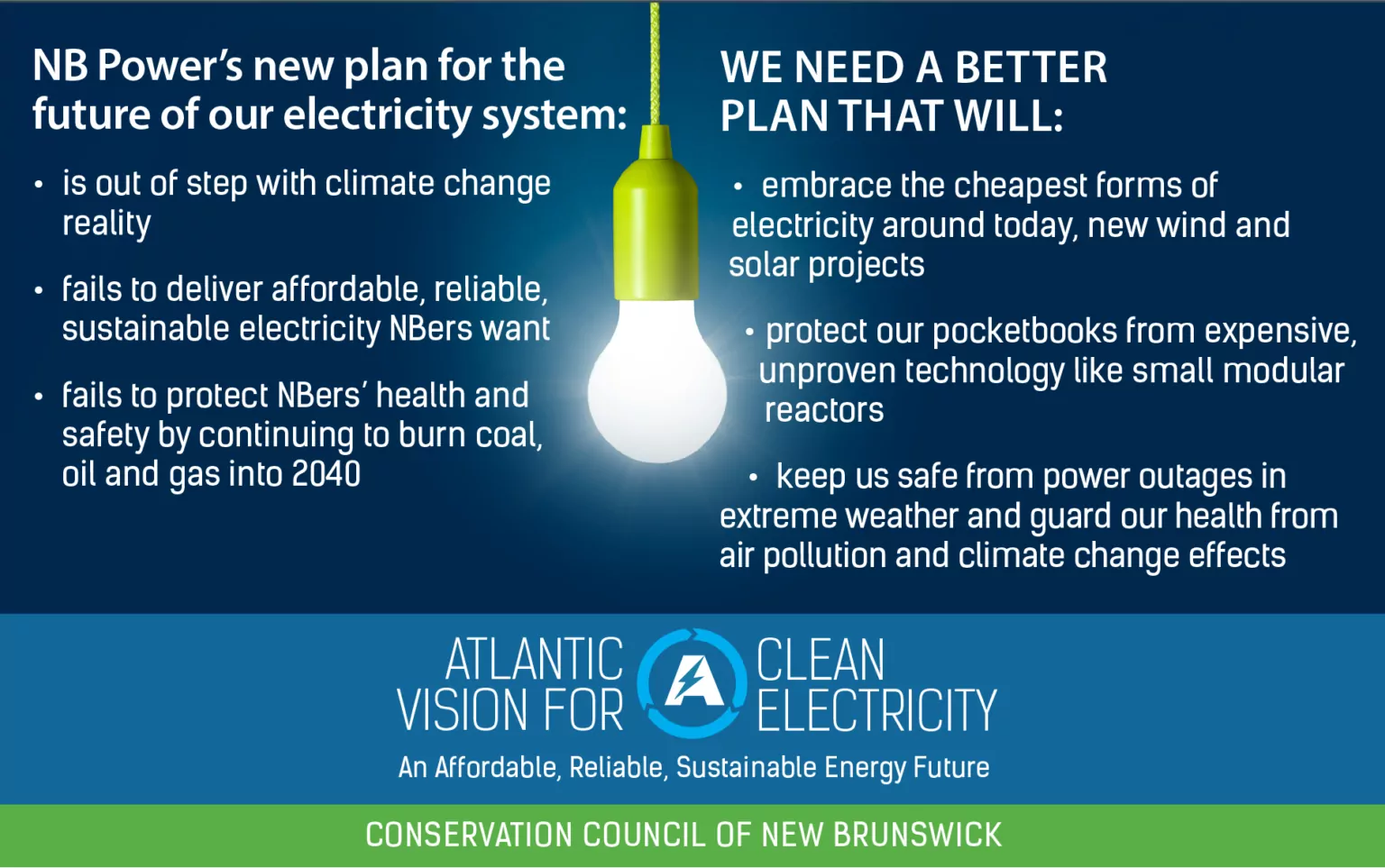
Unceded and unsurrendered Wolastoqey/Mi’kmaq/Peskotomuhkati territory/Fredericton – NB Power’s new plan for the future of the province’s electricity system fails to deliver the affordable, reliable and renewable electricity system that New Brunswickers want and need in the face of increasingly severe climate change. The public utility’s 25-year integrated resource plan (IRP; a demand/supply plan), released Friday, Dec. 4, proposes to keep greenhouse gas emissions (GHGs) at current levels of about 3 million tonnes a year until 2040. The plan is inadequate in the face of worsening climate change and federal legislation to reach near zero emissions in Canada in less than 30 years.
“At the moment the world celebrates the 5th anniversary of the Paris Climate Change Agreement; where New Brunswick celebrates the 4th anniversary of the release of its own climate plan, and where the federal government is expected to announce deeper cuts in GHGs by 2030, our publicly-owned utility and the province argue no further action required,” says Louise Comeau, Director of the Conservation Council of New Brunswick’s Climate Change and Energy program.
NB Power’s plans are not what New Brunswickers asked for. In its own survey, 85 per cent of New Brunswickers told NB Power that ‘New Brunswick’s transition to a clean energy future needs to minimize impacts on rates and the economy.’ NB Power’s IRP fails to achieve this goal.
Today, new wind and solar projects are the cheapest forms of electricity on Earth. Five times cheaper than coal, five times cheaper than nuclear energy, and three times cheaper than natural gas. These technologies have advanced significantly in the last 10 years and are more reliable than ever, especially when paired with new transmission networks and energy storage technologies.
In addition, new research from the Conservation Council of New Brunswick (CCNB) and the Ecology Action Centre (EAC) shows that electricity plans that favour cleaner electricity are cost competitive. In fact, of the 24 electricity plans reviewed, 80 per cent of the scenarios favouring efficiency and renewable energy were cheaper or within just a few per cent of the scenarios favouring conventional, polluting technologies.
“What we need is an electricity system designed to protect our pocketbooks, keep us safe from power outages due to extreme weather, and protects our health from air pollution and climate change,” says Comeau. “Instead we have a provincial electricity plan that ignores climate science and intends to burn polluting and financially risky fossil fuels for decades.”
We can do better. We need a realistic update now to New Brunswick’s electricity plan, not three years from now when the next update is scheduled. We need a new process based on broad stakeholder engagement to develop scenarios. All studies and scenarios should be available for public comment, as is commonplace across Canada.
A realistic electricity plan protects the public interest through a vision of a regionally-connected and non-polluting electricity system that prioritizes energy efficiency, wind, solar and existing hydro power. A realistic electricity plan prioritizes solar neighbourhoods like NB Power’s Northeast Moncton pilot and smart neighbourhoods like the pilot in Shediac that get no mention in the 2020 IRP.
We need investments in solutions right now, like transmission upgrades to support two-way trade among Quebec, Newfoundland and Labrador, Nova Scotia and New Brunswick to ensure an affordable, reliable and sustainable electricity system. Federal financial support is available to make these transmission investments a reality as part of its commitment to phasing out coal and creating a 90 per cent emissions-free electricity system by 2030.
Burning fossil fuels (coal, oil and natural gas) unbalances our climate, and harms human health. If Nova Scotia and New Brunswick phase out coal electricity by 2030, we can avoid more than 125 premature deaths, 12,100 asthma episodes and 81,000 days of breathing difficulty.
Climate change is already costing families, businesses and the economy billions each year. Environment and Climate Change Canada numbers show that successfully phasing-out coal would actually be a net benefit of $4.7-billion in Canada, with $1.2-billion in healthcare savings alone.
NB Power’s proposal ignores the reality of increasing ambition on climate change through policies like emissions caps, carbon pricing and commitments for new renewable energy and efficiency programs. Worse, the NB Power IRP argues against new wind power until 2033, rather than embracing existing engineering solutions, including regional connections to firm capacity from existing hydro power, and investing in battery technologies whose prices are dropping rapidly.
In Nova Scotia’s IRP, released last month, Nova Scotia Power also plans to extend coal burning until 2040 or later. These plans would make New Brunswick and Nova Scotia the last coal-burning provinces in Canada.
“Our politicians and utility leadership are undermining the public interest by making choices that harm New Brunswickers now and in the long-run, but this doesn’t have to be the case” says Lois Corbett, Executive Director of CCNB.
Two additional studies (1, 2) by East Coast Environmental Law, completed for CCNB and EAC, show that government rules stand in the way of investing to help low-income households spend less on energy; prevent utilities from considering the social and environmental costs of our electricity choices, and fail to send long-term signals to plan now for a zero-emitting electricity system over the next 20 to 30 years.
“We need electricity law reform to reach our modernized electricity system goals over the next 20 years, we can’t afford to continue to fail New Brunswickers,” says Comeau.
Recommended links
The Conservation Council of New Brunswick and Ecology Action Centre are collaborating on the Atlantic Electricity Vision, a project involving reports, webinars and research to show that affordable, reliable, sustainable electricity is possible in our region, right now.
Read NB Power’s Integrated Resource Plan 2020
Read our fact sheet on building an electricity system in Atlantic Canada that is affordable
Read our fact sheet on building an electricity system in Atlantic Canada that is reliable
Read our fact sheet on building an electricity system in Atlantic Canada that is sustainable
For more information, contact:
Jon MacNeill, Communications Director, Conservation Council of New Brunswick: [email protected]; 506-238-3539

- Details
- Hits: 4621
2020 Pheonix award
Julie Reimer
In recognition for their dedication and leadership in fighting for awareness surrounding environmental issues in New Brunswick.
2020 Zephyr Award
Liz Smith
In recognition of 20 years of hard work to improve air quality for the citizens of New Brunswick.
2020 Samaqan Award
Vision H20
In recognition of their work in preserving the integrity of watersheds in Southeastern New Brunswick using a multitude of means.
2021 Samaqan Award
Gespe'gewaq Mi'gmaq Resource Council (GMRC)
For its work in harmonizing the strengths of Mi'gmaq knowledge with Western scientific approaches in order to provide a better understanding of the water issues affecting its member communities.
2021 Gaia Award
Linda Stephenson
In recognition of her instrumental role in habitat conservation across New Brunswick and Canada since 1998.
2021 Phoenix Award
Nancy Juneau
For her leadership in the environmental movement in the Acadian Peninsula leading to mobilization of her community through the creation of Imaginons la péninsule acadienne autrement.
2022 Zephyr Award
Hank Scarth
In recognition of his dedication and determination to make a difference for the shorebirds of Saints Rest Beach through public education and conservation.
2022 Samaqan Award
Molly Demma
In recognition of her years of hard work in support of and recognition of the natural and cultural heritage of the Wolastoq river.
Congratulations to the recipients of the NBEN awards. Well deserved!


- Details
- Posted by Jim Emberger
- Hits: 5529
The Brief
Vol. 12 No. 4 | A publication of the NB Media Co-op | December 2020/January 2021 | nbmediacoop.org
RCMP shrugs off findings it acted illegally at Rexton raid against shale gas protesters
By JIM EMBERGER
The RCMP is refusing to accept several findings made by the Civilian Review and Complaints Commission on the RCMP response to the 2013 RCMP raid on the anti-shale gas camp in Rexton, New Brunswick.
Among the Commission’s findings were that the RCMP violated citizens’ Charter Rights on issues of warrantless searches, stops and spot checks, and the retention of personal and social media data gathered by the RCMP, even after it was established that an individual was cleared of any criminal or security concerns.
The final report, released on Nov. 12, comes seven years after the New Brunswick Anti-Shale Gas Alliance called for the investigation.
Without offering any new evidence to support its views, the RCMP rejected the Commission’s findings. In fact, it clearly implied that only the RCMP could judge the constitutionality of actions by its officers.
So, if it can simply dismiss the Civilian Review Commission, is the RCMP accountable to anyone outside of its own ranks?
That the report took seven years to complete is an obvious failure of the system, and emphasizes that ‘justice delayed is justice denied. Except for those who were there, few may remember much about the event beyond pictures of burning cars.
Many who testified before the Commission as eyewitnesses may read this report and marvel that some of its conclusions directly contradict their testimony. This was especially true in instances where it was alleged that the RCMP arrested Indigenous protesters, while they only dispersed nonindigenous protesters.
The Commission concluded that this did not occur, primarily because there was no supporting video evidence, and so simply resolved this issue in favour of RCMP claims. Multiple witnesses, who independently testified about such events (myself included), will not accept the conclusion that they didn’t occur, whether or not they were widespread or videotaped.
This report also cast doubts on the RCMP’s competence and judgment. The Commission found that RCMP negotiators had reached an agreement with the protesters to calm down the tense situation, just as the tactical force was finalizing the next morning’s raid. Had the two groups actually just talked with each other, the entire incident may have been avoided.
A primary reason for justifying the raid was ‘unverified rumours’ of weapons at the protestors’ encampment. Yet the RCMP’s own testimony revealed that its infiltrators, vehicle spot checks, personal searches and continuous surveillance had not turned up a single observation of any firearms. They had simply ‘heard rumours’ about weapons.
The RCMP also admitted that it made a tactical error in letting several police cars remain unmanned, which led to them being burned. The implication at the time was that they were burnt by protesters.
Credible witnesses testified that non-indigenous people, unknown to local residents, were able to approach and burn the cars and escape, without any intercession by the RCMP. As no perpetrators were ever identified, the Commission attributed the incident to a RCMP error, and they didn’t attribute the burning of the cars to the protesters or anyone else specifically.
They did, however, dismiss the possibility that it was the result of agent provocateurs, based solely on the RCMP saying so. So, incompetence or coverup? We’ll never know.
If one thinks that such speculation is a step too far, then I would suggest they read some academic research on this topic such as, Policing Indigenous Movements: Dissent and the Security State by Andrew Crosby and Jeffrey Monaghan. The book covers four Indigenous movements, concluding with the raid on the anti-shale gas camp near the Mi’kmaw First Nation of Elsipogtog in Rexton.
To quote from the book’s promotion, it “raises critical questions regarding the expansion of the security apparatus, the normalization of police surveillance targeting social movements, the relationship between police and energy corporations, the criminalization of dissent and threats to civil liberties and collective action in an era of extractive capitalism and hyper surveillance.”
It also provides context to the Commission report, which focuses solely on RCMP actions. We should not lose sight of, nor excuse, those who were ultimately responsible for this tragedy.
New Brunswick’s Alward government refused for years to engage in discussions with a united province-wide opposition, despite huge demonstrations, petitions from tens of thousands of citizens, and expert testimony. Its intransigence and obvious collusion with the gas industry, led directly to the raid at Rexton. Ironically, that may have been the event that finally doomed shale gas and spelled the end of the Alward government.
Unfortunately, current events, like the RCMP’s violent actions against Wet’suwet’en opposition to the Coastal GasLink LNG pipeline in BC, and its failure to protect Mi’kmaw fishers in Nova Scotia, illustrate that government practices that allow the RCMP and the security services to abet corporate interests (especially fossil fuels) continue unabated.
Commercial rights continue to supersede personal rights, and especially treaty rights, in a peculiar and twisted hierarchy of justice overlaying a barely hidden foundation of racism.
The RCMP’s contention that it is the sole arbiter of the correctness or legality of its actions emphasizes that it, along with the intelligence services, governments, and fossil fuel interests will learn no lessons from the Commission report. And without real accountability they never will.
Jim Emberger is the spokesperson of the New Brunswick
Anti-Shale Gas Alliance

- Details
- Hits: 4789
From now until March 2022, we’re helping New Brunswick more than double its conserved land from 4.7% to 10% of the province -- and you can help, too!
Head to gnb.ca/naturelegacy and learn more about GNB’s approach to choosing new protected and conserved natural areas, and how they want to hear from you.

- Details
- Posted by GDDPC
- Hits: 5401

- Details
- Posted by Jean Louis Deveau
- Hits: 6276
No satisfaction: Chief Tremblay calls an emergency Wabanaki Confederacy meeting
by J.L. Deveau, Ron Tremblay, and Alma Brooks
Imagine how betrayed you would feel if you were an Indigenous person knowing your ancestors had agreed to make peace with the British on a promise made – that any Wolastoquyik (Maliseet person) would be entitled to satisfaction and reparation for any controversy, whether real or imagined – but that 300 years later, a judge reneged on that promise.
This happened after Wolastoqewi-Grand Chief Ron Tremblay and Wolastoqey Grand Council found out that the New Brunswick Department of Tourism, Heritage and Culture had begun working on the development of a Snowmobile Grooming Hub project at Mount Carleton Park, in northern New Brunswick, with no park management plan in place authorizing such a thing.
They went to court to ask for satisfaction and reparation from a judge. However Justice Petrie gave Grand Chief Tremblay and Wolastoqey Grand Council No Satisfaction (like the Rolling Stones’ 1965 hit (I can’t get no satisfaction). An appeal was subsequently filed with the NB Court of Appeal.
Since our last NB Media Co-op article was published, the NB Court of Appeal summoned all three of us to a teleconference call scheduled for Dec. 8. At that time, a judge from the high court will assess the legitimacy of our delay in perfecting (completing) our appeal filed in October 2019. If satisfied with our explanation, the judge can order us to perfect our appeal by a specific date. Alternatively, if not satisfied, the judge can dismiss our appeal.
We're facing a dilemma.
The Treaty of 1725-26 was the product of negotiations not only between two parties, Wolastoqiyik and the British, but also between representatives of a Confederacy, the Wabanaki Confederacy, and the British. "Wabanaki" means "people of the dawn."
The Wabanaki Compact (Treaty of 1725-26) was broken in Wolastokuk (Maliseet homeland). This has implications for all five nations in Wabanakiak (Abenaki, Mi’kmaq, Penobscot, Passamaquoddy, and Wolatoqiyik combined territories). Therefore, Grand Chief Tremblay is beholden to inform the Confederacy of this breach in their treaty with the British and to seek guidance from its peoples on how best to proceed.
Few people in New Brunswick realize that Wolastoqiyik never abandoned their own legal system, agreeing only to set aside their international law of private satisfaction (komucikotuwal) for those instances involving controversies with the British. The deal was that in so doing, they were guaranteed satisfaction and reparation from His Majesty’s laws.
We have two options. Option 1 is to continue with the appeal and file everything before our conference call with the NB Court of Appeal judge on Dec. 8. Option 2 is for Grand Chief Tremblay to revoke Wolastoqewi-Grand Chief Charles Manituphike’s agreement of 1728, to seek redress before the British court system for any controversies involving the settlers and to revive instead their own legal system.
Given the risk of having the appeal thrown out by a judge from the NB Court of Appeal, Grand Chief Tremblay and the Wolastoqey Grand Council have called for an Emergency Wabanaki Confederacy meeting.
Traditionally, a Confederacy meeting takes place in person at some fixed location during mid-winter however that is not possible this upcoming winter because of the pandemic.
The Wabanaki Confederacy meeting will be held online, through the videoconference platform Zoom, on the afternoons of Saturday Nov. 21 and Saturday Nov. 28, from 1pm to 5pm Atlantic time.
The first Saturday will be focused on treaty education, the second on determining how the Grand Council and its Grand Chief ought to proceed following the No Satisfaction outcome of Justice Petrie’s ruling.
Nov. 21 features three experts: Professor Harald Prins on the history of the Confederacy and how Wabanaki spokesperson Loron Saugaaram felt duped by the British even before he signed the Treaty of 1725-26; Professor Katherine Hermes on Indigenous Northeast law and the evolution of the legal arrangements that existed between Native peoples and colonial governments in the 17th and 18th centuries; and, Professor Heather Hirschfeld on how the term satisfaction as the bastion of substantive justice in the 17th and 18th centuries was whittled down to becoming nothing more than the touchy feely expressions of the fulfillment of our carnal needs and wants.
These events are free. The general public is invited to attend the three education sessions on Saturday Nov. 21. The following Saturday, Nov. 28, is reserved just for the Peoples of Wabanaki Confederacy.
Registration is required for both days to receive the link to the online sessions via email. For additional information, please visit our Facebook event page , email [email protected] or call 1-506-260-1331.
This article was first published by NB Media Co-op on November 17th, 2020.
Dr. Jean Louis Deveau is an independent scholar, former manager of Mt. Carleton Park, and co-founder of the Friends of Mt. Carleton Provincial Park.
Alma H. Brooks, BA, is a Wolastoqwey Grandmother (the people of the beautiful & bountiful River) residing in the territory of EkPahak ( the place where the tide ends ) is physically, linguistically, spiritually, culturally, and biologically connected to the traditional homeland of her ancestors.
Ron Tremblay is his colonial birth name but is known as “spasaqsit possesom” (spuz-akw-zid buz-za-zum) – morningstar burning. He is a citizen of Wolastokuk (Wa-lus-da-gook). Being the youngest of 10 children of the late Doris Sappier and Raymond Tremblay, spasaqsit possesom grew-up surrounded by Wolastoqey (Wa-lus-do-kway) Language spoken fluently. spasaqsit possesom credits his mother Doris and grandparents Madeline LePorte and Louise Sappier for his genuine love of Wolastoqey Language and he also acknowledges that they provided him the true teachings of life.
After moving to Fredericton in 1991 he befriended several Elders from local area. The two main Elders Ulsonuwit Sqot (Harry LaPorte) and Sagatay (Gwen Bear) guided him deeper into his Wolastoqey Traditional Ways. After years of involvement in various ceremonies with his teachers spasaqsit possesom gained wisdom and knowledge of “Wolastoqey way of life”. Still today, Ron practices the traditional ways of Wolastoqewiyik. In November 2016, Ron was installed as Traditional Wolastoqewi-Grand Chief. The mandate of the Wolastoqey Grand Council is to protect and preserve Wolastokuk, their non-ceded traditional homeland, waterways, ceremonies and language.
- Details
- Hits: 5858
- Indigenous-owned vehicles torched, food destroyed, and Mi'kmaw fishermen forced to barricade themselves indoors to escape violent mobs hurling rocks and racist insults. [1]
- These were some of the shocking hate crimes committed in Nova Scotia on Tuesday night, while the RCMP watched. [2]
- The Mi'kmaw people's right to fish is protected by the Peace and Friendship Treaties and was upheld by a Supreme Court decision. But so far, the federal government has avoided defining and protecting these treaty rights — leading to unrest and racial violence. [3]
- Prime Minister Trudeau and Minister of Fisheries, Bernadette Jordan, have condemned these appalling acts of terrorism and hate. [4]
- But Jean-Louis the Mi'kmaq need more than words. They’re calling on the federal government to urgently step in before the situation escalates further and someone is seriously injured or killed.
- While this story is dominating the news, the federal government is vulnerable to public pressure. [5] If we flood their inboxes with tens of thousands of messages calling on them to protect the treaty rights of the Mi'kmaq, we could convince them to intervene and put a stop to the violent and unlawful attacks on Indigenous fishers.
- Non-Indigenous fishermen raided a Mi'kmaq food storage facility, cut the power, poured chemicals on live lobsters, and threatened the Indigenous fishermen inside. [6]
- Jason Marr, a fisherman with the Sipekne’katik First Nation barricaded himself inside a facility to escape the violent mob’s racist taunts and threats. He waited for the RCMP to escort him out safely but once the RCMP showed up, "they just stood there". [7] Sipekne’katik Chief Mike Sack said he couldn't believe the violent mob was getting away with terrorist acts while the police were present. [8]
- The Mi’kmaq have a treaty protected, legal right to catch and sell fish to earn a moderate livelihood — one which includes the right for Mi'kmaw people to provide housing, food, clothing and amenities for themselves and their families. This is recognised by a 1999 Supreme Court decision and enshrined in Section 35 of the 1982 Constitution Act. [9]
- Jean-Louis, Mi’kmaw fishermen have 250 lobster traps in the contested area, while non-Indigenous fishermen have approximately 390,000. This isn’t a dispute about over-fishing — it’s racist hate meant to intimidate Indigenous fishermen away from the waters. [10]
We must use our platform to amplify the voices and demands of the Mi'kmaq because it is the right thing to do. Send a message to Prime Minister Trudeau and Minister Jordan now.
Please check out this list of ways people can help.
To donate to people on the ground you can send an e-transfer or paypal to Sipekne'katik First Nation at [email protected]. Please make the subject line: “1752 Moderate Livelihood”.

- Details
- Posted by Kristin Elton
- Hits: 4581

Today we celebrate National Tree Day. Did you know that it's also the 100th anniversary of #NationalForestWeek?
There's no better way to celebrate New Brunswick trees than a Q&A with The Great Trees of New Brunswick co-author Tracy Glynn.
A native of Miramichi and daughter of a horse-logging father, Tracy Glynn was the forest campaigner at the Conservation Council of New Brunswick from 2006 to 2018. Glynn teaches at St. Thomas University, writes and coordinates editing for the NB Media Co-op, and works with land defenders across Turtle Island, Indonesia, the Philippines, Guatemala, Colombia, and beyond.
Q: Tell us about how The Great Trees of New Brunswick book came about.
A: Forester David Palmer approached the Conservation Council of New Brunswick about writing a second edition of The Great Trees of New Brunswick. He wanted to honour the memory of his friend, David Folster, who wrote the first edition. I jumped on the chance to participate in this interesting project, which I thought would be a lovely way to end my time as the forest campaigner at the Conservation Council. I approached Goose Lane, a Fredericton-based publisher of books, to see if they were interested in publishing the book and it took no convincing, they were immediately interested. David did the heavy lifting of visiting almost every tree nominated for the book, taking its measurements and listening to the nominators' stories of their great tree. David and I spent 2018 and 2019 learning more about our trees and writing the book.
Q: Why do you think it's important for New Brunswickers to foster a relationship with our forests?
A: Our forests are so magnificent. Our forests are home to 32 different native tree species, beautiful forest orchids, funky mushrooms, songbirds, woodpeckers and owls, and so many other creatures that are worthy of getting to know, love, and protect.
Q: The Great Trees of New Brunswick Second Edition had such a strong emphasis on native species. Can you tell us why?
A: We wanted to make sure to include a chapter on each native tree species as well as some of the exotic species that folks have come to know and love. The first edition celebrated many of the common trees that folks know like the eastern white pine and sugar maple but we wanted to produce a folksy field guide that would allow readers to identify all the different trees of our forest, including the more elusive ones.
Q: Climate change and invasive species such as the emerald ash borer pose significant threats to our forests. How do you think these will affect the trees featured in this book?
A: Scientists say that climate change and invasive species could lead to the extirpation of some of our native trees. Some of our native trees are endangered like the butternut. In the book, we discuss the outlook for each tree and we discuss how human actions are affecting our trees.
In the book, we write about the emerald ash-borer and how it is ravaging ash stands in eastern Canada and the U.S. All of our three native ash species are susceptible and they show no natural resistance to the insect. The National Tree Seed Centre in Fredericton is collecting ash seed for genetic conservation and it is hoped that ash will have a future in our forest.
Q: What tree is your favorite?
A: That's a hard question. I think all our trees are special. I am continually stunned by yellow birch and its shimmery bark, basswood in bloom, and golden tamarack in the fall. If I had to pick one tree that is special to me, it would be an old eastern white pine on the road where I grew up. Known simply as “the pine tree” to my family and neighbors, the lopsided tree was a meeting place where we would watch for black bears while devouring raspberries. Watching the sun set behind the tree never gets old for me.
Buy your copy of The Great Trees of New Brunswick, 2nd Edition today, and be sure to do your part to help protect our great trees by taking acting against invasive species!
Visit the New Brunswick Invasive Species Council website for more stories like this.

- Details
- Posted by Kristin Elton
- Hits: 5124
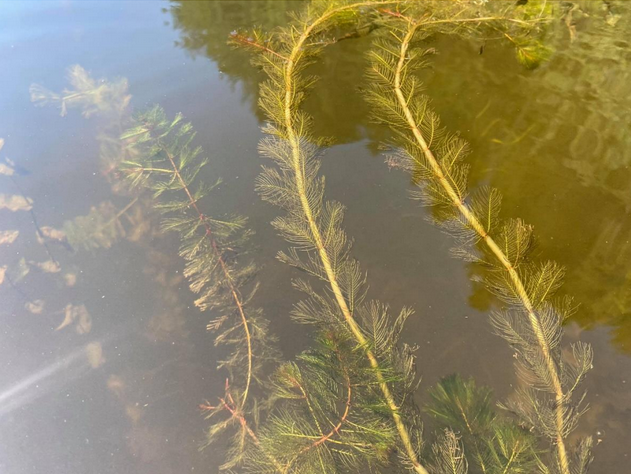
[Kingston, NB]- The New Brunswick Invasive Species Council and the Belleisle Watershed Coalition are asking boaters, anglers, and cottage owners to be on the look-out for Eurasian Water-Milfoil in Belleisle Bay after Dr. Meghann Bruce’s Research Team at the Canadian Rivers Institute observed the first known location of the highly invasive aquatic plant in the area.
The plants were observed at the mouth of the bay by Kingston Creek. “Not only the presence of the plants, but their location is concerning,” says Kristin Elton, Director for the NBISC. “The plant spreads by fragmentation and given how many boats come and go through that area, it is highly likely that pieces have been broken off and transported on propellers, hulls, etc. further into the bay itself where it will create new colonies.”
The research team had surveyed the same area in 2018 and did not find the invader, but given how quickly it has spread throughout other parts of the Saint John River, it is not surprising.
The Belleisle Watershed Coalition has been surveying publicly-accessible areas of the bay for EWM throughout the summer, and while they haven’t found any to date, most of the shoreline is privately owned. “Waterfront property owners hold the key to us tracking and preventing the spread of Eurasian Water Milfoil. If you think you have seen this plant in your waters, contact [email protected]” says Melissa Rafuse, Project Manager at the Belleisle Watershed Coalition.
The good news, says Elton, is that by identifying this new colony relatively early, measures can be taken to stop further spread into the bay. “Boaters need to avoid areas where the plant is growing (if possible) to limit the plants’ fragmentation into even more plants, and if you arrive back at your dock and notice plant material on your boat do NOT throw it back into the water; dispose of it in the trash on land instead.”
Eurasian water-milfoil has the potential to grow into thick, dense mats where it clogs waterways, chokes out other plant species, alters fish habitat, and ruins beaches. “It grows so dense in some areas that it can become very difficult to boat, swim, fish or kayak in these places.” says Rafuse.
Media Contact
Kristin Elton, Director
New Brunswick Invasive Species Council
[email protected]
(506) 262-6247
Melissa Rafuse, Project Manager
Belleisle Watershed Coalition
[email protected]
(902) 691-3162
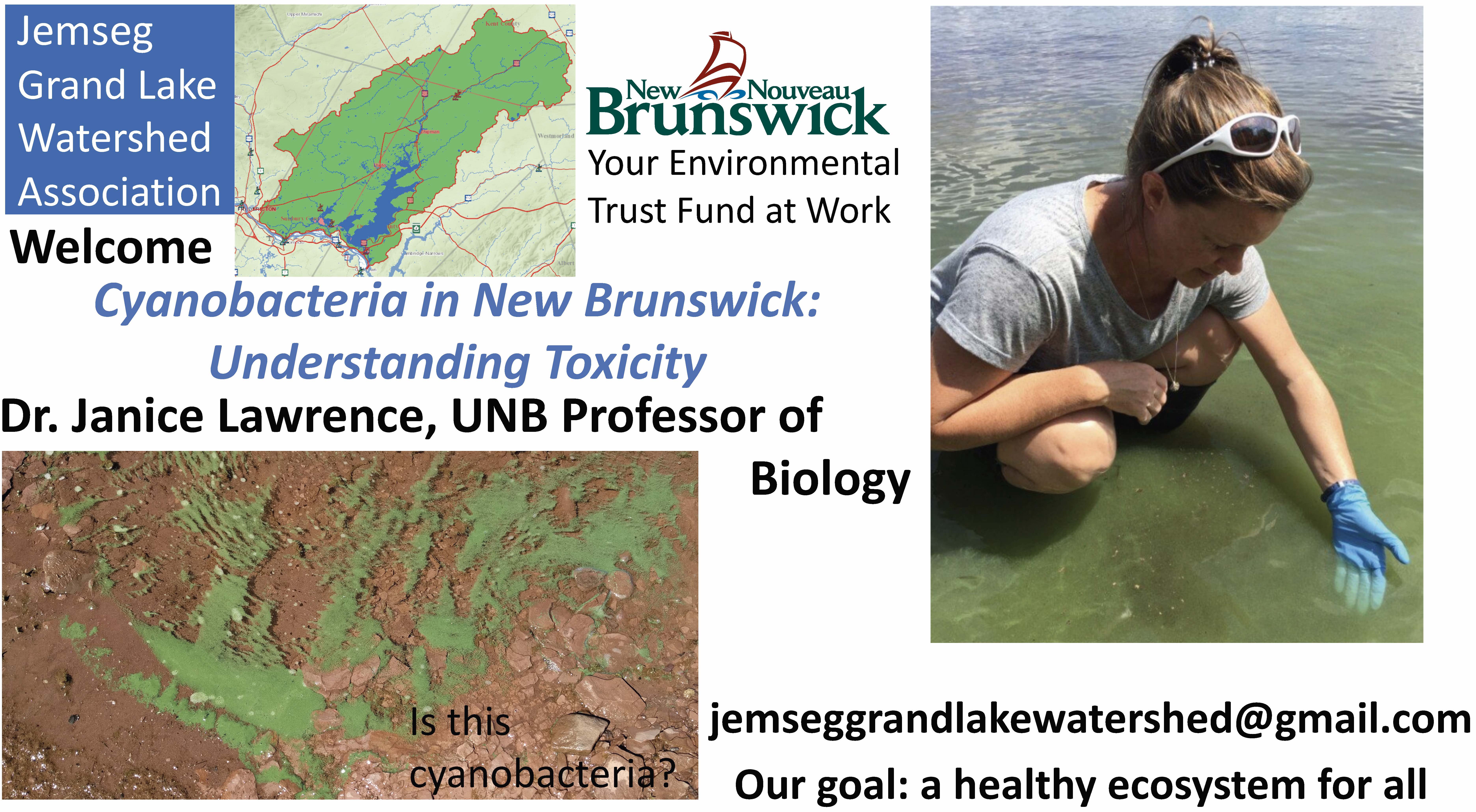
- Details
- Posted by Brad Nickerson
- Hits: 6712
Take a break from Netflix, and watch this excellent video of a recent webinar with Dr. Janice Lawrence, a University of New Brunswick Professor of Biology. Learn about cyanobacteria and how genetic tools are being used to determine if cyanobacteria contain harmful cyanotoxins. Learn how harmful cyanotoxins arise from cyanobacteria, why they are increasing in surface freshwater bodies in Canada, and what we are doing about it in New Brunswick.
Be sure to watch the video to the end as Dr. Lawrence does a superb job of answering questions from the webinar attendees. The online, recorded version of the July 16, 2020 webinar is now available at
https://youtu.be/VjRAT7FCwe8
Please share this description and online webinar with anyone you think might be interested.

- Details
- Posted by Alyssa MacFarlane
- Hits: 7139
We are not going back to the broken economic model we had. We will not stand by helplessly as our small businesses struggle to stay alive. We have the solutions, we know they work, and they won't cost us one more cent than we spend right now..

- Details
- Posted by Annika Chiasson
- Hits: 5874
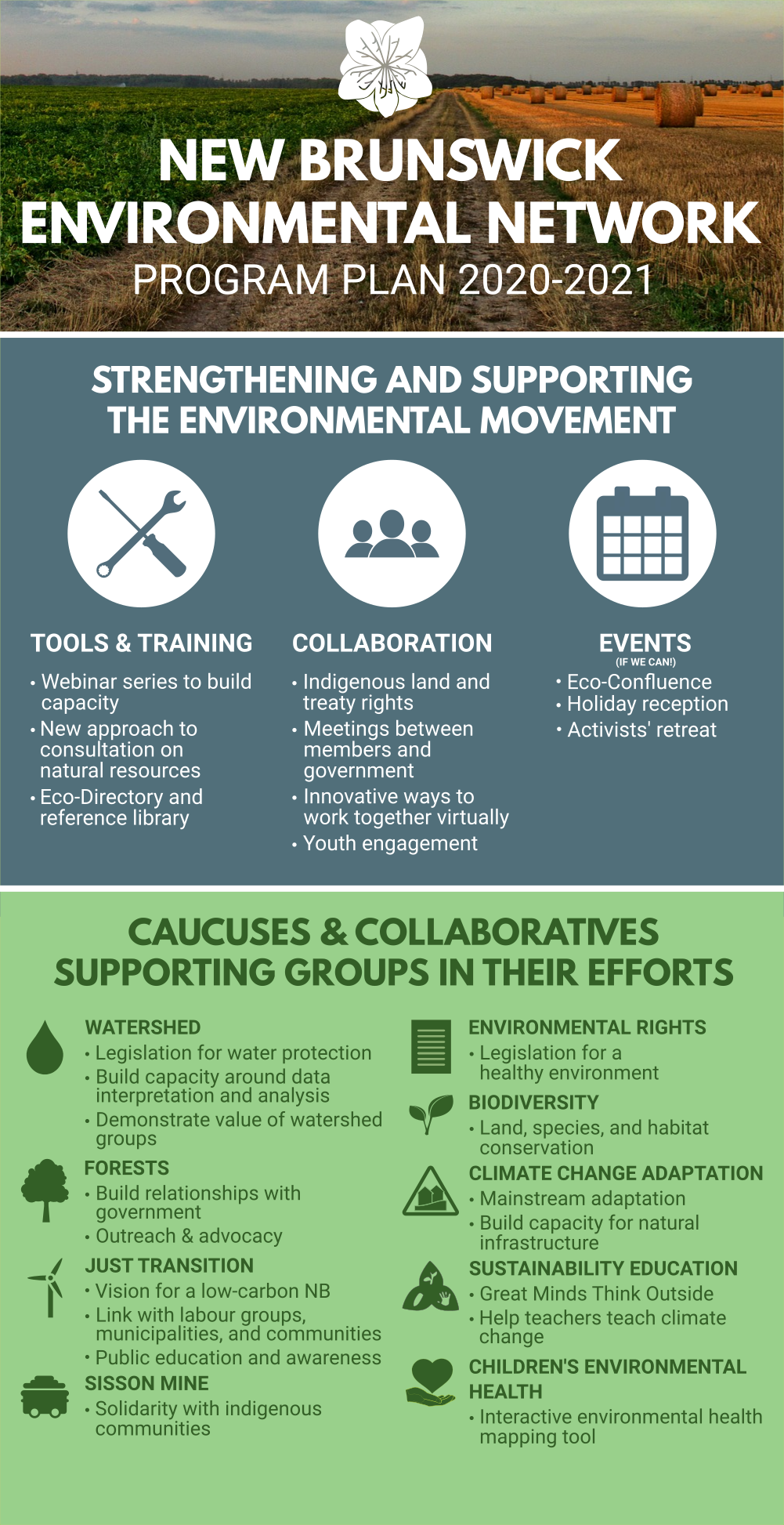
- Details
- Posted by Jim Emberger
- Hits: 7607
However, under the sponsorship of a different "RAVEN" group ("Respecting Aboriginal Values and Environmental Needs") - the tour has been redesigned as a 3-part webinar series.
"We are UnFrackable" – focuses on national resistance to LNG – aka fracked gas. Its goals are to share strategic approaches – from supporting Indigenous legal challenges, to divestment and de-funding campaigns – and to build an unbreakable alliance of action. The narrative peddled by government and industry is that LNG is “ethical”, “environmental”, and “economic”. The webinars will bring together fantastic expert guests and frontline activists to debunk that myth, while connecting the dots of resistance from coast to coast to coast.
The first webinar is FRIDAY APRIL 3 at 8 pm AT and is entitled: #WetsuwetenStrong and the Ethics of LNG, with Hereditary Chief Adam Gagnon and Mike Sawyer, COGC.
It will be an amazing opportunity to hear directly from Wet’suwet’en hereditary leader Chief Dsta’Hyl – Adam Gagnon, in conversation with Mike Sawyer of the Citizen’s Oil and Gas Council.
- Chief Gagnon is a member of the Likhts’amisyu clan who have launched legal challenges to protect their traditional territory from fracked gas pipelines. He will talk about the Constitutional and Charter challenge to Coastal Gas Link and other fossil projects on Wet’suwet’en territory, based on the equity rights of future generations in a time of climate crisis.
- Micheal Sawyer brings 30 years of extensive experience in Canadian regulatory and energy policy matters. Sawyer is no stranger to the power of citizen-driven justice: he’s famous for winning a court challenge against an LNG plant proposed for Lelu Island in BC: three weeks after that victory, the project was cancelled.
- Your host is Mary Lovell, a climate justice organizer that has been primarily organizing against tar sands, extreme oil, and the Trans Mountain project for eight years. Mary is a campaigner with RAVEN and Sierra Club BC.
This first webinar will touch on projects that may affect New Brunswick, but have been flying under the radar.
To sign-up for the webinar and/or find more information: https://raventrust.com/we-are-unfrackable-webinar-series/
We have also put up an event on Facebook: https://www.facebook.com/events/1269560153248578
Contact https://raventrust.com/we-are-unfrackable-webinar-series/
