The federal government is in the process of creating Canada’s first Climate Adaptation Strategy. We know the Nature Network is concerned about climate change and how it will affect our lives… but we’re also concerned about how it will affect the lives of the many species we share a planet with! Join Michael Polanyi, Policy and Campaign Manager, on May 26th to discuss why this strategy is so critical for human and nature’s ability to adapt to climate change.
We will go over the opportunity that lays ahead of us to tell the government that nature needs to be considered.
NATURE MONCTON FIELD TRIP TO THE BAIE VERTE NATURE RESERVE AND PORT ELGIN LAGOON
DATE: Saturday, May 28th (rain date: Sunday, May 29th) TIME: 9:30 AM MEETING PLACE: The parking lot of Saint James United Church at the corner of Main St. (Rte 970) and Siddall Rd. in Baie Verte. GUIDES: Louise Nichols (location) and Roger Leblanc (birds)
The end of May can be a very active time in Nature. While this is the case everywhere there are some spots where the “show” seems to be concentrated. And one of these is certainly the coastal region between Baie Verte and Port Elgin. Situated at the northeastern end of the Isthmus of Chignecto it is clearly on a bird migration route but also harbors vast marsh and coastal habitats that favor a lot of life forms from insects to plants and more. On this field trip, we’ll explore a couple of special spots in this unique region. From the starting point at the church, we will drive down Siddall Rd. until we get to the Baie Verte Nature Reserve, protected by the Nature Conservancy of Canada. We will then walk an easy trail (about 2 km one way) that passes through some marsh areas, open fields, and woods until it finally reaches the beaches of the Northumberland Strait. The area’s diversity is good for birds, but also butterflies, dragonflies, and a variety of plant species. We will pass by an Osprey nest that was active last summer.
Afterward, we’ll drive along Rte 970 to Port Elgin where we’ll stop and visit the lagoon in the centre of town. This lagoon (not widely known) tends to attract a different variety of waterfowl from some other lagoons, with more diving ducks, especially Buffleheads in the spring and fall. The lagoon also attracts swallows to the nest boxes erected at the lagoon and many warbler species to the treed areas around it. If we have time, we can walk a moderately rough trail about half a kilometre through the woods that ends in a marshy area along the shoreline of the Gaspereau River.
Bring lunch and snacks. All are welcome, Nature Moncton member or not.
Join us on Wednesday, June 1st, 2022 from 3-4 PM EST for the second installment of “Waves of Hope” a webinar series on ocean protection hosted by Nature Canada. We will be joined by Charlotte Dawe, Conservation and Policy Campaigner at Wilderness Committee, to dive into the topic of marine species at risk.
Vision H2O invites the citizens of the Village of Cap-Pelé and the Beaubassin East Rural Community as well as all interested parties to its Annual General Meeting on Wednesday, June 1st at 6:30 p.m. on the Zoom virtual platform. This event will give the group the opportunity to present the results of its activities.
You’re invited to participate in a free webinar on the draft 2022–2026 Federal Sustainable Development Strategy, the Government of Canada’s plan for healthy ecosystems, clean growth, and a sustainable future that is cleaner, greener, and more resilient. We will also be discussing energy efficiency with Natural Resources Canada.
This presentation will highlight the National Collaborating Centre for Indigenous Health’s (NCCIH) collaboration on the 2022 national assessment titled the Health of Canadians in a Changing Climate: Advancing our Knowledge for Action, produced by Health Canada’s Climate Change and Health Innovation Bureau. This comprehensive study of current and projected risks from climate change to the health of Canadians included a chapter dedicated to climate change and Indigenous Peoples’ health in Canada. Contributing author, Donna Atkinson will provide an overview of the key findings of this chapter; a summary of specific climate change risks to First Nations, Inuit and Métis peoples’ health; the role of Indigenous knowledges and rights in climate change adaptation, research and policy; and knowledge gaps for future research.
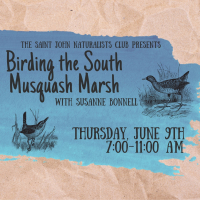
The South Musquash Marsh is a small portion of the NBCC Musquash Estuary Marine Protected Area. The area we will be visiting has been part of the Maritime Marsh Monitoring program for several years and is checked each year for American bittern, least bittern, pied-billed grebe, sora, Virginia rail, American coot, common gallinule, nelsons sparrow, marsh wren, black tern and willet.

 Come and learn from AllEV representative, Jeremie Bernardin, about how to select the right EV fit for you.
 Join us on Wednesday, June 1st, 2022 from 3-4 PM EST for the second installment of “Waves of Hope” a webinar series on ocean protection hosted by Nature Canada. We will be joined by Charlotte Dawe, Conservation and Policy Campaigner at Wilderness Committee, to dive into the topic of marine species at risk.