
| Week 11 |
| Monday. 14 March, 2022 | |
| 8:30 am |
De nos Terres à nos Tables : Forum sur l'autonomie alimentaire de la Péninsule acadienneDu 14 au 17 mars prochain, Imaginons la Péninsule acadienne autrement vous invite à participer à la création d'un plan d'action visant à augmenter l'autonomie alimentaire de la Péninsule acadienne! |
| Tuesday. 15 March, 2022 | |
| 12:00 am |
Back to the Basics: Outdoor Learning for Curriculum and Climate ActionOnline Registration now open! Early bird pricing will be automatically applied to your ticket if you register before Feb 21, 2022.Do you offer a workshop, service, or mentorship to NB teachers? Register before Feb 21 to apply to host a discussion table showing off your programs! |
| 9:00 am |
Virtual Air Quality and Health WorkshopOnline The 2022 Virtual Air Quality & Health Workshop is being held on Tuesday March 15th & Wednesday March 16th (from 9:00am – 12:00pm each day). The workshop is a free event and we hope that you will be interested in participating. |
| 6:30 pm |
Exploring the Beaches of Pointe-SapinAre you from Pointe-Sapin or the surrounding community? Do you care about the Pointe-Sapin coast? Join Healthy Coasts NB for a discussion about beaches in the region, what is being done to help coastal communities and wildlife, and how you can get involved! |
| 7:00 pm |
Nature Moncton March MeetingNATURE MONCTON MARCH MEETING Tuesday March 15th, 2022 at 7:00 PM Virtual Meeting “Monitoring Caribou Habitat in Canada’s Changing North” Presenter: Ryan Danby
Many of Canada’s large northern caribou herds have declined over the last two decades. While the herds are known to fluctuate naturally, the magnitude of their recent declines is well outside of historical observations. Climate-related changes in habitat condition may be partly responsible, and this presentation will explore the use of modern satellite mapping technologies for examining this.
Presenter: Dr. Ryan Danby is an associate professor of Geography and Environmental Studies at Queen’s University in Kingston, Ontario. He has been conducting research in Northern Canada and Alaska for the last 25 years with the aim of better understanding the causes and consequences of ecosystem change and their implications for conservation.
Given that Caribou once roamed in areas north of New Brunswick, this presentation is of interest to us all.
For those who want to attend the meeting, you can do so by clicking the following link: https://us02web.zoom.us/j/87311687739?pwd=K1R1MTZycVFFMWxiVVBaQTB4WmYwUT09All are welcome, Nature Moncton member or not.
|
| Wednesday. 16 March, 2022 | |
| 12:00 am |
Deadline for call for proposals for Atlantic Ecosystems InitiativesOnline Environment and Climate Change Canada's (ECCC) Atlantic Ecosystems Initiatives (AEI) is currently accepting applications for 2022-2023 funding. The deadline for submitting a project is 4:00 pm Atlantic Standard Time (AST), March 16, 2022. |
| 11:00 am | |
| Thursday. 17 March, 2022 | |
| 12:00 am |
Spring Inspiration Session - School Gardens InitiativeSchool Gardens Initiative, Spring Inspiration Session - March 17, 2022 |
| 8:00 pm |
Jemseg Grand Lake Watershed Aquatic Ecosystem – What We Know and Don’t Know After Two Years of MonitoringJoin us for a free Zoom webinar on Thursday, March 17, 2022 at 8:00 p.m. Atlantic time for an interactive meeting with Eric Luiker, our fearless volunteer water quality program leader and aquatic ecologist.Register for the webinar at https://bit.ly/3oCDQGc . A link for the webinar will automatically be sent to your email address once you are registered. Our water quality monitoring program has expanded in 2021 compared to 2020, and now includes nine primary monitoring sites, 14 E. coli sites, and an analysis to determine the species of phytoplankton and zooplankton in one location in Grand Lake. The above picture shows a Niskin bottle designed to sample water below the surface. |
| Saturday. 19 March, 2022 | |
| 10:00 am |
Searching for Species at Risk and Areas of Ecological Significance within the Traditional Territory of the Peskotomukati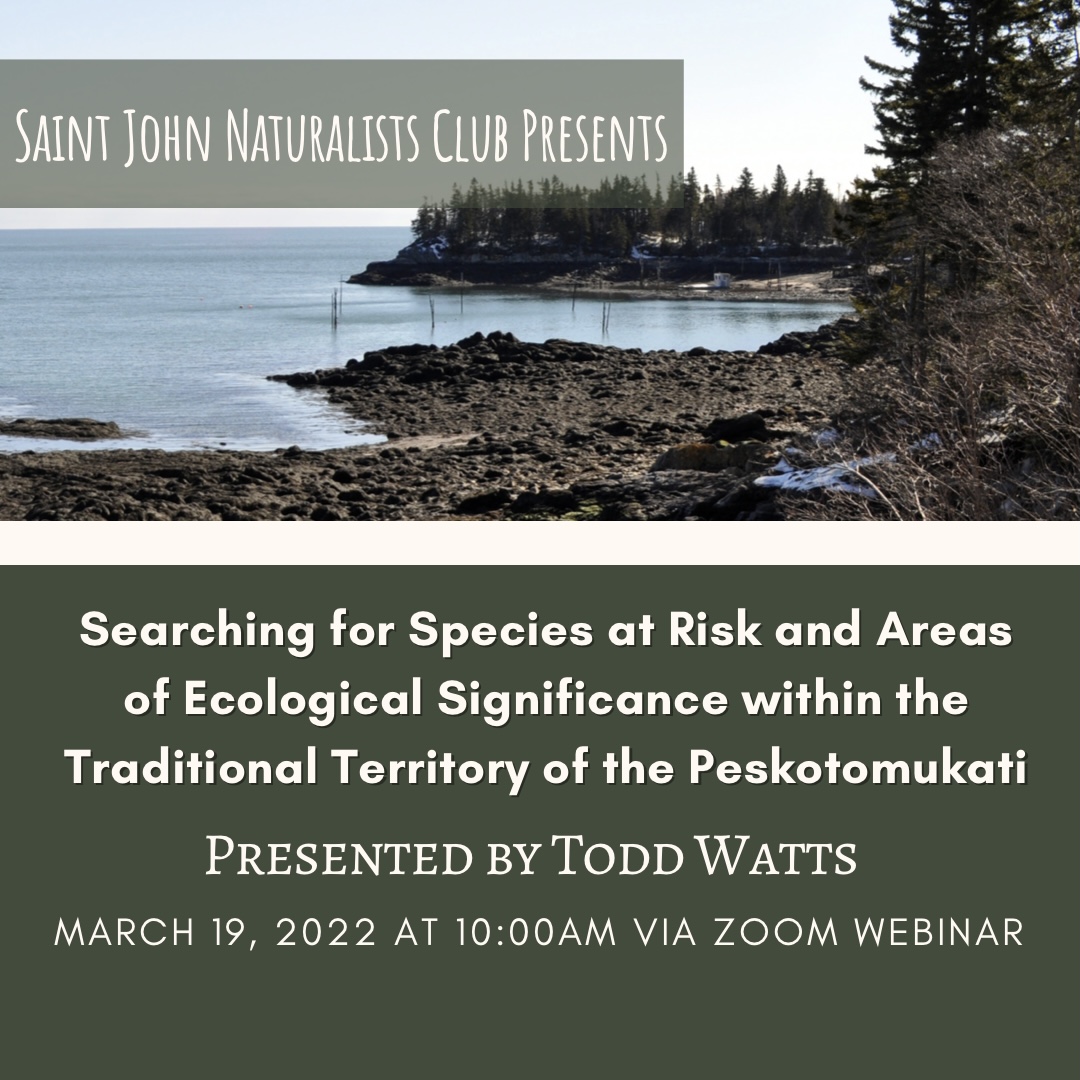 Working for the Peskotomukati at Skutik, Todd Watts has spent much of the last few years searching the land for species at risk and areas of ecological significance. This work has taken place within the traditional territory of the First Nation, which includes the watersheds of the Skutik/St. Croix River, as well as the Digdeguash, Magagadavic, Pocologan, New and Lepreau Rivers. Through this work, he has the opportunity to observe the state of the land in a way that few people do. Join Todd as he talks about this work and its findings. |
