
WebinarsiCAL Subscribe
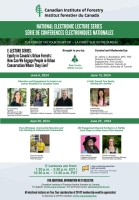 Don't forget to register for our E-Lecture series with the Canadian Institute of Forestry / Institut forestier du Canada! We have an incredible roster of speakers who will be delving into the subject of "Equity in Canada’s Urban Forests: How Can We Engage People in Urban Conservation Where They Live?'' This is a series you definitely don't want to miss!
Webinar dates and topics:
June 6th, 2024 - Education and Engagement to Inspire Low Carbon Resilience in Canadian Cities
June 13th, 2024 - A Path Toward Tree Equity: Starting the Journey
June 20th, 2024 - Trees Winnipeg. Community Education and Tree Planting in Underserved Communities
June 25th, 2024 - DEI Engagement Beyond the Basics: A Halifax Case Study on Urban Forest Plan Renewal
Find out more and register here!
| Event Date | Jun-13-2024 2:30 pm - 3:30 pm |
| Categories | Webinars |

This panel will examine the risks associated with radioactive emissions and provide an opportunity to pose questions about risks and impacts to independent radiation experts.
Government, regulators and the nuclear industry - including the NWMO - claim that radioactive emission limits are kept “as low as reasonably achievable” and that at these controlled emissions levels human and animal health will not be impacted. Science says that there is no level of exposure that does not carry with it some level of risk to human health.
This session will explore the gap between the what science says and what the regulators tell us.
Register here.
| Event Date | 20 June, 2024 2:00 pm |
| Categories | Webinars |
Don't forget to register for our E-Lecture series with the Canadian Institute of Forestry / Institut forestier du Canada! We have an incredible roster of speakers who will be delving into the subject of "Equity in Canada’s Urban Forests: How Can We Engage People in Urban Conservation Where They Live?'' This is a series you definitely don't want to miss!Webinar dates and topics:
June 6th, 2024 - Education and Engagement to Inspire Low Carbon Resilience in Canadian Cities
June 13th, 2024 - A Path Toward Tree Equity: Starting the Journey
June 20th, 2024 - Trees Winnipeg. Community Education and Tree Planting in Underserved Communities
June 25th, 2024 - DEI Engagement Beyond the Basics: A Halifax Case Study on Urban Forest Plan Renewal
Find out more and register here!
| Event Date | 20 June, 2024 2:30 pm |
| Categories | Webinars |
 Sustainability Network welcomes back Canada’s Commissioner of the Environment and Sustainable Development (CESD) to discuss reports tabled in Parliament on April 30, 2024. Commissioner Jerry V. DeMarco and Principals from the Office of the Auditor General of Canada will discuss the issues covered by these recent CESD reports:
Report 1 - Contaminated Sites in the North.
Report 2 - Greening of Building Materials in Public Infrastructure.
Report 3 - Zero Plastic Waste.
Report 4 - Strategic Innovation Fund’s Net Zero Accelerator Initiative—Innovation, Science and Economic Development Canada.
Report 5 - Agriculture and Climate Change Mitigation—Agriculture and Agri-Food Canada.
The webinar will highlight learnings from these CESD reports and provide an opportunity for questions. The event will be hosted through Zoom Webinar and all participants will receive a confirmation email from Zoom with a link to join. After the webinar, all registrants will be provided with a link to the recording and the presentation slides.
Register here.| Event Date | 21 June, 2024 3:00 pm |
| Categories | Webinars |
Don't forget to register for our E-Lecture series with the Canadian Institute of Forestry / Institut forestier du Canada! We have an incredible roster of speakers who will be delving into the subject of "Equity in Canada’s Urban Forests: How Can We Engage People in Urban Conservation Where They Live?'' This is a series you definitely don't want to miss!Webinar dates and topics:
June 6th, 2024 - Education and Engagement to Inspire Low Carbon Resilience in Canadian Cities
June 13th, 2024 - A Path Toward Tree Equity: Starting the Journey
June 20th, 2024 - Trees Winnipeg. Community Education and Tree Planting in Underserved Communities
June 25th, 2024 - DEI Engagement Beyond the Basics: A Halifax Case Study on Urban Forest Plan Renewal
Find out more and register here!
| Event Date | 25 June, 2024 2:30 pm |
| Categories | Webinars |
 This event is in French though English sessions will be available. Please email IMARs at [email protected] for the links.
 Find the event page and register here.
| Event Date | 04 July, 2024 2:00 pm |
| Categories | Webinars |

Session 4: Environmental Justice
July 18, 2-3 PM AST
Find out more and register here.
| Event Date | 09 July, 2024 2:00 pm |
| Individual Price | $50.00 |
| Categories | Webinars |
Session 4: Environmental Justice
July 18, 2-3 PM AST
| Event Date | 11 July, 2024 2:00 pm |
| Individual Price | $50.00 |
| Categories | Webinars |
Session 4: Environmental Justice
July 18, 2-3 PM AST
| Event Date | 16 July, 2024 2:00 pm |
| Individual Price | $50.00 |
| Categories | Webinars |
Session 4: Environmental Justice
July 18, 2-3 PM AST
| Event Date | 18 July, 2024 2:00 pm |
| Individual Price | $50.00 |
| Categories | Webinars |
