
Webinar: Health Effects of Extreme Heat in New Brunswick

An expected impact of a changing climate is an increase in frequency and intensity of extreme heat events, with the potential for devastating outcomes, especially among vulnerable populations. With a rapidly aging population, a high prevalence of relevant chronic diseases and comorbidity in New Brunswick (NB), there is a clear need for research to better understand strategies to mitigate harm for vulnerable NBers. Open-source weather data from Environment Canada, for 13 stations in NB that are collocated with hospitals, was utilized to define heat events in NB during the summer months (May to September) between 2007-2021 (i.e., maximum temperature of 30°C or above for 2 consecutive days and an overnight temperature not less than 18°C for the first night, or humidex of 36°C or above for 2 consecutive days). Health administrative data from NB-IRDT was used to characterize health outcomes over the same time periods, including emergency department admissions, unplanned acute hospitalizations, and mortality. Poisson regression was used to estimate the relative percent increase in average number of health outcomes due to heat events, while adjusting for station, year, month, day of the week, and the maximum temperature on the two days prior. Over 15-years there were nearly 700 heat event days, with most events occurring in more recent years, in proximity to St. Stephen, Fredericton and Bathurst, primarily in months July and August, lasting for a duration of 2 or 3 days. The populations identified to have among the greatest vulnerability were older adults; individuals with diabetes, respiratory disease, and cardiovascular conditions; with mental illness, especially those with schizophrenia; with neurological conditions; individuals living in areas with highest residential instability and highest ethnocultural composition. Vulnerable populations were found to be differentially distributed across heat zones, with heat zones in northern regions among the highest prevalences. Targeted interventions may help to support vulnerable populations in preventing negative health impacts from and in responding to future extreme heat events. Our results provide evidence that can be used to target interventions to areas in NB with the greatest population burden of vulnerabilities to heat.
Our Speaker:
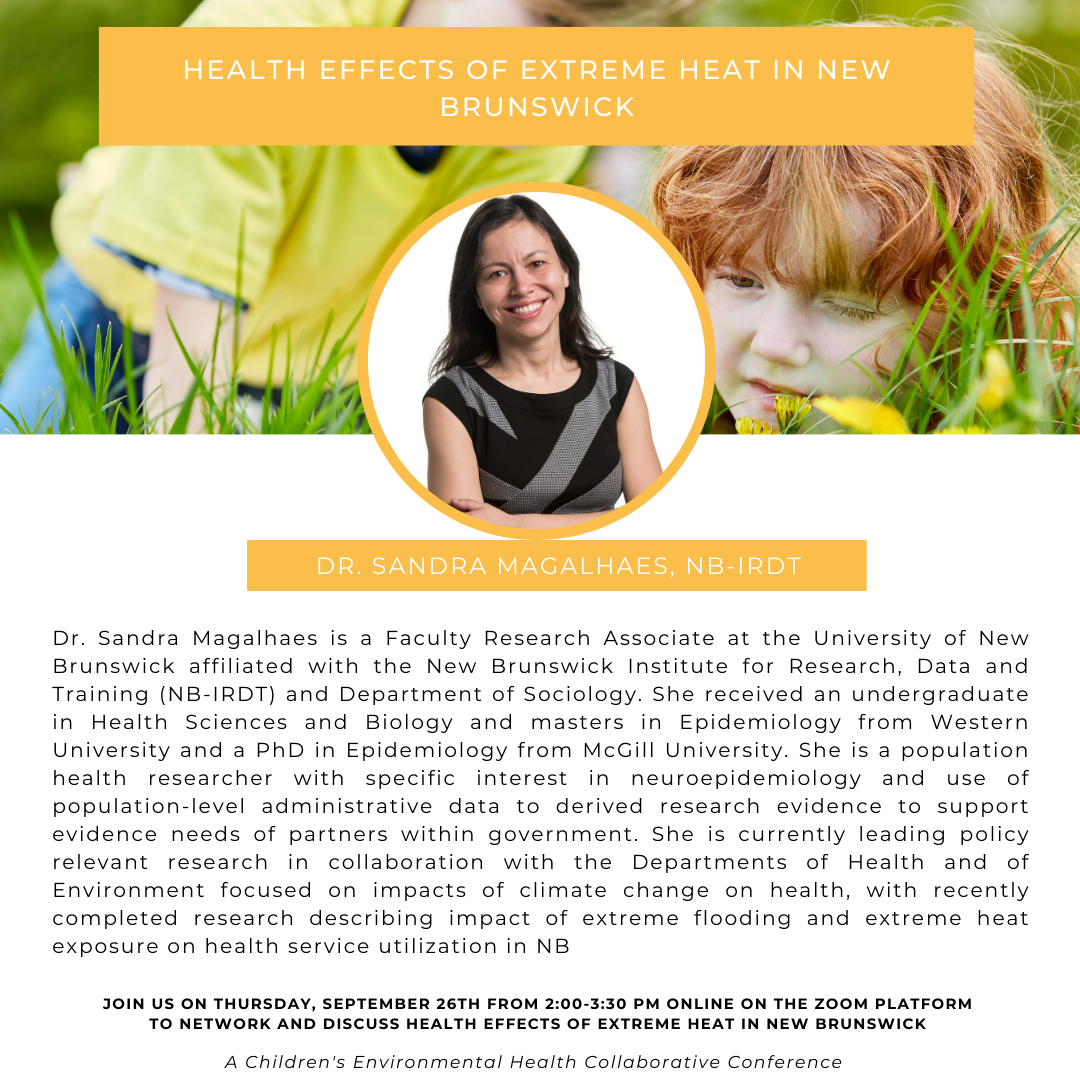
Dr. Sandra Magalhaes is a Faculty Research Associate at the University of New Brunswick affiliated with the New Brunswick Institute for Research, Data and Training (NB-IRDT) and Department of Sociology. She received an undergraduate in Health Sciences and Biology and masters in Epidemiology from Western University and a PhD in Epidemiology from McGill University. She is a population health researcher with specific interest in neuroepidemiology and use of population-level administrative data to derived research evidence to support evidence needs of partners within government. She is currently leading policy relevant research in collaboration with the Departments of Health and of Environment focused on impacts of climate change on health, with recently completed research describing impact of extreme flooding and extreme heat exposure on health service utilization in NB.
Event Information
| Event Date | Sep-26-2024 |
| Event End Date | Sep-26-2024 |
| Categories | CEH Workshop |
We are no longer accepting registration for this event
